
contact us

Club Car golf carts for sale are not one product. A two-passenger course cart, a four-passenger neighborhood cruiser, and a flatbed utility vehicle can share a badge and still solve different jobs. The useful comparison is seats, powertrain, condition, and how you will actually use the cart. Once those four line up, current Club Car inventory is the place to see which configurations are in stock across New England and New York.
Call (508) 273-9939 to talk through a Club Car
Start with who rides, not with the paint. A two-passenger cart fits one or two people. Use it for a golf round, a short property loop, or a tight shed. A four-passenger layout, often written as 2+2, fits a household, a beach cottage, or a campground. Choose it when more than a driver and one guest ride in a normal week.
Club Car publishes a clear size picture for the Onward 4 Passenger. Non-lifted, it is 108 inches long and 48.75 inches wide. Ground clearance is 4.5 inches. The lifted version is 114 inches long and 49.5 inches wide, with 6.4 inches of clearance. Both list an 800-pound vehicle load capacity. Both list a 19 mph top speed on level ground. Those figures come from Club Car's Onward 4 Passenger specifications.
Length matters in a garage, a ferry-town driveway, or a narrow campground lane. A lifted four-passenger cart also needs more room to turn. Club Car lists an 111-inch turning radius when the cart is not lifted. The lifted radius is 116 inches. If the cart has to share a shed with a mower, measure the door before you fall for the lifted look.
Seat count changes daily use around Wareham, Hooksett, or a Cape cottage. A rear bench that sits empty most weeks is only extra length. A rear bench that carries grandparents to the beach, or a crew from the clubhouse to the far green, earns those feet. Write down the largest group you carry in a normal week. That number is the seat count to shop.
Live listings at c2 Vehicles already show the split. On November 20, 2026, the Club Car collection included a new 2027 Onward Lithium in a four-passenger layout and used Tempo carts in both two- and four-passenger lithium setups. Stock turns over. Treat those cards as examples of the configurations the collection carries, not a promise that one unit is still available.
Powertrain is the second fork, and it should follow the route. Electric is the quiet choice for a neighborhood, a campus, or a course where early-morning noise is a problem. Gas is the choice when the cart works long days away from a charger, or when a crew cannot pause to plug in.
On the Onward 4 Passenger, Club Car lists three electric paths and one gas path. Gas uses a 14.0 hp Kohler engine with electronic fuel injection and a 5.6-gallon tank. Lead-acid electric uses six 8-volt batteries and a 250-amp controller. Lithium comes in a 4.0 kWh base pack or a 7.0 kWh XR pack. Both lithium packs use a 375-amp controller.
Weight is part of the same choice. Lithium Onward 4 Passenger carts weigh about 794 to 978 pounds, depending on lift and pack. The lead-acid electric weighs about 1,070 to 1,125 pounds. A lighter cart is easier to trailer and easier on a soft Cape driveway. A heavier lead-acid cart can still be the right buy when the price of an older electric unit matters more than the pounds.
| Powertrain. | Best fit. | What you give up. |
|---|---|---|
| Lithium electric. | Daily neighborhood or cottage use. Lighter cart. Less battery care. | A higher purchase price than many older lead-acid carts. |
| Lead-acid electric. | Budget electric driving when a charger is already at home or in the barn. | A heavier cart. Regular watering on flooded packs. |
| Gas. | Long days, remote properties, and work where charging is awkward. | Noise, fuel, and engine service that electric carts skip. |
If range and battery care are the whole question, the electric golf carts for sale guide goes deeper on packs and charging. This page stays on the buying fork.
The U.S. Department of Energy's electric-vehicle charging basics explain why the outlet matters as much as the pack. A cart that charges overnight is a different buy from a cart that works a full event day.
Read the lithium battery safety page before winter storage.
Winter storage is a New England problem, not a brochure detail. A lithium cart and a flooded lead-acid cart do not sit the same way from November to April. Ask the store whether the cart you want should stay on a charger at home or come in for storage. Seasonal delivery or storage offers change. Confirm the current terms on the cart in front of you before you count them into the price.
Condition is a budget decision, not a quality ranking. New Club Car carts on the collection include current Onward lithium models. Pre-owned cards include later Tempo and Carryall units that have already done course or property work. Both sit in the same Club Car inventory. Both are sold through eight locations.
Choose new when you want the current configuration and no unknown prior use. Ask the sales rep what the manufacturer's warranty covers on that unit. Choose pre-owned when the year, seats, and powertrain you want are already in stock at a lower price. Put the difference toward delivery, a charger, or accessories.
c2 Vehicles offers certified pre-owned coverage on qualifying used carts. Ask the location which terms apply to the exact cart, and start with the warranty page. New vehicles purchased through c2 Vehicles come with the manufacturer's warranty.
Two neighboring guides already own the edges of this choice. What to know before buying a new Club Car stays on new carts. Used Club Car golf carts for sale is the inspection checklist. Use those when you have already picked a side. Use this page when you are still deciding which side the configuration belongs on. The new inventory and pre-owned inventory collections are the live lists behind those choices.
A trade can close a gap when a pre-owned cart is close but not exact. c2 Vehicles has sold Club Car vehicles for more than 40 years. The company started as Country Club Enterprises. It has operated as c2 Vehicles since April 2024. That history helps when an older Precedent and a current Onward need to be priced in the same conversation. Bring the cart you have. Do not guess a trade number from a national listing.
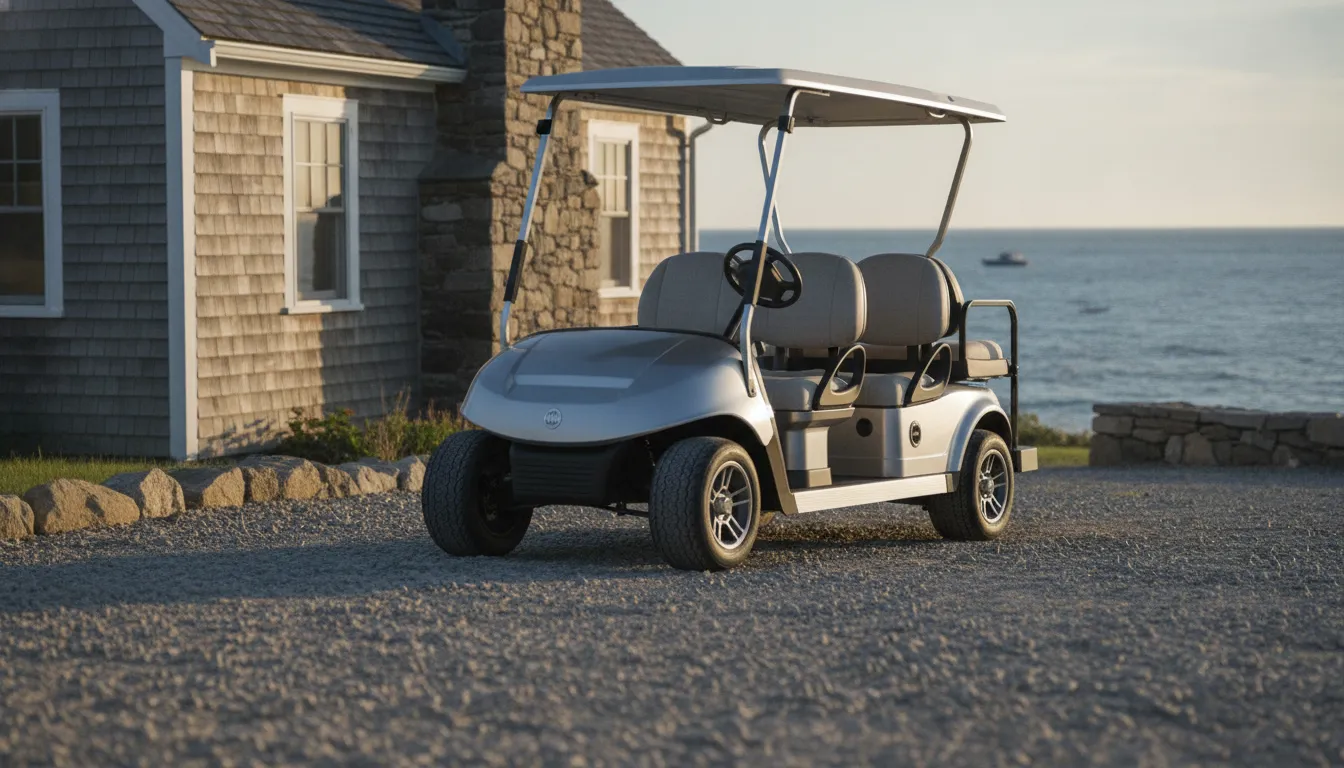
Intended use is what keeps a good cart from being the wrong cart. A four-passenger lithium Onward that fits a Wareham cottage is a poor fleet cart. A Tempo that earns its keep on a golf course is a plain choice for a family that wants a lifted neighborhood cruiser.
For personal and neighborhood use, look first at Onward. c2 Vehicles positions the Onward 4 Forward as a street-legal neighborhood cruiser. It has lithium power, a low-maintenance battery, and four-person seating. Street-legal is not automatic. A low-speed vehicle has to be titled and equipped for the road. Town rules in Massachusetts, Rhode Island, and the rest of the region are not the same.
Read street-legal Club Car golf carts and the Massachusetts low-speed vehicle guide before you assume a cart can leave the driveway. The street-legal collection is where equipped carts are grouped. Headlights on a product photo are not the same thing as a titled low-speed vehicle.
For a golf course or a community fleet, Tempo is the purpose-built cart. Club Car builds it with flooded lead-acid or lithium power and an updated dash. Lithium 2-passenger and 2+2 models can add an auto park brake with StopSmart technology. Club Car says that brake applies on its own, so the cart does not roll when it is stopped or parked, including if power is lost. Golfers do not have to set a pedal the same way. Pair a multi-cart buy with the Club Car Tempo guide for course fleets. Courses and clubs can also start from the golf page.
For property, resort, and commercial work, Carryall is the utility line. Live cards include gas Carryall 300, 500, and 700 models, plus a lithium Carryall 502. Some use a two-passenger cab and a bed instead of a rear bench. c2 Vehicles describes Carryall utility vehicles as commercial-grade carts for work and play. They offer a cargo bed and gas or electric drivetrains.
The Carryall utility guide covers that job in detail. The commercial page is the path for a fleet conversation with a territory manager. c2 Vehicles staffs commercial territory managers across the region. A resort that needs several flatbeds, or a course that needs a Tempo lithium fleet, should use that path. This article is the personal and small-fleet comparison, not a bid sheet.
Once the four choices are made, stop browsing the whole brand and filter. c2 Vehicles is the exclusive Club Car distributor for New England. The stores carry new and pre-owned inventory, factory-trained technicians, and mobile service. That does not mean every configuration is on the floor this week. The collection is the live list. A short phone call can confirm a cart that a product card cannot.
Financing runs through Club Car, Sheffield Financial, and DLL Finance. Sheffield Financial describes more than three decades in consumer financing. DLL says you can get credit pre-approved for a new vehicle in a few clicks. The financing page is where those options are spelled out. Do not treat a web rate as final until the lender approves the specific cart.
Service after the sale, including door-to-door work, sits on the service page. Factory-trained technicians and OEM parts are the reason a New England buyer stays with the distributor instead of a one-time private sale. If the cart will live on the Cape, in Vermont, or at the Menands store's New York coverage, confirm which location can do mobile service for that address.
A broader brand tour already lives in the Club Car buyer's guide. That page covers how Club Car compares with other names and what routine maintenance looks like. Model-level detail for the personal cruiser is in the Onward buying guide. Older Precedent shoppers should use the Precedent review. Precedent and Onward are not the same cart.
Budget shoppers who want a number before they pick a configuration can read how much a new 4-seater golf cart costs. Come back here to decide whether that 4-seater should be an Onward, a Tempo, or something with a bed. Price without a use case just sends you back to the full collection.
c2 Vehicles lists current Club Car carts in the Club Car collection. The same carts are stocked across eight stores, from Wareham and Greenfield to Hooksett, Saco, Clinton, Middletown, South Burlington, and Menands. The find a location page has the store details. Call (508) 273-9939 if you want a specific passenger count or powertrain pulled up before you drive.
Only if you regularly carry more than two people. The Onward 4 Passenger is 108 inches long when it is not lifted and 114 inches when it is lifted. Load capacity is 800 pounds. A two-passenger Tempo or Onward is easier to store and is the usual golf-course layout. Buy the seat count you use every week.
Tempo is the fleet cart. Club Car builds it for course duty with lead-acid or lithium power. Lithium 2-passenger and 2+2 models can add an auto park brake. A personal Onward is a different product. Courses that need several carts should start with the Tempo fleet guide and the golf page.
Only if that specific cart is equipped and titled as a low-speed vehicle and the town allows it. Many golf carts are not street-legal. Rules differ by state and municipality. Confirm the cart and the town before you plan a road route. The street-legal collection separates those carts from standard golf carts.
Qualifying certified pre-owned carts can. New carts include the manufacturer's warranty. Ask the store which certified pre-owned terms apply to the cart you are buying, and read the warranty page before you treat coverage as part of the deal.