
contact us

Choosing low speed vehicles in Massachusetts starts with a practical question: where will you drive, and what does that particular road allow? A low-speed vehicle (LSV) can suit some neighborhood trips or managed worksite routes, but it is not a substitute for a standard car on every road. The vehicle’s classification, equipment, registration requirements, road conditions, and local rules all matter.
Explore vehicles and request a demonstration
“Low-speed vehicle” is a vehicle classification, not just a casual name for any golf cart. Some small electric vehicles are built and equipped for limited public-road use, while many golf carts are intended for golf courses, private property, or other settings where they do not mix with ordinary traffic. A cart’s appearance alone does not establish that it is an LSV or that it can be driven on a particular Massachusetts road.
Start with the exact vehicle, not a broad product label. Ask the dealer to identify the model’s road-use classification and the documentation that comes with it. Confirm whether the specific vehicle is built and equipped for the intended use; do not assume that adding accessories turns a standard golf cart into a street-legal LSV.
For Massachusetts-specific requirements, consult the state’s Low speed vehicles guidance. State rules and local road conditions can affect where an LSV may be used. Confirm current requirements with the appropriate state and municipal authorities before you plan regular road travel.
Think about passenger count, cargo, route length, where you will park, and whether your use is on public roads, private property, or both. A four-seat neighborhood cruiser, for example, answers a different need from a utility vehicle carrying tools around a campus or property. Compare intended use before comparing appearance or accessories.
| Vehicle type | Possible fit | What to verify |
|---|---|---|
| Road-oriented LSV | Short neighborhood trips where the road and vehicle qualify | Model classification, required equipment, registration and permitted roads |
| Personal golf cart | Golf-course, private-property, or community use where permitted | Passenger capacity, property rules, storage and whether public-road use is excluded |
| Utility vehicle | Moving people, supplies, or equipment around a business or large property | Cargo needs, terrain, payload guidance, site rules and road-use status |
These are broad categories, not legal determinations for a specific model. Explore street-legal vehicles and LSV options alongside personal transportation vehicles. For work applications, compare utility vehicles and commercial vehicle and fleet solutions.
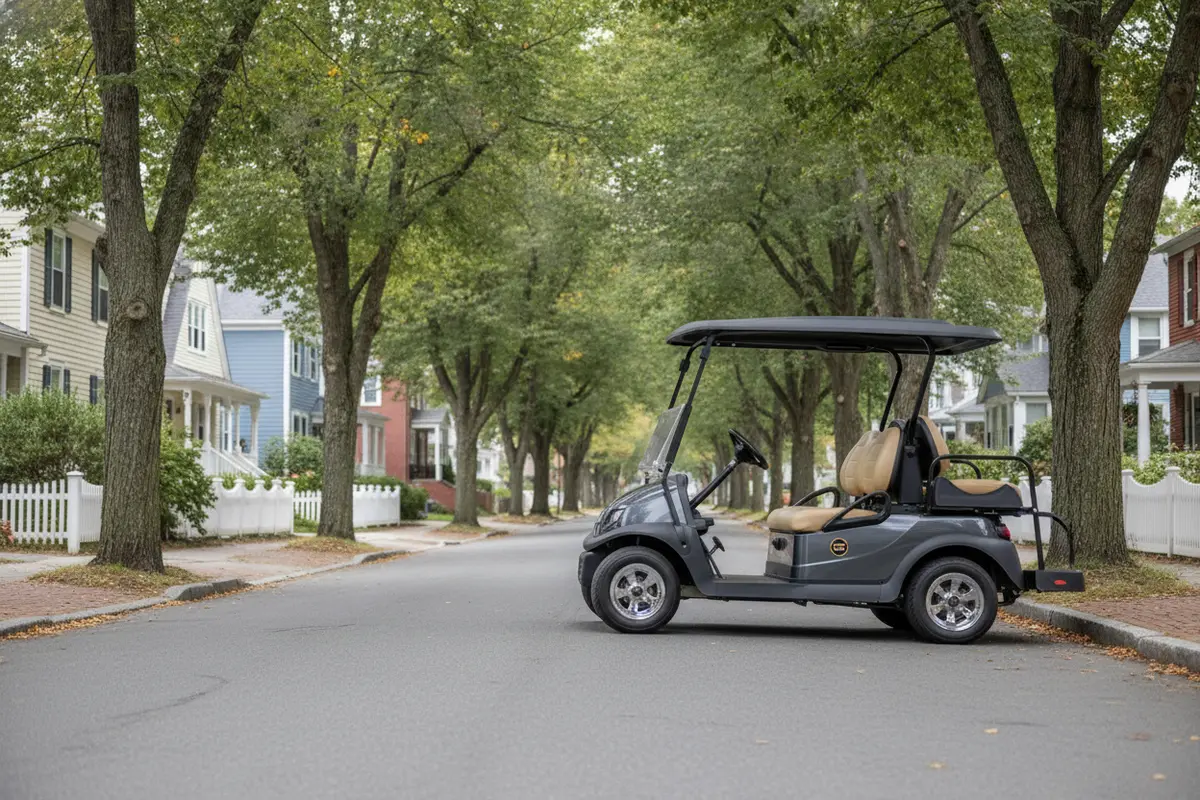
Ask for a walk-through of the specific vehicle and its documentation. Depending on its classification and intended road use, safety equipment and vehicle features may differ. Rather than relying on a generic checklist or a salesperson’s shorthand, verify what the manufacturer specifies and what Massachusetts requires for that model.
Use the model’s paperwork to answer questions, and have the dealer show you how key features work. If any point remains unclear, pause before purchase and verify it with the manufacturer or state authority. Do not assume a vehicle qualifies for road use because it has lights, seat belts, or a license plate bracket.
Road access is a core part of the purchase decision. Massachusetts has requirements and restrictions for low-speed vehicles, and the rules are not a blanket permission to drive every small vehicle on every public road. The state’s official LSV information is a useful starting point, but a buyer should verify the current rule and its application to the specific vehicle and route.
Before relying on an LSV for a commute, errands, or property operations, make a route-specific check. Identify the roads you expect to use, including the road at each end of the trip. Check posted limits and restrictions, crossings, traffic speed, shoulders, intersections, and any local rules. Ask the relevant municipal authority about local restrictions or access rules, and consult the Massachusetts Registry of Motor Vehicles or other appropriate state authority about registration and vehicle documentation.
For a managed community, resort, campus, or commercial site, there can be two separate questions: whether the vehicle may use a public road to get there and whether the property manager permits it on private roads or paths. Obtain the property’s rules in advance. An LSV’s public-road status does not automatically settle its use on private property, and private-property permission does not grant public-road access.
For an electric LSV, choose a charging routine that fits where it will be stored. Check the vehicle manual for charging instructions, compatible equipment, and electrical requirements. Confirm whether a suitable outlet is available at home, a workplace, a campus facility, or another storage location. If installation or electrical work may be needed, ask a qualified electrician to assess the site rather than assuming a standard outlet is appropriate.
Range depends on the vehicle and how it is used. Passenger load, cargo, terrain, stops, temperature, speed, and accessory use can affect how far a vehicle travels between charges. Plan around the shortest realistic trip pattern, not the best-case number in a product description. Leave a margin for detours and changing conditions, especially if the vehicle will serve more than one person or department.
Compare battery and charging details when reviewing electric vehicles or lithium-powered options. Ask the dealer which charging setup is specified for the exact model and what routine care the owner should follow. Follow the manufacturer's instructions for charging, storage, and maintenance.
For a worksite, campus, resort, golf facility, municipality, or property-management operation, map the job before selecting a vehicle. List who will drive, what they will carry, how often the vehicle will run, where it will be stored, and which paths or roads it will use. Then determine whether a personal vehicle, road-oriented LSV, or purpose-built utility model is the better fit.
For a single property, a vehicle can be selected around a defined route and task. A fleet needs a repeatable plan: consistent vehicle types, operator orientation, charging responsibility, maintenance records, and a process for reporting issues. C2 Vehicles serves personal and commercial buyers and offers fleet consultation and commercial vehicle solutions across its regional footprint. Review commercial options and discuss the operation’s requirements before choosing a configuration.
Support matters because the best vehicle on paper still needs care over time. Ask who can perform scheduled maintenance, where service is available, how warranty concerns are handled, and whether parts support is practical for your location. If the vehicle will be essential for a business, ask how service interruptions are managed and whether mobile support may be relevant to your situation.
c2 Vehicles is the largest distributor of golf carts and other small-wheeled electric and gas vehicles in New England, with seven locations across the six New England states. That regional presence can help Massachusetts buyers compare vehicles and discuss local support. Use the location finder to identify a nearby team, and review available new and pre-owned inventory. Inventory changes, so confirm the current model and specifications directly.
When comparing a new vehicle with a pre-owned one, ask about its service history, condition, included equipment, and warranty coverage. A pre-owned golf cart is not necessarily an LSV, even if it looks similar to a road-oriented model. Confirm the classification and any documentation for the exact unit. You can also review pre-owned vehicles and financing information as part of your comparison.
Use a short, written checklist to keep the decision grounded in the intended trips. Bring it to a showroom visit or a conversation with a dealer, and ask for answers tied to the particular model rather than general statements about carts or LSVs.
Bring specific questions to a local dealer rather than relying on a broad “street legal” label. A dealer can help identify the model and explain its features, while government authorities and local officials are the right sources for current legal requirements and the rules on a particular road.
Compare demo vehicles and ask about the right fit
The most useful comparison is the one tied to your actual route and daily task. Confirm the vehicle classification, review the manufacturer’s documentation, check the state’s current LSV guidance, and verify local road and property rules before you depend on public-road access. Then weigh passenger or cargo needs, charging, service, and dealer support together.
If you are still comparing options, find a c2 Vehicles location to discuss your use and next steps. Ask the team to walk through the exact vehicle and its documentation so you can follow up on any registration or road-use questions with the proper authorities.
A careful check before buying can help you choose a vehicle that fits your Massachusetts trips without confusing a golf cart, utility vehicle, and LSV.
No. A golf cart is not automatically an LSV, and the presence of road-style equipment does not by itself establish eligibility. Check the exact vehicle classification and current state and local requirements before driving on a public road.
Not necessarily. Suitability depends on the vehicle, road access and conditions, route, and applicable rules. Check each road on the planned route and consider traffic, crossings, distance, and the vehicle’s operating limits.
Ask about the model’s charging instructions, required charging setup, expected range under your use conditions, battery care, and service support. Use the manufacturer’s guidance for the specific vehicle.
A dealer can identify a model and explain its equipment and documentation, but buyers should confirm current legal requirements and local road restrictions with the appropriate state and municipal authorities.