
contact us

Asking how much is a golf cart cheap used is a useful starting point, but the sticker price alone does not tell you whether a cart is a good value. Battery condition, needed repairs, warranty coverage, delivery, and how you plan to use it can change the total cost significantly. Compare the complete condition and ownership picture before deciding what ‘cheap’ means for you.
There is no reliable single price that applies to every used cart. Age, make, seating, powertrain, battery type, condition, and included equipment all matter. Inventory and pricing also change, so check current listings rather than relying on an old price range or a listing you saw elsewhere.
Start by comparing vehicles with similar configurations. A basic two-passenger cart is not directly comparable to a six-passenger model or a street-legal low-speed vehicle. Nor is a cart that needs batteries comparable to one that has been inspected and is ready for its intended use. Review the current golf cart and small-vehicle inventory and note each vehicle’s model, age, seating, power source, condition description, and listed equipment.
| Cost factor | What to check | Why it matters |
|---|---|---|
| Purchase price | Compare similar age, seating, make, and powertrain | A lower number may reflect different features or condition |
| Batteries and charging | Ask about battery age, test results, charger, and charging behavior | A worn pack or charger can add expense and interrupt use |
| Mechanical condition | Check brakes, steering, tires, suspension, and controls | Wear or faults may require service after purchase |
| Warranty | Get coverage, exclusions, duration, and claim process in writing | Coverage can reduce some repair uncertainty, but not every cost |
| Delivery and setup | Confirm delivery area, fees, and what is included | Transport can affect the amount you pay to get the cart home |
On an electric cart, the battery pack is one of the most important items to investigate. A cart may run during a short demonstration but still have limited usable range or need more frequent charging. Ask how old the batteries are, what type they are, whether they have been tested, and whether the charger is included and functioning.
Do not assume that a particular battery chemistry guarantees a certain range or remaining life. Actual performance depends on the vehicle, battery condition, terrain, load, and use. For model-specific battery care and charging guidance, consult the manufacturer’s documentation and the U.S. Consumer Product Safety Commission’s consumer product safety resources. A useful comparison is not simply electric versus gas; it is the expected upkeep and performance of the individual vehicle you are evaluating.
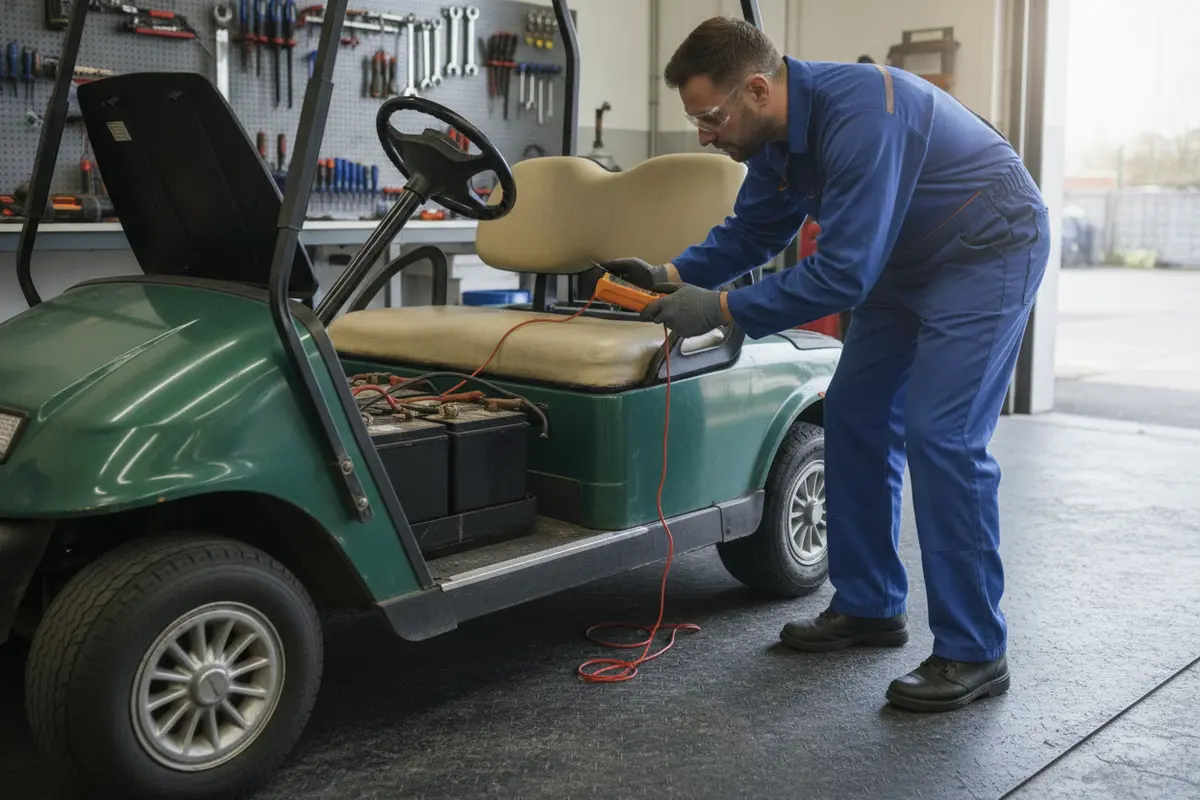
Ask to see the cart in operation, not just parked for photographs. Test it on a suitable route and listen for unusual sounds. Check that steering feels controlled, brakes respond consistently, and the cart starts, stops, and changes direction as expected. Look for visible damage, corrosion, loose components, uneven tire wear, and signs of poor storage.
Separate observations from assumptions. A clean body does not prove that the battery pack or drivetrain is sound, and an older appearance does not automatically mean that every component needs replacement. Write down what you can verify, what the seller says, and what remains unknown. If the seller describes a repair as completed, ask for a receipt or service record. If a part is promised before delivery, make sure the promise identifies the work and timing in writing.
If anything seems uncertain, arrange a professional inspection before purchase. A lower purchase price is not a bargain if an important fault is hidden or the cart is unsuitable for your daily use. C2 Vehicles offers service and inspection support; ask what an inspection includes and whether it is available for the cart you are considering. For more context on the company’s regional support and locations, visit the C2 Vehicles overview.
Think in terms of total ownership cost: the amount to buy the cart, prepare it for use, transport it, and address likely maintenance or repairs. Ask for any warranty terms in writing. Verify who provides the coverage, its duration, covered components, exclusions, and where repairs can be handled. ‘Warranty included’ is not enough detail to judge the protection.
Certified Pre-Owned vehicles may offer a different value proposition from an uninspected private sale. C2 Vehicles describes its CPO vehicles as up to five years old, serviced in-house, and backed by a three-year bumper-to-bumper warranty. Check the specific vehicle’s eligibility and written coverage terms. Compare current pre-owned listings and ask whether the particular cart is certified and what the warranty covers. A warranty is useful only to the extent its covered parts and conditions match the risks you want to manage; understand any maintenance obligations, claim process, and exclusions before relying on it.
Delivery is another practical cost. Confirm whether delivery is available to your address, what it costs, and whether setup or orientation is included. If you are considering financing, ask about available terms and the total amount payable rather than focusing only on a monthly figure. Do not assume every used vehicle qualifies for the same financing or delivery options. Also ask whether there are expenses you must handle before the cart can be used as intended, such as arranging transport or addressing a condition identified during inspection.
Before comparing two listings, write down the known and unknown costs for each. This does not require an exact forecast. It is a way to expose missing information before you commit.
Do not assign a made-up dollar value to an unknown repair. Instead, request a written estimate or keep that item as an unresolved risk. If the seller cannot clarify it, compare the cart with an alternative whose condition is better documented. That comparison may show that a higher asking price is reasonable—or confirm that the lower-priced cart still fits your budget after accounting for its needs.
‘Cheap’ depends on the work the cart must do. Consider where it will travel, how many people it needs to carry, how often it will be used, and whether it needs to operate on private property or public roads. Road use requires particular care: not every golf cart is street legal, and local rules vary. Verify the exact vehicle’s approval and requirements with the relevant state and local authorities.
For personal use, browse golf carts and small vehicles for individual buyers, or compare the Club Car range and fleet solutions. A model’s intended use matters more than choosing the lowest listing price. You can also consider whether buying is necessary for occasional use; C2 Vehicles offers golf cart and utility vehicle rentals, which may suit a temporary need better than taking on ownership.
Use a consistent checklist when comparing carts. Answers should be specific and supported by documents or a demonstration where possible.
Keep a written comparison of the answers. It makes it easier to separate a genuinely well-maintained vehicle from one that only has a low asking price. You can also ask whether any parts or service are available after the sale, where repairs may be handled, and how to get help if a problem appears soon after delivery. C2 Vehicles has locations across New England; confirm which location can assist with the specific vehicle and your address.
Use a simple scorecard. First, define your must-haves: passenger capacity, powertrain, use location, and expected frequency. Then compare condition, battery or engine information, service history, warranty, and delivery. Finally, estimate near-term expenses that are not included in the sale.
| Comparison question | Cart A | Cart B |
|---|---|---|
| Does it fit the intended use and passenger needs? | Yes / No / Confirm | Yes / No / Confirm |
| Are maintenance and condition records available? | Yes / No / Confirm | Yes / No / Confirm |
| Is battery or engine condition documented? | Yes / No / Confirm | Yes / No / Confirm |
| Is warranty coverage clearly explained? | Yes / No / Confirm | Yes / No / Confirm |
| Are delivery and immediate repair needs understood? | Yes / No / Confirm | Yes / No / Confirm |
Give each cart one of three labels for every row: confirmed, needs follow-up, or not suitable. A confirmed answer should be supported by a demonstration, record, or written term whenever possible. If you find several follow-up items, do not treat the missing information as neutral; it affects how confidently you can estimate the total. This keeps the decision grounded in the actual vehicle, not a general claim that all cheap carts are either risky or worthwhile.
A higher-priced cart may represent better value if it has documented maintenance, a battery pack or engine condition that better fits your expected use, a clear warranty, and fewer immediate repairs. That does not mean the more expensive listing is automatically the better choice. Check the actual evidence and make sure the features justify the difference for your situation.
Conversely, a low-priced cart can be a sensible option when you understand its limitations, can handle its maintenance needs, and the full purchase-and-preparation cost remains acceptable. The useful comparison is not price against price, but verified condition and fit against the total expected cost. If a seller cannot answer important questions, treat the missing information as a reason to investigate further.
No. A lower-priced cart can make sense when its condition, service needs, and equipment match your use. Verify what is included and budget for any known maintenance rather than judging only by the asking price.
Only after understanding the battery condition and the likely replacement expense. Ask for test information and compare the cart’s total expected cost with other vehicles that are ready for use.
It may be, if the inspection, service work, and written warranty provide value for your needs. Confirm the specific cart’s certification status and coverage details before making a decision.
No. Road eligibility depends on the vehicle and applicable state and local rules. Confirm the exact model’s qualifications and restrictions before using it on public streets.
Ask about pre-owned cart options
The right inexpensive used cart is the one whose condition, features, support, and complete cost fit the way you plan to use it.