
contact us

Golf cart battery replacement in Rhode Island starts with confirming that the batteries, rather than the charger or another electrical component, are causing the problem. Slow acceleration, shorter run time, and difficulty holding a charge can point to aging batteries, but testing the full system helps avoid replacing a pack unnecessarily.
Ask about golf cart battery service
A cart that loses range or feels sluggish may have a battery problem. These symptoms are clues, not a diagnosis. Charger issues, loose or corroded connections, and other electrical faults can create similar behavior.
Keep notes on when the symptoms occur, how long the cart runs, and whether the charger behaves differently. Share the details with a service technician. Do not continue using a battery that is leaking, swollen, or visibly damaged; avoid contact and arrange professional attention. For owners comparing service options, c2 Vehicles offers golf cart repair and parts support.
Before choosing replacement batteries, identify the cart's existing electrical system. Battery chemistry, total pack voltage, battery count, wiring arrangement, physical dimensions, and charger compatibility all matter. A replacement that fits physically may still be unsuitable electrically.
| Consideration | Lead-acid pack | Lithium pack | What to confirm |
|---|---|---|---|
| System voltage | Often built from several individual batteries | May use a purpose-built pack | Match the vehicle's required total voltage and configuration |
| Charging | Requires a charger matched to the battery type | Requires compatible charging and battery management | Confirm whether the existing charger is approved or must be changed |
| Installation | Multiple heavy batteries and interconnects may be involved | Pack-specific wiring and mounting may be involved | Check dimensions, secure mounting, cables, and manufacturer instructions |
| Care and disposal | May require routine inspection and correct recycling | Follow pack-specific handling and end-of-life guidance | Ask who handles removed batteries and what recycling route applies |
Do not infer voltage from the number of batteries alone. Check the vehicle label, owner documentation, or technician's inspection. Likewise, lithium is not a drop-in choice for every cart: the pack, charger, wiring, and vehicle configuration must be compatible.
For a lithium system, ask about the battery management system and the manufacturer's care instructions. c2 Vehicles provides lithium battery safety information; review it alongside the instructions for the particular vehicle and battery. You can also review its lithium vehicle options to understand that chemistry is used across different models, not as a universal retrofit for every cart.
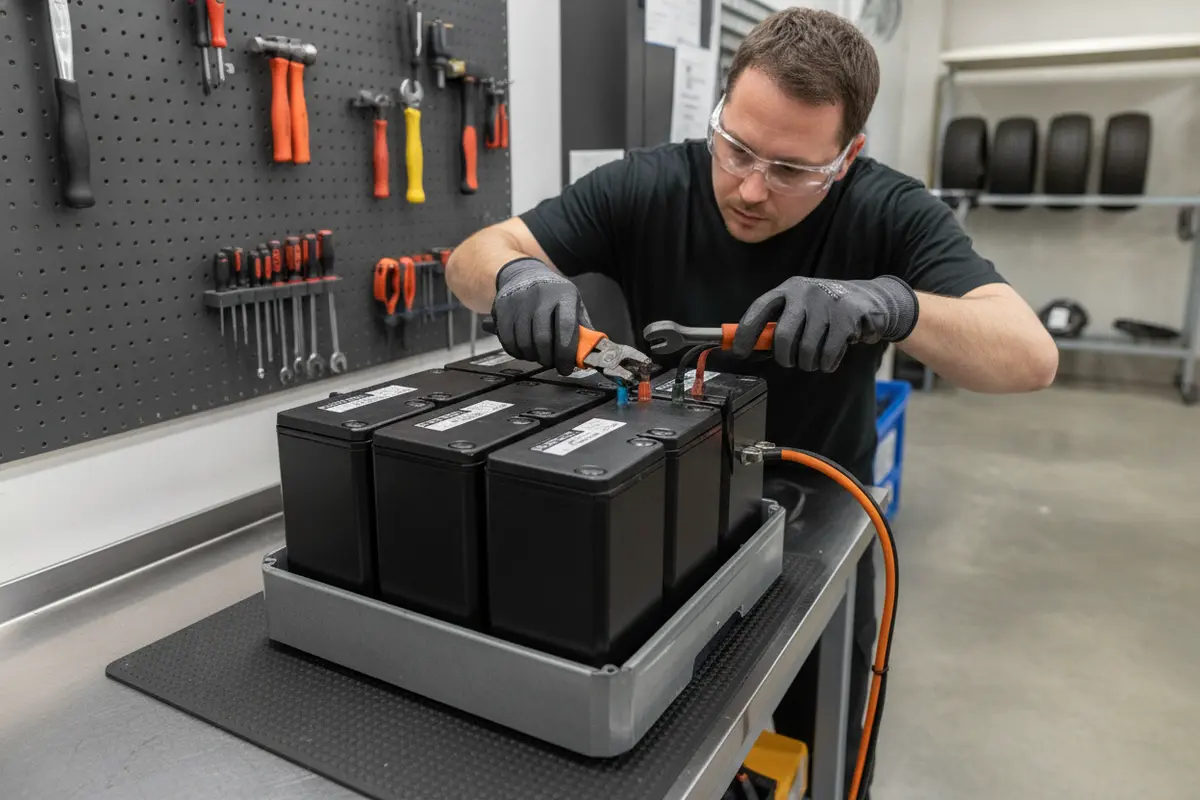
A useful diagnosis looks at the pack as a system, not only at one battery. A technician can check charger operation, connections, cable condition, and battery readings under appropriate conditions. Measurements need interpretation in light of the battery chemistry and manufacturer guidance.
Never test batteries by creating sparks, shorting terminals, or improvising a load. Battery packs can supply hazardous current. If you are unsure how to isolate power or take a reading safely, leave testing to a trained technician. A symptom log makes a service visit more useful: distinguish what happens just after charging from what appears after a longer drive, and note whether the cart was carrying passengers, climbing hills, or operating in cold weather. These details are context, not proof that a battery has failed.
Before setting an appointment, check whether the cart can be transported safely and whether the technician needs the charger as well as the vehicle. Describe any recent charger changes, periods of storage, or unusual interruptions in charging. Do not remove the battery pack to make transport easier unless the manufacturer specifically directs you and you can do so safely.
Golf cart battery replacement involves heavy components, electrical energy, and chemistry-specific handling. Professional installation can help confirm that the new pack works with the cart and charger and that connections are secure.
Ask whether the service includes diagnosis, installation, charger evaluation, and a post-installation test. Clarify whether damaged cables, connectors, a charger replacement, or compartment repairs are separate work. A written recommendation helps you understand what is essential for compatibility and what is an optional improvement. c2 Vehicles offers service and parts support; confirm current availability and the work appropriate for your vehicle when arranging service. The service page is a starting point for asking whether your cart and issue are within the team's current scope.
After the work, ask for the battery make and model, warranty documentation, and charging instructions. Keep these with the cart's records. Make sure you understand what the charger indicator means for the new system and whether the manufacturer recommends leaving it connected, disconnecting it after a charge, or following another routine. Do not assume care instructions for one chemistry apply to another.
Do not put vehicle batteries in household trash or leave them outdoors. Keep removed batteries upright and protected from damage while awaiting an approved recycling or disposal route. Lead-acid batteries and lithium packs have different handling requirements, so identify the chemistry before transport and follow local requirements and manufacturer guidance.
Ask the service provider whether removal and recycling are included, where the batteries will go, and whether you need to do anything before drop-off. If transporting a battery yourself, get handling instructions first, especially if it is damaged. Avoid contact with terminals and prevent movement or impact during transport. Do not store a damaged pack near heat, moisture, or materials that could be affected by a leak; seek instructions from a qualified provider rather than improvising packaging.
Arrange an inspection when range or charging behavior changes repeatedly, rather than waiting for the cart to stop working during an important outing or workday. If the pack shows physical damage, stop using the cart and seek professional advice promptly.
Rhode Island owners can use c2 Vehicles' Find a Location page to check current service coverage and location details. The business serves New England through seven locations across the six states, but hours and appointment availability can change; verify them directly before traveling. Do not assume every location handles every repair or that a particular battery is on hand. Call or contact the team with the vehicle details and symptom summary before making a trip.
For general context on energy programs in the state, the Rhode Island Office of Energy Resources energy profiles page is an official state resource. It is not a golf cart repair guide; use your vehicle and battery maker's instructions for technical requirements.
Owners who are also comparing vehicle types can browse c2 Vehicles' personal-use vehicle information or Club Car selection. A battery diagnosis is still the right first step when the existing cart has a performance problem. Replacing a vehicle is a separate decision based on condition, intended use, and the owner's needs.
Clear questions help you compare a repair recommendation with your actual use, whether the cart is for a home, vacation property, golf course, or commercial setting. Start with these:
If comparing service options, use the same vehicle details and ask each provider to explain what is included. Ask how any warranty claim is handled, which records to retain, and whether routine inspection or charging practices affect coverage. Avoid choosing on battery chemistry alone: compatibility, proper setup, and support after installation are part of the decision. A recommendation should account for the way you use the cart, the existing equipment, and the manufacturer's requirements.
It depends on the battery system and test results. In a multi-battery pack, one weak unit may affect the whole system, but mixing old and new batteries can create performance or charging issues. Have the complete pack assessed and follow the vehicle and battery maker's recommendations.
Some carts can be converted, but not every cart or existing charger is compatible. Confirm pack voltage, physical fit, charger suitability, wiring, and any system-specific requirements with a qualified technician before purchasing.
Time varies with the vehicle, battery type, parts availability, and whether the charger or cables also need attention. Ask the service provider for an estimate after they identify the cart and inspect the system.
Warranty terms depend on the vehicle and battery. Before work begins, ask which warranty applies, who provides it, what documentation to keep, and whether installation requirements affect coverage.
Contact c2 Vehicles about Rhode Island service
With a proper diagnosis and a compatible installation, you can restore dependable cart use while making a clear plan for charging, maintenance, and battery recycling.
Before committing to a replacement, organize the cart's identifying details, symptom notes, and charger information. That preparation helps the service conversation focus on diagnosis and compatibility, rather than guesswork about which pack may fit. Ask for clear written next steps, including installation scope and disposal arrangements, then follow the instructions for the specific battery system once work is complete.
A careful assessment is the practical first step toward safe, reliable golf cart use in Rhode Island.
A little preparation makes it easier to diagnose the cart and decide what work is actually needed. Before calling, gather the vehicle's make and model, approximate age, and any identification information shown on its label. If you have a manual, keep it nearby. You do not need to dismantle the cart or remove the batteries to provide useful details.
Write down a short timeline rather than relying on memory. For example, note that the cart used to complete a familiar route on one charge, but recently needs charging before the return trip. Mention whether the change appeared gradually or suddenly. Record the usual passenger or cargo load, terrain, and how long the cart was stored before the issue appeared. Those details let the technician compare like with like rather than treating every range complaint as the same problem.
If the cart still runs, avoid deliberately driving it until it stops to demonstrate the problem. That can leave you stranded and does not replace a controlled assessment. Instead, describe the change and the conditions under which it occurs. If the cart has a visibly damaged battery, stop using it and ask how to proceed before transporting it.
The right replacement plan depends not only on the cart's electrical specifications but also on its regular duty. A homeowner who takes short trips around a property may use the cart differently from a golf course, resort, property manager, or rental operator. This does not mean that one battery chemistry is automatically best for a particular type of owner. It means the service recommendation should account for the expected use and the equipment already installed.
For personal use, think through a typical week: how often the cart is driven, how many passengers it usually carries, whether routes include hills, and where it is charged and stored. If use is seasonal, mention how the cart is kept during periods when it is idle. Ask the technician which charging and storage instructions apply to the proposed battery and whether those routines differ from what you currently do.
For a business or shared-use cart, consider the operating schedule and who is responsible for charging. A vehicle used by several people may need a simple, consistent handoff routine. Identify where it is parked, which outlet or charging area is available, and whether the cart must be ready at a predictable time each day. If several carts have similar symptoms, report whether the issue affects one vehicle or multiple vehicles; that distinction can help separate an individual battery concern from a shared charging or use issue.
It can also help to describe the consequence of downtime without overstating the technical problem. For a household, the cart may be needed for regular property trips. At a golf course or commercial site, an unavailable vehicle may interrupt a planned task. The purpose is to help set expectations and discuss scheduling, not to pressure a technician into skipping diagnosis. Ask whether the vehicle can be inspected at a service location or whether another arrangement is appropriate, and verify details with the provider.
A useful recommendation should connect the test results to the proposed work. If replacement is advised, ask the provider to identify the evidence behind that decision in plain language. You should be able to understand whether the concern is an individual battery, the full pack, the charger, a cable or connection, or a combination of issues. A symptom alone is not enough to establish which component has failed.
Ask for the main specifications in writing so you can compare them with the vehicle documentation and any existing service records. The exact information will vary by system, but the discussion can cover:
This written outline helps prevent misunderstandings. For instance, a quotation that includes batteries but not charger changes may leave an important compatibility question unresolved. Likewise, a recommendation to change chemistry should explain what vehicle or charger requirements make that choice suitable. If an answer is unclear, ask for clarification before authorizing work rather than assuming a familiar-looking pack will operate correctly.
Battery chemistry comparisons are most useful when they focus on the cart and the owner's priorities, not broad claims about a technology. Lead-acid and lithium systems differ in their construction and care requirements, but the correct decision depends on compatibility, cost information from the provider, intended use, charging equipment, and manufacturer instructions. This guide does not assign a price or promise a particular run time because those details depend on the vehicle and selected products.
Use these questions to structure the conversation:
A lithium pack may be attractive to an owner comparing different systems, but it should not be treated as a universal upgrade. Ask how battery management and compatible charging are addressed for the exact cart. c2 Vehicles' lithium battery safety page is useful background, but the product-specific documentation remains essential. If retaining the current chemistry is being considered, ask whether the test results support that option and what maintenance the replacement system requires.
For either type, compare the complete service scope rather than a battery label alone. An apparently similar replacement can differ in size, terminals, voltage, charger requirements, and included work. Request a clear explanation of any additional parts or labor before approving the job. That makes it easier to understand what is necessary for safe compatibility and what is optional.
Before taking the cart back into regular use, ask the technician to explain what was tested and what the results mean. Confirm that the charging system operates with the new pack, that connections and restraints were inspected, and that the vehicle was checked according to the applicable service procedure. Ask whether there are any restrictions for the first charge or initial use. Follow the battery maker's instructions rather than relying on habits formed with the previous pack.
Keep the paperwork together: battery identification, installation date, warranty information, charger instructions, and any service notes. If a future concern appears, these records help identify the equipment and establish what work was completed. Make a note of the normal charger indicator behavior and the expected routine, so another driver or household member does not have to guess.
During the first few uses, pay attention to whether the cart behaves consistently under ordinary conditions. If charging or performance seems unusual, stop short of trying electrical fixes yourself. Record what you observe and contact the service provider. A clear description—when it occurred, what the charger displayed, and how the cart was being used—is more useful than repeated charging experiments or improvised tests.
Service availability can change, so Rhode Island owners should verify current location details and appointment options before traveling. Use c2 Vehicles' Find a Location page to review current information, then contact the team with the cart's details and a concise symptom history. Ask whether the specific location can assess the battery system and whether an appointment or other arrangement is needed.
c2 Vehicles serves New England through seven locations across all six states, including Rhode Island coverage. That regional network is useful context, but it does not establish that every location handles every repair or has a particular battery in stock on a given day. Confirm the scope and availability directly. If you are unsure which location is appropriate, describe where the cart is located and ask where to start.
Owners may also explore the company's personal-use vehicle information when comparing whether to repair an existing cart or consider another vehicle. For a battery issue, however, begin with diagnosis and compatibility rather than choosing a replacement vehicle based only on a symptom. The condition of the cart, the intended use, and the inspection findings all matter to that decision.
Use this sequence to move from a symptom to an informed decision without guessing at a replacement:
This process is useful whether the cart is used at home or as part of a business operation. The important distinction is between symptoms that suggest an issue and test results that identify the cause. In Rhode Island, start by checking current service coverage, share the vehicle information, and ask for a recommendation that explains both compatibility and the work being proposed.