
contact us

A construction site golf cart rental can help move people, tools, and small supplies across a large jobsite, but the right vehicle depends on the route and the load. Before booking, map the work areas, estimate payload, and decide how the cart will be charged, operated, and supported. A cart is not a substitute for equipment designed to lift or haul heavy materials.
Discuss your jobsite rental needs
Start with the recurring trips that take workers away from their tasks. A utility cart may suit repeated movement between a parking area, site office, staging zone, or work area when paths are appropriate for the vehicle. It may also carry tools or supplies within its rated capacity. It is not a road vehicle by default, and it should not be treated as a forklift, dump truck, or towing solution unless the specific unit is rated and configured for that work.
Write down the work to be done before comparing vehicles:
This task list prevents a common mismatch: choosing by passenger count alone when cargo, ground conditions, or shift length matters more. For a work-focused vehicle comparison, review commercial utility and fleet solutions and utility vehicle options.
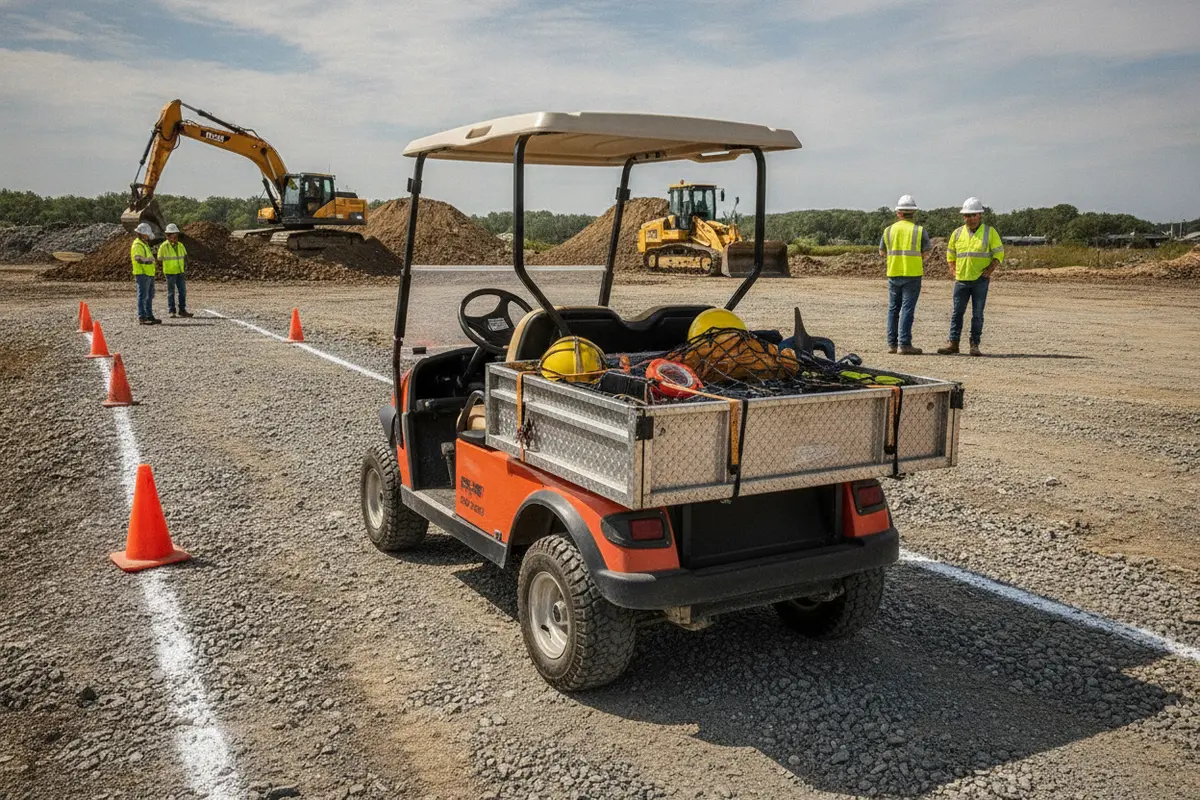
Walk or map the route and note the most difficult section, not just the easiest stretch. Loose fill, ruts, wet grass, steep grades, sharp turns, and congested intersections can change what is practical. Ask the rental provider to confirm the specific vehicle’s ground clearance, tire setup, payload rating, passenger capacity, and any limits on slopes or surfaces. Do not assume that all golf carts or utility vehicles have the same capabilities.
Use the table as a planning comparison, then verify actual specifications for the available rental unit. Ratings and equipment vary by model.
| Jobsite need | What to assess | Question for the provider |
|---|---|---|
| Moving workers | Passenger seats, seat belts where equipped, route width, entry and exit points | How many people can this specific unit carry, and on which surfaces? |
| Carrying tools | Rated payload, cargo-bed dimensions, load restraint, distribution | What is the load limit, and how should cargo be secured? |
| Uneven ground | Surface firmness, grade, clearance, tires, weather exposure | Are these route conditions within the vehicle’s operating limits? |
| Long shifts | Daily distance, duty cycle, charge window, access to power | What charging plan and backup option are recommended? |
| Changing site layout | Temporary roads, barriers, traffic flow, visibility | Can the unit be repositioned or exchanged if the route changes? |
Construction employers must assess workplace hazards and take steps to protect workers under OSHA’s general industry and construction safety requirements; consult the applicable OSHA construction standards for requirements relevant to the site. Keep the cart separated from excavators, trucks, cranes, and delivery vehicles wherever possible. Establish marked paths, controlled crossings, low-speed expectations, and a parking area. If a route changes, reassess it before sending a cart through. A previously clear path may now be blocked, soft, or shared with active equipment.
A simple site sketch can make the discussion concrete. Mark the entrance, unloading point, parking area, charging location, work zones, pedestrian crossings, and any gates or narrow passages. Add areas that are off-limits, such as an excavation edge, crane swing area, or a lane reserved for deliveries. Identify who can approve route changes, so operators do not create their own shortcuts when work shifts.
Think through the route at the times the cart will actually travel. A corridor that is clear early in the morning may be crowded at a delivery window or blocked by materials later in the day. If workers must cross an active vehicle route, specify where and how they will cross. Consider visibility around blind corners and whether parked equipment could obstruct a driver’s view. These site details matter as much as the vehicle’s advertised capabilities.
Electric and gas vehicles each require a practical operating plan. For an electric cart, estimate daily use and identify a suitable charging location before delivery. Confirm the charger and electrical requirements with the provider, and keep charging away from traffic, standing water, and work that could damage cables. Never improvise a charging setup or use equipment that the provider has not approved.
A gas unit may suit some schedules or locations, but it brings refueling, ventilation, and fuel-storage considerations. Confirm safe refueling procedures and where the vehicle may operate. The choice depends on the model, availability, site conditions, and the work pattern, not on a general assumption that one power type is always better.
For electric vehicles, c2 Vehicles shares information about lithium battery safety. Follow the instructions for the particular vehicle and battery; do not apply assumptions across different systems.
Estimate the cart’s busiest continuous period rather than averaging usage across an entire day. A vehicle that runs in short bursts may have a different practical schedule from one assigned to shuttle workers continuously. Record when it can be parked, whether an approved charging window is available, and who checks its state before the next shift. For a gas model, define a refueling process and ensure the assigned operator knows where refueling is allowed.
Plan a fallback for downtime. Identify whether another vehicle can cover essential trips, whether a route can be served on foot temporarily, and whom to call if the cart is damaged or will not charge. Do not count on a replacement being immediately available unless the rental terms and provider confirm it. A modest contingency plan can prevent a minor equipment issue from disrupting a whole work sequence.
Rental planning works best when the provider understands the jobsite before delivery. Share the site address, delivery access, expected start and end dates, route conditions, passenger needs, cargo details, and operating hours. Explain whether the site is still changing and whether the vehicle must travel between separate work zones.
c2 Vehicles provides golf cart and utility vehicle rentals across New England. Explore rental options, or use the location finder to consider regional support. Rental availability, delivery coverage, and vehicle configurations should be confirmed for the dates and site in question.
Make the first conversation efficient by gathering a few practical details. Include a site contact and phone number, requested delivery and pickup windows, site access instructions, and the expected rental period. Describe the route with plain observations: paved or unpaved, firm or soft, level or sloped, and whether the area is likely to become muddy. If the site has a map or a marked-up plan, use it to show the route and any restricted zones.
List the load as well as the number of riders. For cargo, estimate the combined weight, size, and shape of items, and explain whether materials need a secure bed or specialized attachment. State how many trips are expected and whether the cart will operate on one shift or across multiple shifts. These are planning inputs, not a substitute for the provider confirming rated limits on the available vehicle.
Ask how rental terms address changes in the project schedule, vehicle damage, breakdowns, and early return. Clarify which party handles routine checks and what condition is expected at collection. Put the agreed process in writing so a supervisor, operator, and site contact have the same expectations.
A rental cart adds another vehicle to a changing work environment. Assign an operator process and keep it simple: only authorized, trained workers use the cart; users inspect it before operation; loads stay within the stated limit; and pedestrians have clear priority at crossings. A damaged cart, unusual noise, poor braking, or a new hazard should trigger a stop and report rather than continued use.
Build these checks into the daily site routine:
Ask the rental provider which inspection and maintenance responsibilities apply to the rental. c2 Vehicles also offers vehicle service and support; clarify the process for a rental unit rather than assuming that normal service arrangements automatically apply.
Before a cart is put into service, explain the allowed route, who may drive it, where passengers may sit, and how loads are secured. Make the speed expectation clear for the site and identify places where an operator must stop or yield. Keep the rules specific enough that a new worker can follow them without guessing. If workers use several types of equipment, distinguish cart rules from rules for forklifts, trucks, and other machines.
Use a short pre-use check that fits the vehicle and the rental provider’s instructions. Look for visible damage, tire problems, steering or brake issues, and warning signs specified by the manufacturer. Document defects and take the unit out of use until the issue is addressed. Avoid modifying the cart, adding attachments, or carrying a load in a way that the provider has not approved.
Weather and work activity can change the risk quickly. After heavy rain, check whether a familiar path has softened or developed standing water. After excavation or material delivery, inspect the route for new edges, debris, or obstructions. Supervisors should treat route approval as an ongoing decision, not a one-time sign-off made on delivery day.
Use a short, specific question list. It helps reveal whether a rental can meet the actual job requirements and avoids relying on generic descriptions.
Because construction schedules can move, ask how changes are handled before signing or confirming. A clear plan for delivery windows, extensions, exchanges, and collection is more useful than assuming the vehicle can be kept or swapped on short notice.
Construction sites also vary in their internal approval process. Determine who can authorize the rental, who accepts delivery, who conducts daily checks, and who reports a fault. If the cart is shared across subcontractors or work crews, decide how keys are controlled and how operators learn the route rules. This prevents confusion about responsibility when a shift changes or a cart is parked in an unexpected area.
For a New England project, regional logistics deserve a direct conversation. Ask whether the requested date, site access, and delivery window are feasible, and explain if the project has separate work areas or a changing sequence. C2 Vehicles serves the six New England states, but the exact rental configuration and delivery arrangements need confirmation for each project.
Request help planning a New England jobsite rental
A utility cart with a cargo bed may carry small tools or supplies only within the specific vehicle’s rated payload and cargo dimensions. Confirm the rating, secure the load, and use purpose-built equipment for heavy, oversized, or lifting tasks.
Do not assume it is permitted. Vehicle approval and road rules vary, and many carts are intended for off-road or private-property use. Confirm the exact vehicle’s status and the applicable local and state requirements before any public-road use.
Compare the work schedule, route, charging or refueling access, and available vehicle configuration. Ask the rental provider about the specific units and follow their operating instructions; there is no single best power type for every site.
Contact a provider once you know the project dates, delivery access, route, and intended use. Ask about availability and lead time for the requested configuration, especially if the site needs multiple vehicles or a defined delivery window.
Good rental planning starts with the job, not the cart: define the route, payload, operating schedule, safety boundaries, and support process, then confirm that the available vehicle fits. For a New England construction site, share those details with c2 Vehicles before settling on a rental plan.