
contact us

A golf cart battery installation service is more than swapping old batteries for new ones. The right installation starts by identifying the cart’s battery chemistry, pack voltage, charger, cable condition, and compartment fit. It should also include checks that help confirm the system is compatible before the cart returns to use.
Ask about golf cart battery service
A complete service visit begins with identifying the cart and its existing electrical setup. The technician should establish what battery type and configuration the cart uses, then confirm that the replacement components suit the vehicle. The work may include removing the old pack, inspecting the compartment and cables, fitting the replacement, checking connections, and testing charging and operation. Before booking, ask what tasks are included and what would be handled separately.
Installation is also a useful time to inspect components that may have contributed to poor performance. Corroded terminals, loose connections, damaged insulation, worn cables, and signs of heat can affect a new pack. Replacing batteries without investigating visible connection problems may leave the underlying issue unresolved. Ask whether the provider will report issues found before proceeding with additional work.
For help with service or parts, review c2 Vehicles service support and its battery selection. If you need a local service point, use the location finder to plan a visit.
Start with the cart manufacturer’s guidance and the specifications of the existing system. Golf carts may use lead-acid or lithium-ion batteries, and each chemistry has its own charging and maintenance needs. A lithium pack is not automatically a drop-in replacement for a lead-acid setup. The voltage, battery management system, mounting, wiring, and charger all need to be suitable for the vehicle.
Do not mix batteries with different chemistries, ages, capacities, or states of wear in one pack unless the manufacturer explicitly permits that configuration. If the cart’s history is unclear, provide the service provider with the make, model, model year if known, and photographs of the existing labels. This can help identify the system before parts are selected.
Also explain any recent changes. A cart may have had batteries or a charger replaced previously, and labels on components can reveal a mismatch. If the current setup does not match the owner’s manual, do not assume the most recently installed component is the correct reference. Have a qualified technician verify the system and recommend a compatible configuration.
It helps to treat identification as a short pre-installation checklist rather than a guess based on appearance. Record the number of batteries, each battery’s voltage and chemistry, and how the pack is wired, but only from visible labels and safe observations. Do not move cables to inspect hidden markings. Share clear photos with the technician and note whether the cart has been modified, such as with accessories that may draw power. A change in accessories does not automatically mean a different battery is needed, but it is useful context when diagnosing run time or charging concerns.
Pack voltage and capacity answer different questions. Voltage describes the electrical system configuration; capacity relates to how much energy the pack can store under stated test conditions. A battery with a familiar shape or similar voltage label may still be unsuitable if its capacity, discharge limits, or control requirements do not match the cart. Ask the provider to explain the selected specifications in relation to the manufacturer’s recommendations, rather than relying on a visual match.
The charger must match the battery chemistry and pack voltage. A charger designed for one battery type may apply an unsuitable charging profile to another. Read the charger label and battery maker’s requirements; a connector that physically fits does not prove compatibility.
Inspect the charging cord, plug, and receptacle for visible damage. Follow the cart and charger manuals for operating instructions. If either the batteries or charger have changed, confirm that the complete charging setup is approved for the new configuration before charging. Palm Beach County Fire Rescue’s golf cart safety guidance also advises users to refer to the cart manual and battery maintenance instructions.
Before the service appointment, note the charger make and model or take a clear photograph of its label. Ask whether the existing unit is compatible with the proposed battery pack, and whether a charger change or configuration adjustment is required. This avoids treating the battery pack and charger as unrelated purchases when they operate as one system.
Ask the technician to explain what the charger indicator means during and after a normal cycle. Indicator lights and automatic features vary by charger, so avoid assuming that a particular color or shutoff behavior proves the pack is healthy. If charging has become unusually slow, stops early, or does not begin, describe precisely what happens and whether it occurs every time. This kind of observation can help distinguish a charger issue from a battery, connection, or cart problem.
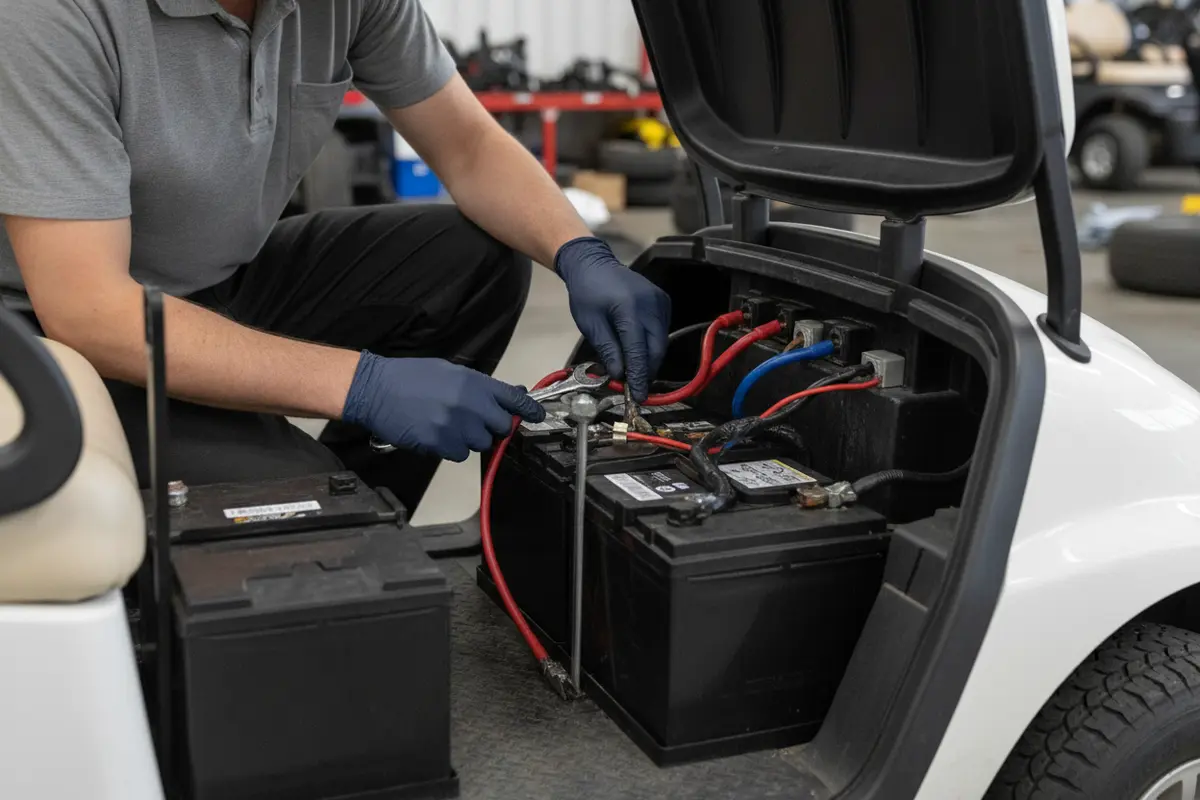
Battery work can expose a person to electrical energy, heavy components, and corrosive materials. Hazards and precautions depend on the battery type and cart. Follow manufacturer instructions and use suitable protective equipment. If you are not trained to work on the system, professional installation is the safer choice.
Battery packs can be heavy, and incorrect polarity or a short circuit can damage equipment or cause injury. Do not guess at a disconnection or reconnection sequence. The correct procedure depends on the specific cart and battery; use the manuals or have a qualified technician do the work. Keep children and bystanders away from the work area.
If a battery appears swollen, unusually hot, leaking, or physically damaged, do not handle or attempt to repair it. Keep people clear and seek instructions from the battery manufacturer or an appropriate local hazardous-materials resource. A damaged battery calls for a careful response rather than ordinary removal and storage.
Preparation also includes choosing a suitable work area. Keep the route to the cart compartment clear so a heavy battery does not need to be carried around obstacles. Keep tools and loose hardware away from exposed terminals, and do not place metal objects on top of a battery. Follow the cart and battery instructions for ventilation and protective covers. If the manual gives a specific isolation method, use that method; generic steps found online may not apply to every cart.
After work, resist the temptation to make adjustments while the system is energized. If a cable looks loose, a cover does not sit correctly, or a warning appears, stop and ask the installer to inspect it. A neat installation should leave wiring routed and protected as specified, with no pinched cables or unsecured components. The service provider should explain any limitations or follow-up work rather than leaving an uncertain condition for the owner to troubleshoot.
| Consideration | DIY installation | Professional service |
|---|---|---|
| System identification | You confirm chemistry, voltage, and configuration from labels and manuals. | A technician can inspect the cart and verify the setup before installation. |
| Tools and handling | You provide appropriate tools, lifting help, and protective equipment. | The service provider can use suitable equipment and installation experience. |
| Compatibility | You check battery fit, wiring, charger, and manufacturer requirements. | The technician can inspect connections and assess charger compatibility. |
| Testing | You need a safe method to verify charging and operation. | Ask which post-installation tests are included. |
| Labor and scope | You take on the work and responsibility for correct installation. | Labor depends on cart design, battery configuration, condition, and added work; request a quote. |
DIY work may suit someone who can identify the system, follow the manual, safely handle the batteries, and verify the installation. Professional service is often preferable when wiring is unfamiliar, terminals are damaged, corrosion is present, a lithium conversion is being considered, or lifting and access are difficult. A service visit may also be practical when you want a technician to inspect the charger and connections as part of the same job.
When requesting a quote, describe the cart and the symptoms rather than asking only for a battery swap. Mention whether the cart charges, how it behaves under use, and whether any warning signs have appeared. Ask what the quote covers: battery removal and installation, inspection of cables and terminals, charger assessment, testing, disposal, and any additional labor. This makes it easier to compare scopes rather than comparing a single headline figure.
For example, one estimate might cover only fitting a customer-supplied pack, while another might include system identification, charger review, post-installation checks, and handling of the old batteries. Those are different scopes even if each is described as installation. Ask what happens if a technician finds corroded cables or a damaged receptacle: will work pause for your approval, and how will any added parts or labor be discussed? Clear scope avoids surprises and gives you a useful basis for comparing proposals.
There is no universal labor figure that can be applied to every cart. Access, battery count, configuration, condition, and whether the replacement changes chemistry can all affect the work. Avoid comparing quotes on labor alone without checking whether diagnostic time, testing, and disposal are included. If you are supplying the batteries, confirm in advance that the provider will install that specific pack and what documentation they need to verify compatibility.
A little preparation can make diagnosis and installation more straightforward. Gather the cart’s make and model, model year if available, and any service records. Photograph battery labels, charger label, and the compartment if you can do so safely without touching exposed connections. Share what you have noticed, such as reduced run time, slow charging, or unusual heat, without assuming that the batteries are the only cause.
Do not attempt to clean or loosen connections to prepare the cart unless the manual describes a safe procedure and you are comfortable doing it. Leave the battery compartment as-is if there is damage, leakage, corrosion, or uncertainty. Clear information is more useful than a last-minute adjustment that could create another problem.
Write down a simple timeline of the symptoms. For instance, note whether reduced run time began gradually or appeared after a charger change, whether charging stops at the same point, and whether the cart behaves differently on a slope or with a load. These details do not diagnose the cause by themselves, but they help the technician ask focused questions. Bring the charger if requested, and confirm how to transport it safely rather than assuming that the shop can test every unit without it.
Also clarify the practical logistics. Ask whether the work is performed at a service location or whether mobile support may be available for your situation, and whether the cart must be delivered on a trailer. c2 Vehicles’ service information and location finder are useful starting points for discussing the next step. Confirm appointment timing and any instructions before setting out, especially if the cart is not currently able to move under its own power.
Do not place used batteries in household trash or leave them outdoors. Battery types have different handling and recycling requirements. Keep removed batteries upright and protected from damage, and arrange recycling through a qualified battery recycler or local program that accepts that chemistry. Ask the installer whether removal and recycling are included and confirm how the batteries will be transported and accepted.
Ask how the old pack will be handled before work begins, especially if the batteries are damaged or if the service provider does not include recycling. Do not drain, dismantle, or repair a battery yourself. If a battery is leaking, swollen, unusually hot, or physically damaged, avoid handling it and seek instructions from the manufacturer or an appropriate local hazardous-materials resource.
Recycling arrangements are worth confirming separately from installation. Ask whether the provider takes possession of the removed pack, whether a fee or separate drop-off applies, and whether the facility accepts the exact chemistry involved. If you are responsible for transport, obtain instructions first and use an approved route or collection option. Do not store batteries where they can be knocked over, exposed to weather, or reached by children while waiting for collection.
Before taking the cart away, ask what was installed and what checks were performed. A useful closeout includes confirming battery chemistry and pack voltage, checking cable connections and secure mounting, and verifying that the charger and cart operate as expected under the provider’s procedure. Request the correct charging and maintenance instructions for the batteries fitted.
Testing should be described clearly. Ask whether it included checking the charging connection, confirming that the cart powers on, and observing its operation. Do not assume a brief power-on confirms every aspect of battery health or range. The service provider can explain the limits of the checks performed and what to monitor during normal use.
For future support, keep the invoice and battery documentation together with the cart manual. Record any charger replacement or service visit. These details help the next technician distinguish a new symptom from an older issue and verify which components are currently installed.
Before leaving, repeat back the recommended charging routine and ask when the pack should be checked again, if the manufacturer specifies a follow-up. Different chemistries have different maintenance needs, so avoid carrying over habits from the previous battery type. If water checks, cleaning, or storage precautions apply, request instructions for the exact installed product. Keep those directions near the manual rather than relying on memory.
Choose professional help if you cannot confidently identify the cart’s voltage, chemistry, or charger; if wiring or terminals show damage; or if the work requires lifting equipment you do not have. A technician can also help when you are considering a change in battery chemistry, since the change may require more than replacing batteries. c2 Vehicles provides service support across its New England network; learn about service and repair, explore lithium battery safety information, or use the location finder to plan a visit.
For a cart used regularly at a home, golf facility, resort, or worksite, downtime can disrupt plans. Explain how and where the vehicle is used when discussing the job. That context can help the service provider understand whether the main concern is a safe replacement, charger compatibility, or returning the cart to dependable day-to-day use. Avoid selecting a replacement solely by matching a physical size or a single label; confirm the full system.
A commercial operator may want to schedule work around usage periods and confirm that several vehicles can be evaluated under a consistent process. A homeowner may instead value a clear explanation of routine care and what signs merit a call. In either case, make the service goal explicit: resolve a compatibility concern, address poor charging, replace a worn pack, or assess a conversion. The more specific the goal, the easier it is to agree on what success and testing will mean.
Customers across Massachusetts, Connecticut, Rhode Island, Vermont, New Hampshire, and Maine can use the company’s regional service network to discuss support. The appropriate appointment, transport plan, and work scope depend on the cart and its condition. For someone comparing service options, ask where the work will take place, which parts are included, and how follow-up questions are handled after installation. The c2 Vehicles company information provides additional background on its regional presence.
Contact c2 Vehicles to discuss battery installation
Possibly, but compatibility must be confirmed for the specific cart, pack voltage, charger, wiring, and battery management requirements. Consult the manufacturer or a qualified technician before changing chemistry.
Only if the charger is approved for the replacement battery chemistry and pack voltage. Check the manuals and specifications rather than relying on the connector alone.
It depends on the service provider. Ask before the appointment whether removal and recycling are included and which battery types they accept.
Labor can depend on cart access and configuration, battery type, the condition of cables and terminals, and whether additional repairs or testing are needed. Request a quote based on the specific cart and ask what the quoted work includes.
A carefully matched and tested battery system gives you clear charging instructions and a better basis for maintaining the cart after installation.