
contact us

A golf cart can feel easy to drive, but a neighborhood ride combines passengers, traffic, turns, changing surfaces, and sometimes darkness. That makes everyday habits important, especially for families. An American Academy of Pediatrics analysis estimated about 53,855 pediatric golf cart injuries from 2010 through 2023. With falls accounting for nearly half of cases and head, face, and neck injuries among the most common.
The most important golf cart safety tips are control speed, keep every passenger seated within capacity. Use seat belts when available, supervise children closely, and confirm that lights and equipment work before driving. Families should also distinguish a standard golf cart from a properly equipped LSV and follow the rules that apply to their route.
With those fundamentals in place, responsible neighborhood driving starts with understanding why vehicle type, road conditions, and passenger behavior all affect the margin for safety.
Golf carts have moved well beyond the fairway. Families use them around neighborhoods, coastal communities, campgrounds, campuses, and vacation properties, where a short ride can involve pedestrians, bicycles, parked cars, uneven pavement, and changing traffic conditions. That broader use makes golf cart safety tips more than a list of reminders. They are the foundation for making thoughtful decisions about passengers, speed, equipment, and where a vehicle can legally travel.
Injury data reinforces the need for a careful approach. An American Academy of Pediatrics analysis of NEISS data estimated approximately 53,855 pediatric golf cart injuries in the United States from 2010 through 2023. Or about 3,846 per year. The average injured child was about 11.7 years old, and nearly half of the injuries involved falls from the cart. Head, face, and neck injuries were among the most frequent injury locations. These findings do not mean every ride is dangerous, but they do show why children and adults need clear rules before the vehicle moves.
A standard golf cart and a street-legal Low Speed Vehicle (LSV) are not interchangeable. A conventional cart may be designed primarily for off-road use, with equipment and operating limits that do not make it suitable for public roads. NHTSA distinguishes certain golf carts from federally regulated motor vehicles based on factors including their off-road design and top speed of 20 mph or less. That classification does not remove the operator's responsibility to follow local rules or operate carefully.
An LSV is built and certified for a different use, but street legality still depends on the vehicle, its equipment, and applicable state and municipal requirements. Before taking any cart onto a neighborhood road, confirm whether it is an LSV, review the owner's manual, and check local ordinances. See c2 Vehicles' street-legal safety requirements for more context on the distinction.
Golf carts are easy to operate, but their open design leaves passengers more exposed than they may expect. A safe ride starts with treating the cart like a vehicle, following the owner's manual, and making every passenger part of the safety routine. The following rules reflect guidance from State Farm's golf cart safety recommendations and Nationwide Children's Hospital.
When the trip is over, select park, engage the parking brake, and remove the key before leaving the cart unattended. These small steps help prevent unintended movement and unauthorized use, especially around children and visitors.
Golf carts can be a convenient way to get around a neighborhood, campground, or vacation property, but children need clear boundaries before the cart moves. An American Academy of Pediatrics analysis of NEISS data estimated about 53,855 pediatric golf cart injuries from 2010 through 2023, or roughly 3,846 injuries each year. The mean age of an injured child was about 11.7, and falls accounted for approximately half of the injuries. Head, face, and neck injuries were the most common overall. These findings reinforce a simple point: a short ride still requires vehicle-level safety habits.
Nationwide Children's Hospital recommends that children be at least 6 years old to ride, with adults supervising younger family members rather than treating the cart like a stroller. The driver should be at least 16 and capable of controlling the vehicle, judging turns, and responding calmly to changing conditions. Follow the manufacturer's seating and passenger limits, and use seat belts or hip restraints whenever they are available.
Falls often happen during sharp turns, sudden stops, quick direction changes, or an unstable entry and exit. Start slowly, brake gradually, and reduce speed well before a turn. Keep both hands on the wheel when driving, and do not let children distract the driver. Wet pavement, gravel, steep grades, and poor visibility call for even more caution. Never allow a child to operate the cart from a passenger position, and never drive under the influence of alcohol or medication that affects alertness.
Before leaving, explain the rules in language children can remember: sit back, hold on. Keep your feet down, and wait for the driver to say it is safe to get out. If a child cannot reliably follow those instructions, skip the ride. For additional guidance, review the Nationwide Children's golf cart safety recommendations and follow the vehicle owner's manual.
New England evenings can become dark earlier than expected, especially in late summer and fall. A golf cart that feels easy to see around a bright neighborhood may be difficult for drivers. Cyclists, and pedestrians to spot at dusk, after sunset, or in changing weather. Before a seasonal evening ride, confirm that the vehicle has the right equipment and that every light works.
Walk around the vehicle before driving. Test the headlights, taillights, brake lights, and turn signals, then inspect lenses and reflectors for damage, dirt, or obstructions. Make sure the brake pedal and other controls feel normal. If a light is dim, intermittent, or broken, schedule service before taking the cart onto a public road. Equipment that is not working cannot provide reliable warning to anyone nearby.
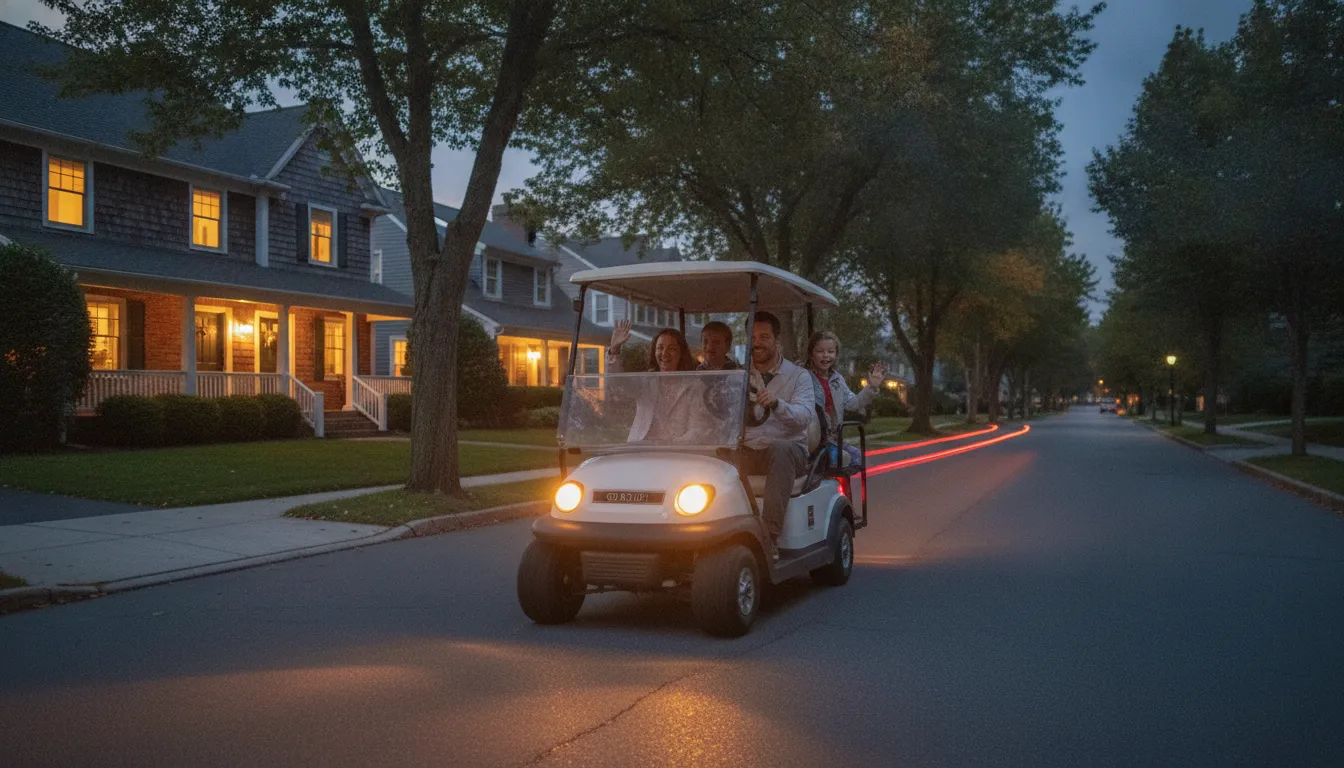
Not every golf cart comes equipped for street use. Equipment varies by model and trim, so confirm the specifications for your vehicle instead of assuming it has headlights, seat belts, reflectors, or turn signals. The c2 Vehicles team notes that owners should verify the presence and function of these features before operating a specific model. See the golf cart street-legal guidelines.
Low Speed Vehicles, or LSVs, are different from standard golf carts. An LSV is designed and certified for a defined road-use category and meets applicable DOT lighting requirements, while a standard cart may not be street-ready. An LSV still must follow state and local rules, which vary across New England. Confirm the vehicle's classification and local requirements before driving after dark, and use extra caution at dusk, dawn, in rain, and on poorly lit roads. These basic golf cart safety tips help visibility equipment support, rather than replace, careful driving.
A standard golf cart and a street-legal Low Speed Vehicle (LSV) are not interchangeable. Many golf carts are designed primarily for off-road use and are not street-legal simply because they have headlights, mirrors, or a higher top speed. Federal guidance distinguishes certain golf carts from motor vehicles, while state and municipal rules determine where they may operate on public roads. Before entering a neighborhood street, confirm that the vehicle is approved for that use and that you understand the local requirements.
In Massachusetts, an LSV is a four-wheel motor vehicle with a gross vehicle weight rating under 3,000 pounds. A top speed greater than 20 mph but no more than 25 mph, and the required NHTSA certification. The operator must have a Class D learner's permit or driver's license. The vehicle must also be registered, titled, insured, and inspected. Massachusetts prohibits LSV operation on limited-access highways, express state highways, and roads with posted speed limits above 30 mph. See the Massachusetts LSV requirements for the current state rules.
Those requirements do not automatically apply across Connecticut, Rhode Island, Vermont, New Hampshire, Maine, or Eastern New York. A town or city may add restrictions involving roads, hours, equipment, licensing, or registration. Even when an LSV appears eligible for a particular route, check the ordinance for the community where you plan to drive. The c2 Vehicles golf cart street-legal guidelines can help you identify the right questions to ask. For a deeper explanation of vehicle classification and equipment, review the street-legal safety requirements.
The safest approach is to treat every neighborhood trip as a road trip, not as an extension of the golf course. If you are unsure whether a vehicle or route qualifies, pause and verify the ordinance with the local authorities before driving.
Safety starts with choosing a vehicle that matches how and where you plan to drive. c2 Vehicles is the exclusive Club Car distributor for New England. And its team can help compare personal, utility, and low-speed vehicle configurations. Equipment can vary by model and trim, so confirm the exact specification before purchase, especially if you need seat belts, lighting, or turn signals.
| Model Family | Best For | Safety Features | Street-Legal Status |
|---|---|---|---|
| Club Car Onward | Neighborhood transportation, golf communities, and family recreation | Available configurations can include seat belts, headlights, and turn signals. Lithium power supports a smooth, quiet ride, while the four-person layout keeps passengers in designated seats. | Some Onward configurations qualify as LSVs, including models designed for street use. Confirm the exact model's DOT equipment, registration requirements, and local road restrictions before driving on public roads. |
| Club Car Carryall | Golf courses, resorts, properties, and commercial work | Utility-focused construction and a cargo bed support controlled transport for work and play. Safety equipment, seating, lighting, and drivetrain specifications depend on the configuration, so review the vehicle details with c2 Vehicles. | Do not assume a Carryall is street-legal. Standard utility vehicles may be intended for private or off-road property use unless a specific configuration is approved and equipped for public-road operation. |
| GEM LSV | Low-speed neighborhood travel and planned community transportation | Built as a low-speed electric vehicle with street-use equipment such as DOT-compliant lighting and seat belts on applicable models. Verify the exact equipment and passenger capacity for the vehicle you select. | GEM LSV models are designed for street-legal use, but state, municipal, registration, insurance, and road-access rules still apply. Check local requirements before operating one on public roads. |
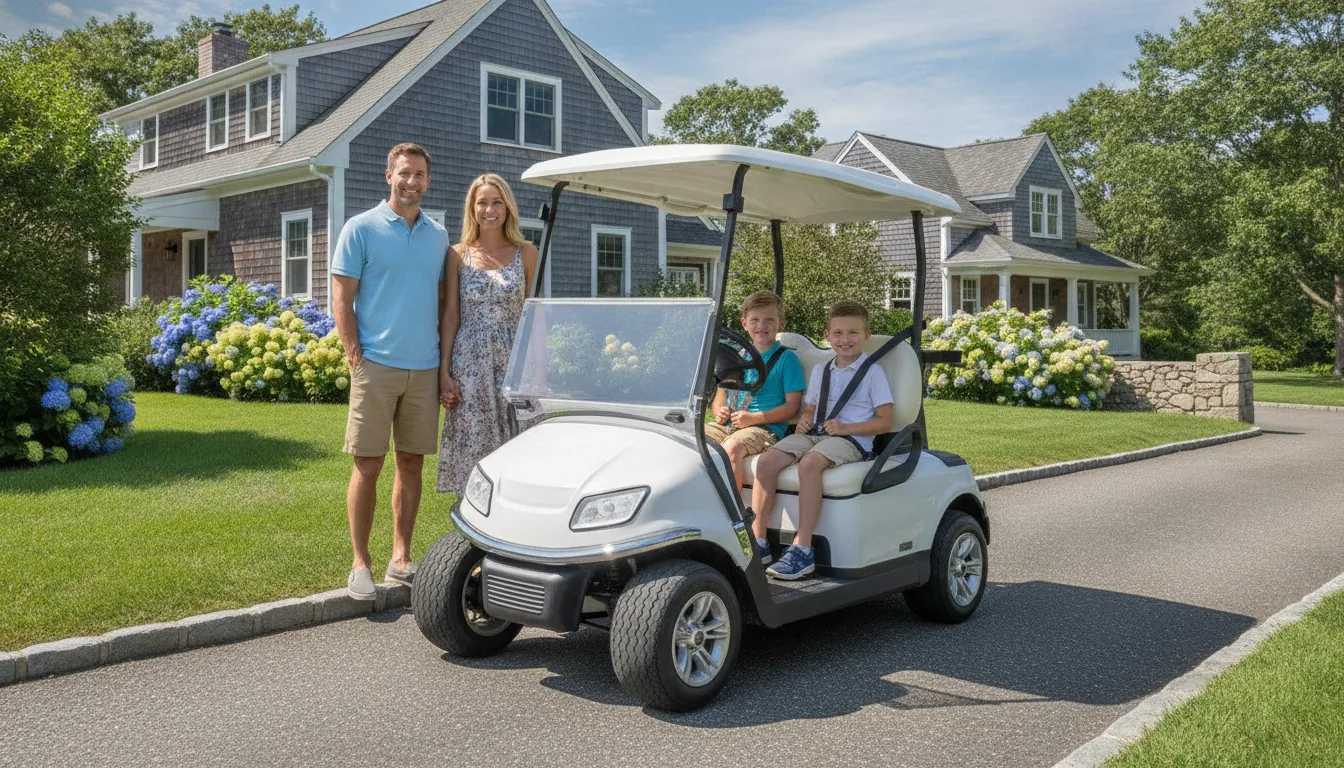
The distinction between a standard golf cart and a street-legal LSV matters. A cart that works well on a private property is not automatically approved for neighborhood roads. And local rules can differ across Massachusetts, Connecticut, Rhode Island, Vermont, New Hampshire, and Maine. Review c2 Vehicles' golf cart street-legal guidelines and verify the requirements in your municipality.
Factory-trained technicians at c2 Vehicles can also inspect brakes, steering, tires, batteries, lights, and other critical systems. Service is available at c2 locations, helping families and commercial operators keep safety equipment functional throughout the driving season. If you are comparing models, ask the team to walk through the exact features and schedule service before putting a vehicle into regular use.
Safety begins before you turn the key. A cart with worn brakes, underinflated tires, loose steering. Or a failing battery can be harder to control when you are carrying passengers or traveling on uneven neighborhood roads. A preseason inspection is a practical way to identify problems before family outings, rental operations, or regular property trips begin.
Battery care also affects reliable, predictable operation. Lead-acid batteries require proper watering, while lithium-ion batteries require the correct charging procedure for the system. Follow the owner's manual instead of guessing, and stop using a battery that is leaking, swollen, damaged, or producing an unusual odor. For a fuller seasonal checklist, review proper golf cart maintenance.
Routine service is especially important when a vehicle is used frequently, carries multiple passengers. Or operates on public roads where permitted. c2 Vehicles' factory-trained technicians can inspect critical systems and help identify maintenance needs before they become safety problems. Mobile service may also be available for qualifying needs, making it easier to keep vehicles in dependable condition.
When you notice a braking, steering, tire, lighting, or battery concern, do not put off an inspection. Schedule service at a c2 Vehicles location and get clear guidance on the repairs or maintenance your cart needs.
Not automatically. A standard golf cart and a street-legal Low Speed Vehicle (LSV) are different vehicle categories, and local rules vary by state and municipality. In Massachusetts, an LSV must be NHTSA-certified, registered, titled, insured, and inspected. It also requires a Class D learner's permit or driver's license and cannot be driven on roads with speed limits over 30 mph. Check the rules for the exact town and road before driving in traffic. Massachusetts LSV requirements
Nationwide Children's Hospital recommends that passengers be adults or children age 6 and older. Children should sit in a designated seat, use a seat belt or hip restraint when available. Keep their feet on the floor and limbs inside, and remain seated until the cart stops. Never carry a child on a driver's lap or allow standing while the cart is moving. Nationwide Children's safety guidance
The answer depends on the vehicle and local law. Massachusetts requires a Class D learner's permit or driver's license for an LSV, while rules for non-street-legal golf carts may differ by municipality. Confirm the requirements with your state and town before allowing a family member to drive. Massachusetts LSV law
Before driving after dark, verify that the vehicle has working headlights, taillights, brake lights, reflectors, and turn signals where required for its classification. Equipment varies by model, so inspect each function before a dusk ride and avoid driving in poor visibility. An LSV's required equipment may differ from a recreational golf cart's equipment.
Under Massachusetts law, an LSV is designed for a top speed greater than 20 mph and no more than 25 mph. That speed limit does not make every golf cart an LSV or authorize operation on every road. Follow the posted limit, local restrictions, and the vehicle manufacturer's specifications. Mass.gov LSV definition
Regular service can help keep brakes, tires, steering, batteries, and safety equipment ready for family and neighborhood use. If your golf cart is due for an inspection or you have questions about its equipment, schedule service with c2 Vehicles. The team can help identify maintenance needs and keep your vehicle prepared for responsible driving.