
contact us

If you are comparing electric work vehicles for sale in New Hampshire, start with the job, not the badge. A facilities team moving tools across a campus needs a different setup than a resort transporting guests, a municipality maintaining a park, or a property manager servicing multiple buildings. The right vehicle balances cargo and passenger needs with charging access, winter readiness, route requirements, service support, and total operating cost.
Request a Commercial Quote for Your New Hampshire Fleet
c2 Vehicles serves New Hampshire businesses from its Hooksett location and supports commercial buyers throughout New England. The live utility inventory changes, so the examples below are a snapshot checked on September 15, 2026. Confirm current availability, location, exact specifications, and pricing before making a purchase decision.
An electric work vehicle is most valuable when it matches the daily route and workload closely. A smaller unit can be easier to maneuver between buildings, while a larger cargo bed may reduce trips for a grounds crew. A four-passenger configuration can move a team, but it may not carry the same cargo volume as a two-passenger work vehicle. Compare the following factors before focusing on a model name.
The best comparison is therefore not simply electric versus gas. It is the cost and productivity of the complete operating system: vehicle, charging, operator time, maintenance, attachments, delivery, and service.
c2 Vehicles' live utility collection showed current Hooksett listings when this article was rechecked on September 15, 2026. These listings demonstrate the range of use cases available to New Hampshire buyers, but they should not be treated as a permanent catalog. The store controls availability and may sell or relocate a vehicle after this guide is published.
The 2026 Fusion Utility Medium Bed Lithium was listed in the live Hooksett utility collection as a four-passenger electric utility vehicle. Its medium bed and four-seat layout make it a practical starting point for a campus, resort, campground, or property operation that needs to move people and light equipment in the same trip. The live catalog listed road tires, an extended canopy, turn signals, headlights, taillights, and a horn.
The catalog and product information identify this vehicle as a street-legal low-speed vehicle, while noting that roadway use varies by state. That listing language is not a substitute for New Hampshire registration and route guidance. Ask the commercial team to confirm whether the vehicle's equipment and intended route fit your use before treating it as a road-going solution.
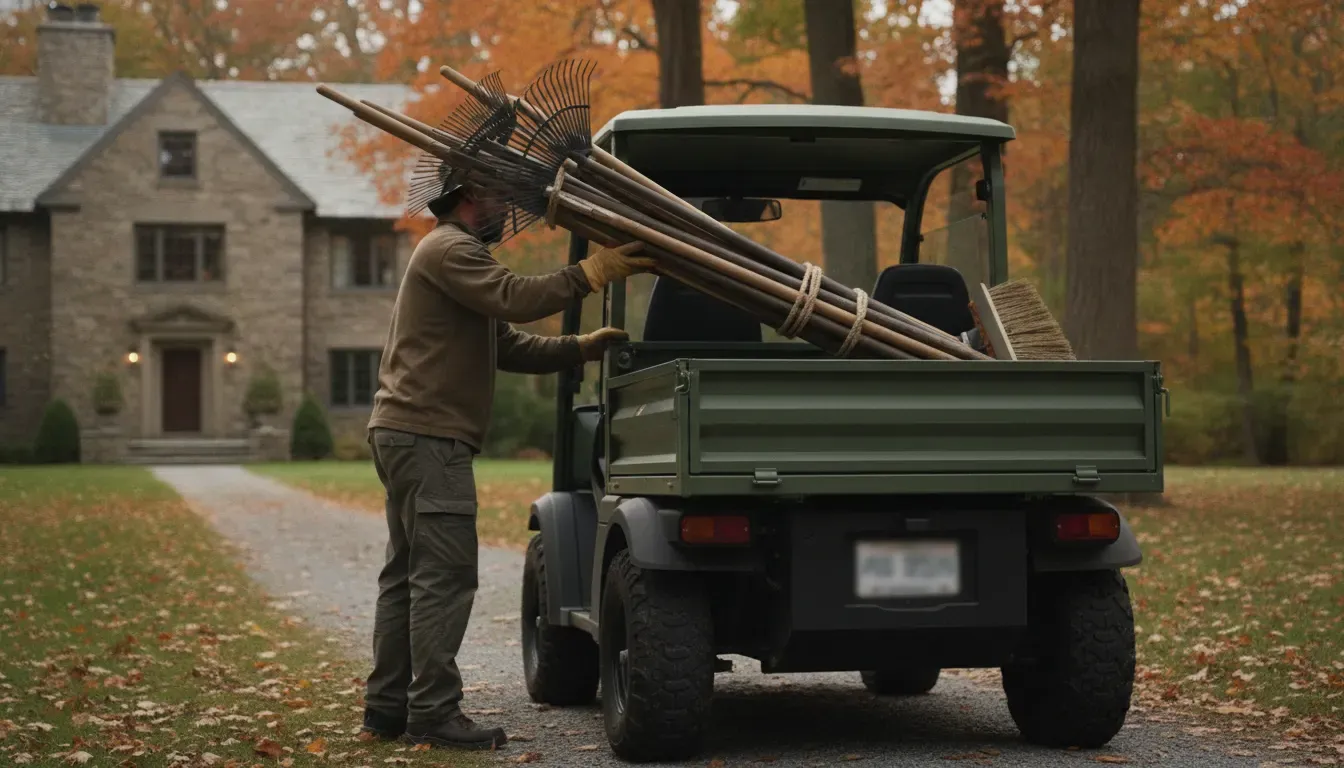
The 2026 Fusion Utility Short Bed Lithium was listed in Hooksett as a two-passenger electric utility vehicle. Its shorter bed and smaller crew configuration can suit a maintenance supervisor, building engineer, or grounds employee who needs a compact vehicle for daily rounds and light cargo. The listing showed a standard canopy, turn signals, headlights, taillights, and a horn.
This model was also identified on its product page as a street-legal low-speed vehicle with state-dependent roadway use. Confirm the exact registration, route, and operating requirements before planning public-road travel. For work that stays on private property, the more important questions may be maneuverability, charging location, bed access, and service response.
The 2025 Polaris PRO XD Kinetic Lithium was listed in the live Hooksett utility collection as a two-passenger lithium vehicle. Its product information identifies it as not street legal and equipped with off-road tires. That makes it a different type of tool from the Fusion listings: it is better evaluated for private worksites, rough property routes, and operations where traction and durable utility use matter more than road access.
Do not apply a generic payload or towing figure to this exact listing without checking the applicable configuration documentation. Polaris publishes separate Pro XD specifications for different sizes, powertrains, and crew configurations. The official Polaris hauling and towing guide explains that payload includes passengers, accessories, and cargo, and distinguishes cargo-box limits from total payload. That distinction should be part of every fleet review.
The live Hooksett collection also showed gas-powered Club Car Carryall listings, including the Carryall 700 and the Carryall 300. They are not electric models, and their live pages identify them as not street legal. They are useful comparison points because a commercial buyer should choose the powertrain and bed configuration that fit the work, not force every job into an electric format.
For manufacturer-level context, Club Car describes the Carryall 700 as a two-passenger utility vehicle with a nearly six-foot bed and a 1,000-pound payload capacity, with gasoline, electric, and lithium options across the product family. Exact specifications depend on the model and configuration. If a gas comparison vehicle can complete a remote, high-utilization route without charging downtime, it may be the more productive choice. If your operation has predictable routes and convenient charging, an electric model may lower routine operating friction.
Match the vehicle to the work pattern that repeats most often. A vehicle selected for an occasional task can be a poor fleet asset if it is oversized every day. The following job-first framework keeps the decision practical.
| Business use | Prioritize | Configuration to investigate |
|---|---|---|
| Facilities and property management | Easy maneuvering, secure tool storage, charging near buildings, and low routine noise | Two-passenger electric utility vehicle with a practical bed and canopy |
| Grounds maintenance | Bed access, payload, tire choice, attachments, and repeated short routes | Medium-bed utility vehicle, with payload matched to tools and materials |
| Campuses and resorts | Passenger capacity, guest-facing presentation, quiet operation, and safe route planning | Four-passenger electric utility vehicle when people movement is frequent |
| Municipal parks and private properties | Terrain, seasonal access, weather protection, service response, and road-use status | Private-property electric utility vehicle or model-specific LSV, depending on route |
| Rental and event operations | Repeatable configurations, charging turnaround, delivery, inspections, and support | Standardized fleet configuration backed by commercial consultation and service |
For work on a single campus or resort, a compact electric vehicle may replace many short truck trips without requiring a full-size vehicle for every task. For construction, industrial, or remote property work, review ground conditions and payload first. A quiet, efficient powertrain does not compensate for a vehicle that cannot safely carry the required load or reach the work area.
Charging is an operating decision, not just a vehicle feature. Before purchasing, map the daily route, starting state of charge, end-of-shift parking location, outlet access, and the time available between shifts. Then ask the dealer whether the proposed model and battery system fit that duty cycle. Avoid choosing on an advertised maximum range alone because cargo, temperature, terrain, speed, tires, and operator habits affect real use.
New Hampshire's winter conditions also make service geography important. A fleet that can be supported by mobile technicians or a nearby service center may be more practical than a seemingly lower-cost vehicle with limited parts and repair access.
Plan Service and Winterization for Your Fleet
Start with a written duty cycle. List the number of operators, average passengers, tools, materials, attachments, route miles, grades, surface types, daily hours, charging windows, and seasonal changes. This gives a commercial territory manager the information needed to recommend a configuration without guessing.
Payload deserves special attention. A vehicle's total payload can include passengers, accessories, and cargo, while the cargo bed may have its own limit. For example, a crew that loads tools and materials into a bed must subtract the occupants and installed accessories from the total allowable weight. Overloading can affect handling, braking, tires, suspension, and component life.
Total operating cost should include more than energy. Compare:
Electric vehicles can be attractive for predictable short routes, frequent starts and stops, and properties where quiet operation matters. Gas vehicles can remain practical for remote or high-utilization work where fast refueling and long continuous operation are central. The correct answer depends on the route, not on a universal promise about one powertrain.
Used inventory can also fit a commercial budget, but evaluate it as a work asset. Ask for service records, battery condition, inspection results, charger compatibility, tire and brake condition, warranty terms, and the expected workload. c2 Vehicles states that its pre-owned vehicles go through a 25-point safety inspection and that commercial buyers can receive commercial warranty coverage. Confirm the terms for the exact vehicle and buyer before purchase.

Commercial buyers need a partner that can help specify, deliver, and maintain the vehicle after the sale. c2 Vehicles has more than 40 years of commercial experience, dedicated territory managers, custom-build capabilities, financing and leasing options, regional delivery, and service coverage across New England. The company's commercial team serves resorts, education, property management, government, campgrounds, industrial operations, and rental fleets.
For New Hampshire buyers, the commercial conversation should cover more than a product link. Bring the written duty cycle and ask about:
Use the Find a Location page to confirm the nearest c2 facility, and use the commercial vehicle collection to browse work-focused inventory. Because stock moves between locations and sells, the most useful next step is a current quote built around your operation.
Request a Fleet Consultation Before You Buy
The best vehicle is the one that meets the job's payload, passenger, route, terrain, charging, and service requirements. The Fusion Utility Medium Bed can be a strong starting point for a team that needs four seats and a medium bed. The Fusion Utility Short Bed may suit compact two-person maintenance routes. A Polaris PRO XD Kinetic should be assessed for private-property work where its live listing status and off-road configuration fit the application. Confirm exact specifications and availability with the commercial team.
Some models are listed as street legal low-speed vehicles, while other utility models are explicitly listed as not street legal. Roadway use, registration, equipment, speed limits, and local rules vary. Never assume a vehicle is road legal because it is electric or because another model in the same category is road legal. Verify the exact model and intended route with c2 Vehicles and the appropriate New Hampshire authorities.
Yes, when the vehicle's condition and support fit the workload. Ask for the battery history, charger information, inspection results, service records, warranty terms, and a realistic assessment of the route. A lower purchase cost does not help if battery, tire, or downtime risk is left unplanned.
No incentive is assumed in this guide. Programs, eligibility, and application rules can change, and commercial vehicles may be treated differently from passenger EVs. Ask a tax professional or the relevant New Hampshire and federal program administrator to confirm current eligibility. Build the fleet comparison using verified purchase, operating, charging, and service costs rather than an unconfirmed incentive.
Request a Quote for Electric Work Vehicles in New Hampshire
Bring your route, payload, passenger, charging, and seasonal requirements to c2 Vehicles' commercial team. They can help you compare current Hooksett inventory, financing or leasing options, delivery, and service support.