
contact us

Choosing among the best used gas golf cart models in New England starts with the job, not the badge. A cart for a steep driveway, coastal property, golf course, campground. Or maintenance route needs a different evaluation from one used for short trips on a level neighborhood road.
Horsepower, fuel-system condition, cargo needs, corrosion exposure, service history, and local operating rules all matter. This guide shows how to compare those factors before you buy.
View current pre-owned inventory.
For many New England buyers. The best used gas golf cart models are well-maintained vehicles with enough power for the terrain and load. c2 Vehicles recommends comparing the exact unit's engine. Hours, tires, brakes, service history, equipment, and warranty. Club Car Carryall fits utility work, while Polaris Pro XD suits heavier commercial duty.
Start by describing a normal day with the vehicle. Will it carry passengers, tools, mulch, or supplies? Will it climb a long driveway, cross wet grass, or travel between buildings on a large property? Will it run for several hours at a resort, golf course, campground, school, or industrial site? Those answers define the required duty cycle.
Gas power can be useful when routes are long, charging access is limited, or a vehicle must return to work quickly after refueling. It also brings additional maintenance items, including engine oil, air filtration, spark plugs, fuel-system components, and exhaust-related checks.
A gas drivetrain is not automatically better than electric. It is a different ownership choice.
Condition should carry more weight than age alone. Look for clean cold starts, steady idle, predictable throttle response, firm brakes, straight steering, healthy suspension, and a frame without serious corrosion or impact damage. In coastal Maine, Cape Cod, the Islands, Rhode Island, and other areas exposed to salt air, corrosion deserves special attention. Ask where the vehicle was stored and whether it worked outdoors year-round.
Support is part of the purchase decision. c2 Vehicles serves New England through seven locations across all six states, with factory-trained technicians, OEM parts, and mobile service. Review the service support before choosing a used vehicle for a working operation.
Club Car is a practical starting point for buyers who want a well-supported used gas vehicle for personal transportation or utility work. The strongest match depends on the configuration.
A passenger-oriented cart can work well for golf, neighborhood travel, or vacation properties. A Carryall utility vehicle is more appropriate when hauling and grounds work are central to the job.
The Club Car Carryall 700 is a useful reference point for comparing utility capacity and engine output. Club Car's published materials list a 14 horsepower Kohler EFI four-cycle gas engine, a 5.5-gallon fuel tank, a 17 mph maximum speed, and a 1,500-pound maximum vehicle capacity.
These are manufacturer specifications for the referenced configuration, not a promise that every used Carryall has the same equipment or condition. Review the Club Car Carryall 700 specifications alongside the actual listing.

That combination can make a Carryall gas model worth examining for acreage, farms, campgrounds, resorts, property managers, and maintenance teams. The cargo bed gives the vehicle a clear work role. Before purchase, confirm the bed condition, tires, suspension, brakes, frame, and accessories. A heavily used work vehicle may need more immediate maintenance than a lightly used recreational cart of the same age.
A standard Club Car gas cart may be the better choice when the main needs are passenger transportation, golf, and short property trips. It can be easier to maneuver and more comfortable for a homeowner or seasonal resident than a larger utility vehicle. However, do not choose a passenger configuration if it will regularly carry heavy materials. Repeated overloading can accelerate wear in the suspension, brakes, tires, and frame.
For either configuration, ask for the model year, engine type, operating hours if available, maintenance invoices, and a cold-start demonstration. Rated horsepower is useful context, but it does not replace a test drive or inspection. Hills, passenger weight, tire condition, gearing, and throttle calibration all affect how a used cart feels in service.
Polaris Pro XD and Tomberlin should not be treated as interchangeable categories. Polaris Pro XD is a commercial utility vehicle family designed around hauling and work-site use. Tomberlin vehicles may appeal to personal-transportation buyers, but the exact powertrain and equipment depend on the model and year. Compare the job each vehicle performs instead of assuming every option is a conventional golf cart.
| Vehicle family | Best starting use case | Fuel and power questions | Verify before buying |
|---|---|---|---|
| Club Car Carryall | Property maintenance, hauling, grounds work, and fleet support. | Gas engine size, rated horsepower, fuel-system condition, and service interval. | Cargo bed, payload guidance, brakes, frame, tires, and corrosion. |
| Polaris Pro XD | Commercial, industrial, farm, resort, and work-site transport. | Engine displacement, horsepower, 4x4 system, fuel capacity, and operating hours. | Payload, bed, suspension, drivetrain, safety equipment, and prior workload. |
| Tomberlin | Personal travel and recreation when the exact configuration fits. | Confirm whether the unit is gas or electric, then verify engine output and fuel-system details. | VIN, equipment, seating, condition, documentation, and local road-use eligibility. |
| MadJax X-Series | Personal neighborhood and recreational use. | Current X-Series materials describe a lithium electric powertrain, not a gas engine. | Battery type, charger, range condition, suspension, and legal equipment. |
Polaris publishes substantially different specifications for its Pro XD Full-Size Gas than for a typical neighborhood golf cart. The manufacturer lists a 1,000 cc ProStar gas engine rated at 39.5 horsepower and on-demand 4x4.
It also lists an 11.5-gallon fuel capacity, 11 inches of ground clearance, and a 1,850-pound payload capacity for the referenced full-size specification. Its adjustable top speed is listed up to 40 mph. Read the Polaris Pro XD Full-Size Gas specifications for source details.
Those numbers make the Pro XD relevant for demanding commercial tasks, but it may be more vehicle than a homeowner needs. A full-size utility vehicle can require more storage space, a wider route, and a different maintenance budget. Check the exact used unit's hours, 4x4 operation, tires, bed, hitch, suspension, hydraulic brakes, and prior job-site exposure.
Tomberlin can be a reasonable option for a buyer seeking a personal vehicle with a particular seating layout or road-oriented equipment. Do not apply a single horsepower or range figure to every Tomberlin. Confirm the exact model, year, engine or battery system, safety equipment, and service history. Any claim about street use must also be checked against the unit's equipment and the rules where it will operate.
One accuracy point matters here: current MadJax X-Series information identifies a lithium electric vehicle family. If a used listing is described as a gas MadJax X-Series, ask for the serial information and drivetrain details before relying on that description. This protects the buyer from comparing the wrong powertrain or budgeting for the wrong maintenance.
In short, Polaris is the clearest work-focused choice in this comparison. Club Car offers a broad range of personal and utility configurations, and Tomberlin requires an exact-unit review. MadJax X-Series belongs in an electric comparison unless the specific listing proves otherwise.
Explore commercial vehicle solutions for New England.
A professional inspection is one of the best protections in a used purchase. If you are inspecting a private-party vehicle, see it cold and ask the seller not to start it before you arrive.
If you are reviewing dealer inventory, ask what inspection was completed, what repairs were made. And which items remain due. c2 Vehicles applies a 25-point inspection to pre-owned vehicles. Its in-house service team can also help evaluate condition and maintenance needs.
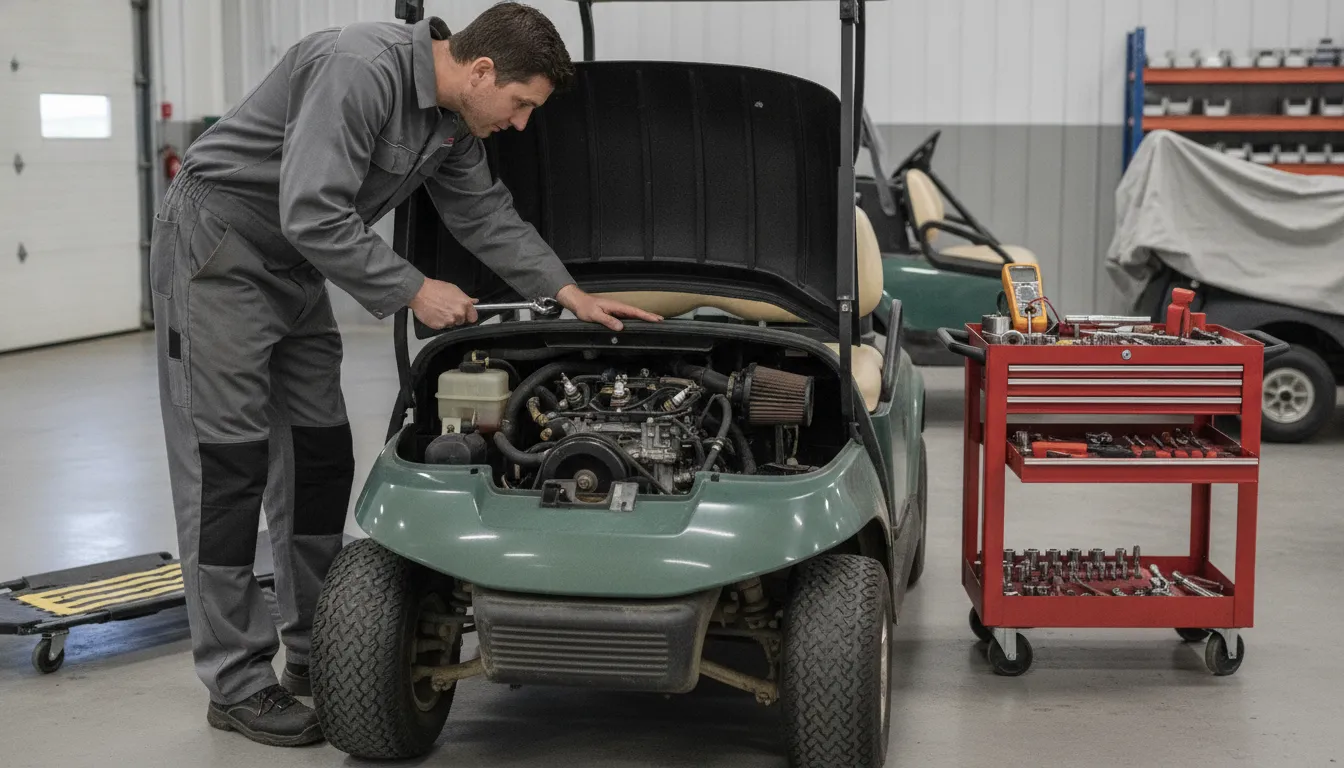
Inspection findings should shape the offer and the ownership budget. A lower purchase price is not a bargain if the vehicle immediately needs tires, brakes, suspension work, fuel-system repairs, or corrosion remediation. Ask what is included, what is covered, and where future work can be completed.
Gas may be the more convenient choice when a vehicle must run for extended periods, carry a load, or cover a large property without a planned charging stop. Refueling can reduce downtime. That advantage is most relevant to golf courses, resorts, campgrounds, maintenance crews, farms, and commercial operators. Engine condition and correct gearing still determine real-world hill performance.
Electric may be a better fit for quiet residential travel, short repeatable routes, and buyers who can charge consistently between uses. It can simplify daily operation, but battery age and condition are critical in a used purchase. Ask for battery testing, charger information, service records, and an estimate of usable range under the expected load. See personal vehicle options when comparing passenger-focused configurations.
Do not use horsepower as the only comparison. A 14 horsepower Carryall gas specification and a 39.5 horsepower Polaris Pro XD specification describe vehicles built for different jobs. Size, gearing, drivetrain, weight, ground clearance, tires, payload, and braking all influence the result. The right question is whether the exact unit can safely and reliably perform your route.
Road legality is separate from hill performance. Some low-speed vehicles may be equipped for limited road use, while others are intended only for private property or work sites. Requirements vary by state and municipality. Ask c2 Vehicles to review the specific vehicle and intended route rather than assuming a gas drivetrain, lights, or seat belts make a vehicle street-legal.
Schedule service support for your used vehicle.
Used ownership is easier when the dealer can support the vehicle after the sale. Ask whether routine gas maintenance, inspections, repairs, parts, and mobile service are available from a nearby location.
c2 Vehicles has service centers across New England. It also provides factory-trained technicians, OEM parts, and door-to-door mobile service for homes, campuses, golf courses, and commercial sites.
Warranty coverage depends on the exact vehicle and program. c2 Vehicles' certified pre-owned positioning includes vehicles that may be up to five years old and backed by a three-year bumper-to-bumper warranty. Confirm the current warranty terms, eligibility, exclusions, transfer rules, and covered service for the specific listing. Do not assume that every used gas vehicle receives the same coverage.
Service access can be especially valuable in New England, where seasonal storage, winterization, road salt, coastal moisture, and spring startup create predictable maintenance needs. Ask about oil and filter changes, fuel-system checks, tire service, brake inspection, steering alignment, and storage preparation. Commercial buyers should also discuss fleet maintenance and response expectations before committing to a vehicle. Review golf vehicle solutions for course-specific use cases.
Compare the vehicle, the support plan, and the route together. Review what refurbished golf carts may include, then ask about financing, trade-in value, delivery, accessories, and service. These practical details often matter more than a small difference in purchase price.
Find a c2 Vehicles location to compare used models.
A well-maintained gas vehicle with the correct gearing, tires, suspension, and load rating can suit hills. Club Car utility configurations and Polaris Pro XD vehicles are useful starting points for work-oriented routes. Evaluate the exact engine, drivetrain, brakes, tires, and condition. Never choose by horsepower alone, and have the vehicle assessed under the expected passenger or cargo load.
Not automatically. Road-use rules and equipment requirements vary by state and municipality. The specific vehicle may need approved lighting, mirrors, seat belts, a VIN, and other equipment, but those features do not guarantee permission on every road. Confirm the exact vehicle, route, speed limit, registration requirements, and local rules before operating on public streets.
There is no single horsepower target. A personal cart on level routes has different needs from a loaded utility vehicle on hills. For reference, Club Car lists a 14 horsepower gas engine for the Carryall 700, while Polaris lists 39.5 horsepower for the Pro XD Full-Size Gas. Those vehicles have different sizes and duties, so compare the complete configuration and condition.
Ask whether the exact unit qualifies, what components are covered, how long coverage lasts. Whether parts and labor are included, where covered work is performed, and whether the warranty transfers. Also ask about the inspection record and repairs already completed. c2 Vehicles can explain the current certified pre-owned and service options for the specific vehicle.
Compare the route, duty cycle, terrain, charging access, noise preference, maintenance budget, and condition of the exact vehicle. Gas can reduce downtime on long or intensive routes. Electric can suit quiet, repeatable trips with dependable charging. For a used electric cart, battery health is as important as engine health is for a gas cart.