
contact us

Accessible golf cart rentals can help guests with limited mobility travel between parking, entrances, ceremony spaces, and other event areas. The right plan starts with the route and the people who will use it, then confirms vehicle fit, staffing, and operating rules with the rental provider.
Accessibility is more than having a cart on site. It means a guest can get from one place to another with dignity, reasonable comfort, and a clear way to request help. A cart can support mobility, but it does not automatically make an entire venue accessible. Check the actual route, surfaces, slopes, turning space, weather exposure, and distance between key locations.
Start by mapping the trip, not by choosing a vehicle. List the parking area, drop-off point, entrance, gathering spaces, restrooms, and any separate activity areas. Then identify where guests may need a ride and when demand will peak. This helps determine whether a cart is useful for short transfers, longer venue circulation, or both.
Build the plan around choice and dignity. Avoid asking a guest to explain a medical history in a public setting. Instead, provide a discreet way to share practical transportation needs, such as whether a person can transfer to a seat, needs to remain in a mobility device, or would benefit from a ride over a particular distance. Let guests identify what assistance they want rather than assuming that one type of support works for everyone.
Make the service easy to find. Include the pickup location and contact method in event information, and tell ushers, venue staff, or the planner how requests will be handled. If guests do not know the cart exists or cannot locate its operator, the vehicle may be available but not useful. A visible sign at an agreed pickup point and a named staff contact can remove that uncertainty.
Do not assume every golf cart has the same entry, seating, restraint, or passenger arrangement. Describe the specific needs to the rental provider and ask what vehicle configurations are available. If someone uses a wheelchair or other mobility device, explain its dimensions and how the person expects to transfer or ride. Ask directly whether the vehicle can accommodate the person and device safely; do not rely on a generic label.
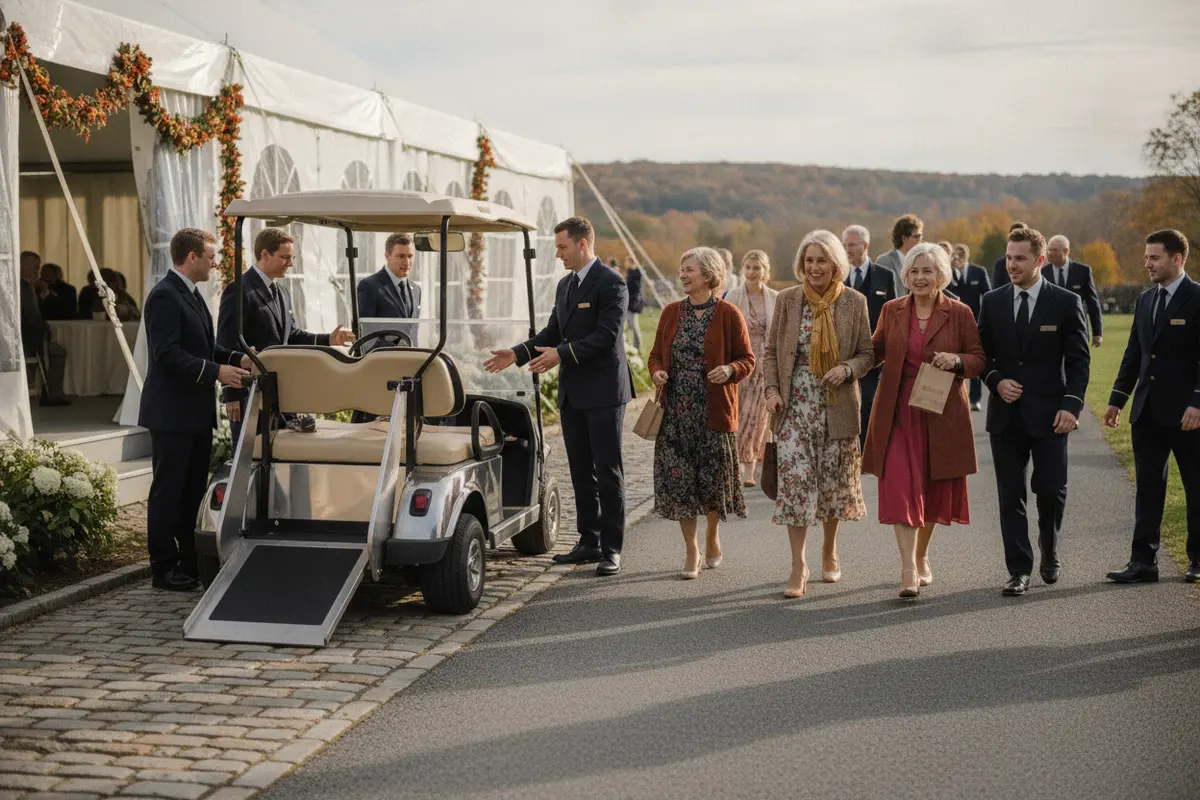
Ask the provider to confirm the details in advance, ideally against the actual vehicle that would be supplied. Useful questions include:
Also talk through boarding and unloading. Ask whether the cart can stop close to the pickup point, whether the area provides enough space to approach and turn, and how the driver should assist without taking over. Do not assume a passenger can step up, sit down, or hold a position in the same way as another rider. A demonstration can make these practical questions easier to resolve.
A rental provider may not have a configuration that fits every individual need. If the answer is uncertain, arrange a conversation with the guest or their chosen support person, while protecting their privacy. A short site visit or vehicle demonstration can reveal fit issues that a phone description misses. Record the agreed vehicle, boarding method, route, and point of contact so event-day staff follow the same plan.
Match the setup to the trip. A standard passenger cart may work for transporting guests who can transfer into its seats and travel along the venue’s paths. A wheelchair-accessible cart may be necessary for guests who need to remain in a mobility device. For a large venue or simultaneous arrival period, more than one vehicle or a dedicated shuttle loop may be needed. Confirm capacity and suitability with the provider rather than estimating from a photograph.
| Planning option | May suit | Confirm before booking |
|---|---|---|
| Passenger golf cart | Short trips for guests able to use the vehicle’s seating and entry | Passenger capacity, entry, restraints, path condition, and turnaround space |
| Wheelchair-accessible cart | Guests who need to remain in a mobility device during transport | Device dimensions, securement, boarding process, route clearance, and availability |
| Dedicated shuttle loop | Repeated trips between distant parking and venue areas | Stops, frequency, staffing, accessible boarding, and contingency arrangements |
| Mixed transportation plan | Events with varied needs, distances, or peak arrival times | How guests request the appropriate option and how dispatch coordinates trips |
Consider whether guests need an individual ride on request or a predictable loop. A loop can make service visible and easy to understand, but it may involve waiting. On-demand rides can be more flexible, but require a clear contact method and someone responsible for dispatch. Some events use both: a scheduled route between main locations and a contact person for specific needs.
Think about timing as carefully as vehicle count. Arrival is often concentrated in a short window, while trips during the event may be occasional. Departure can create a second rush, especially if parking is distant or guests leave at once. Ask the venue to estimate how many people might request assistance in each period, then decide whether one vehicle can make repeated trips quickly enough or whether the plan needs a loop, a second vehicle, or staggered pickup arrangements.
Do not promise a particular waiting time until the route and schedule have been tested. A longer route, a slow boarding process, congestion, or a weather-related change can affect turnaround. Explain how guests will know the service window and what to do if a ride is delayed. If people are expected to wait, identify a safe, comfortable place where they will not be standing in a vehicle lane or exposed to unnecessary weather.
For broader event and venue planning, review C2 Vehicles rental options and the company’s commercial vehicle and fleet solutions. Vehicle availability and configurations should be confirmed directly for the date and site.
Walk the route at the time and conditions expected for the event. A path that looks simple on a map may become congested when guests arrive, or difficult when wet. Identify accessible loading areas, safe turning points, crossings, and places where a driver can pause without blocking pedestrian flow. Mark a backup route if a path becomes unavailable.
During the walk-through, check the route in both directions. A cart may fit through a gate when approaching but need extra room to turn around at the destination. Note slopes, cross-slopes, loose gravel, soft ground, curb transitions, overhead branches, and any shared areas where people are likely to gather. Measure narrow points rather than relying on an impression, then compare them with the vehicle’s width and turning needs.
Loading should happen in a stable, well-lit place away from moving traffic. Agree on where the cart may pause, how passengers enter and exit, and whether a staff member should be present. Keep the path clear of decorations, cables, chairs, catering equipment, and temporary signs. If the route crosses a busy pedestrian area, determine whether the driver should wait for a clear crossing or use an alternate path.
Assign distinct roles. A driver focuses on safe operation and passenger communication. A dispatcher or event contact receives requests, coordinates pickup, and informs guests about delays. A venue lead can report route closures, weather changes, or schedule shifts. For a professionally managed wedding or large event, coordinate with the planner, venue staff, and valet team so that transportation information is consistent and guests are not sent to competing pickup points.
Ask the rental company about driver requirements, operating boundaries, keys, charging or refueling, and what to do if a cart stops working. For a university event, consider family members and grandparents with limited mobility who may need to travel from parking to a ceremony or campus gathering. A guest-facing contact and a clear service window help them plan without needing to navigate an unfamiliar campus on foot.
For questions about vehicle servicing and support, see C2 Vehicles service and parts. If you need to discuss a specific site, use the contact page to describe the route, guest needs, date, and expected transportation hours.
Share the event’s essential details early. Include the venue address, event dates and hours, estimated trip distances, surface types, expected peak times, and any vehicle-access needs. Ask what is included in the rental arrangement and what responsibilities stay with the venue. Clarify delivery and pickup logistics, operator requirements, and the process for resolving a breakdown.
Ask how the provider communicates any change in vehicle availability or delivery timing. Confirm who supplies keys, who is responsible for keeping them secure, and whether the cart may be operated only in a defined area. If the event runs late, clarify the permitted operating hours and what happens if the planned rental period needs to change. These details are easier to settle before guests arrive than during a busy event.
Ask for written confirmation of the configuration and any operating restrictions. Accessibility needs are individual, and neither a rental listing nor a vehicle category alone proves a specific cart will work for a specific person. If the provider cannot verify fit, make another transportation arrangement for that guest rather than leaving the question unresolved. Keep a backup contact and a simple contingency plan available to the people managing rides.
When comparing providers, compare the whole plan rather than the vehicle alone. Consider whether the provider can explain the configuration, answer site questions, coordinate delivery, and tell you what support is available if there is a problem. A lower-complexity option may be appropriate for a short, controlled route; a multi-stop venue with variable demand requires clearer dispatch and contingency arrangements. Put each provider’s answers beside the same questions to make gaps visible.
Outdoor events in New England can involve changing weather, uneven historic grounds, gravel paths, and seasonal conditions. These may affect traction, visibility, comfort, and the amount of time guests are willing to wait outside. Consider covered waiting areas, an indoor alternative, and how the route changes in rain or after dark.
For rain, decide in advance whether the route remains safe, whether service pauses, and who makes that call. For an evening event, check lighting at pickup points and along the route, not only around the main building. In cold weather, consider how long a guest might wait outside and whether a sheltered location is available. These are venue and operations decisions, not reasons to assume a cart can safely use every path in every condition.
Timing matters too. A venue may need more transportation support during arrival and departure than during the main program. For coastal, resort, campus, or rural settings, confirm the distance between parking and the gathering area rather than assuming a short walk. C2 Vehicles serves New England through seven locations across Massachusetts, Connecticut, Rhode Island, Vermont, New Hampshire, and Maine; its rental team can discuss regional logistics and vehicle availability.
For an event at a college or university, account for family members arriving together, including older relatives with limited mobility. For a professionally managed wedding or event, coordinate the cart plan with the venue staff, planner, or valet team so guests know where to ask for assistance and drivers have a point person. The planning goal is not merely to move a cart around the property, but to make the trip understandable and dependable for the person who needs it.
Venues with multiple buildings or outdoor activity areas should identify the exact destinations served rather than describing service as available “everywhere.” A map or short written route can help staff give consistent directions. If a path closes, make sure the dispatcher can communicate the alternate pickup point promptly and that the alternate route has also been checked.
Accessibility obligations depend on the venue, event, and applicable law. Do not treat a golf cart rental as a substitute for an accessibility review. Ask the venue’s accessibility lead or qualified advisor to assess the event plan and explain which requirements apply. The National Golf Course Owners Association discusses ADA provisions related to golf cart accessibility; consult the relevant regulation and a qualified advisor for your situation: NGCOA guidance on golf cart accessibility.
That source concerns golf-course operations, so it should not be read as a complete guide to every event venue or rental circumstance. Keep the practical questions separate from legal compliance: determine whether a specific vehicle fits, and separately confirm the venue’s duties with an appropriate professional. If you are unsure which rules govern your event, do not rely on a rental provider’s general description to settle the legal question.
No. Configurations differ, and a standard passenger cart may not accommodate a wheelchair or other mobility device. Confirm the person’s needs and the actual vehicle’s dimensions, access, and securement arrangements before booking.
There is no single number that fits every event. Base the plan on guest requests, distances, peak arrival times, route conditions, and whether rides are on demand or scheduled. Discuss capacity and availability with the provider.
No. Surface, width, slope, obstacles, and operating rules affect whether a route is suitable. Walk and test the planned route with the vehicle and confirm any restrictions with the venue and rental provider.
Start during venue and event planning, before guest travel details are finalized. Early coordination gives the venue time to assess paths and gives the provider time to confirm a suitable vehicle or alternative.
Discuss your event rental needs
A clear plan helps guests understand how to request a ride and helps staff deliver it reliably. Confirm vehicle fit, routes, responsibilities, and a backup option before event day.