
contact us

A utility vehicle rental can help a municipality cover a defined need without committing to a permanent fleet addition. The right choice depends on the work, the site, the length and pattern of use, and how the vehicle will be operated. This guide walks through those decisions for New England towns, public facilities, parks, campuses, and other municipal operations.
Discuss your municipal vehicle needs
Start with the job the vehicle needs to do, not with a model or a guess about fleet size. A rental is worth exploring when a municipality has a time-limited requirement, a seasonal workload, or a need to evaluate a small vehicle before deciding whether to add one to its regular fleet. It can also help address a temporary gap while an organization reviews its longer-term plan.
Possible use cases vary by department and site. A parks team may need to move people or supplies around a large property. A facilities group may have recurring checks across a campus. A public event may call for short-distance movement of staff and equipment. These examples are prompts for a needs assessment, not an assumption that one vehicle or configuration suits every task.
A rental is not automatically the economical or operational choice. If the same vehicle would be used frequently across many years, compare rental costs and conditions over the expected period with the full cost and responsibilities of ownership. If use is intermittent, a rental may be worth comparing with buying and maintaining an underused asset. The decision should account for more than the initial price.
A useful request describes the work and operating conditions in enough detail for a supplier to assess the fit. “We need a cart” leaves important questions unanswered. A short written brief can help municipal staff compare proposals on the same basis and avoid discovering key constraints after a vehicle is selected.
Municipal fleet planning guidance can help organize the assessment. The U.S. Department of Energy's Municipal Fleet Action Plan Guide highlights understanding vehicle and charging needs as part of replacement planning. A rental assessment is not the same as a replacement plan, but documenting the work, vehicle fit, and charging requirements is a useful starting point for either decision.
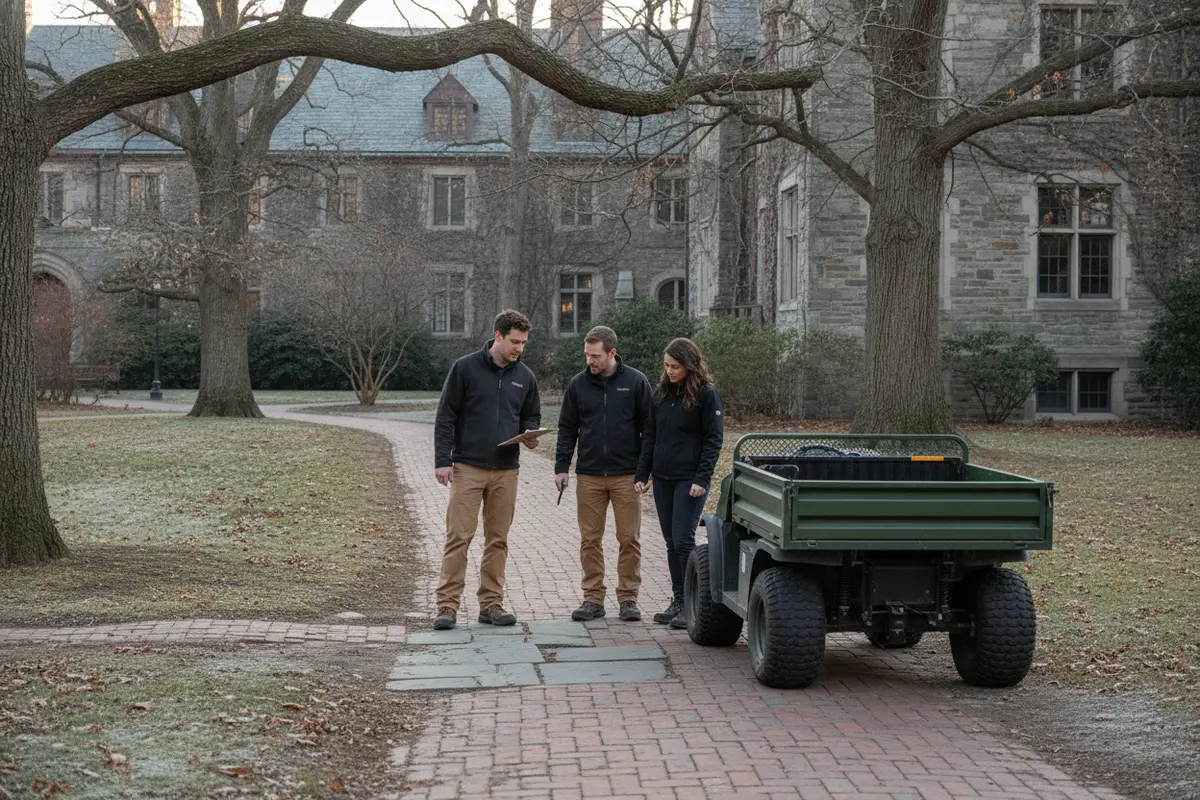
A vehicle's usefulness depends on where it can operate, not just on its general category. Walk the intended route with the people who know the site. Check gate widths, turning space, surface condition, grades, pedestrian traffic, loading areas, and access to storage. A vehicle that fits one part of a property may not be appropriate for every route.
Clarify whether operation stays on private property or involves travel on public roads. Do not assume that a utility vehicle or golf cart is street legal. Low-speed vehicle approval, equipment requirements, speed limits, and permitted roads can depend on the vehicle and on state and local rules. A municipality should verify applicable requirements with the relevant authorities and confirm the vehicle's status before any public-road use. c2 Vehicles also cautions that street-use rules vary by state and municipality; a model's classification should be confirmed rather than inferred.
For public areas, include pedestrian interaction in the plan. Define where the vehicle may go, how operators should yield, where it may be parked, and how loads are secured. Set expectations for keys, access, and authorized drivers. Municipal safety, insurance, and risk-management staff should review the proposed use under local policy. This article is planning guidance, not legal or safety advice.
If the task involves carrying tools or supplies, make the cargo requirement explicit. A vehicle intended for personnel movement may not suit a work crew's materials. The right question is not simply “Can it carry something?” but whether the proposed vehicle and configuration are rated and equipped for the actual people, cargo, terrain, and route. Ask for confirmation from the rental provider.
Compare the options against the expected pattern of use and the municipality's ability to support the vehicle. A one-time rental, a recurring seasonal arrangement, and ownership solve different problems. A simple comparison helps the team surface what it still needs to confirm.
| Option | May fit when | Questions to resolve |
|---|---|---|
| Short-term rental | A project, peak period, or defined event creates temporary demand. | What dates, work areas, users, and vehicle configuration are needed? What do delivery, return, and service arrangements include? |
| Recurring or seasonal rental | The same type of need returns, but year-round ownership may not be justified. | Can the schedule be planned in advance? Are the rental terms, availability, and support consistent with the recurring operating plan? |
| Purchase | Use is frequent and ongoing, and the municipality can plan for storage, maintenance, and lifecycle costs. | What are the acquisition, upkeep, charging or fuel, storage, replacement, and resale considerations? |
| Use an existing vehicle | Another department or site may have capacity that aligns with the need. | Can departments coordinate access, scheduling, operator authorization, and responsibility for upkeep? |
For a more complete comparison, estimate the total period of need rather than looking at a single rental day or purchase amount. Include the expected frequency of use, time spent idle, staffing, storage, maintenance, energy or fuel, and administrative effort. Ask purchasing and finance staff which costs and approvals must be included in the municipality's review.
Where the answer is not clear, a limited rental can provide practical information about routes, utilization, storage, and staff needs. Record what worked and what did not. That evidence can inform a later decision about whether to repeat the rental, change the vehicle type, coordinate across departments, or prepare a purchase proposal.
For an electric utility vehicle, charging and storage belong in the plan before the rental begins. First identify the location where the vehicle will be parked when not in use. Confirm that the location is secure, accessible to authorized staff, and suitable for the vehicle. Then ask the provider to explain the charging equipment and electrical requirements for the specific unit.
Do not assume that every electric model uses the same charger, charging time, or electrical setup. Confirm details for the actual vehicle and site. If charging infrastructure is not ready, discuss that constraint early and ask whether another configuration or schedule is practical. A rental provider can clarify vehicle-specific requirements, while the municipality should involve its facilities or electrical staff in evaluating the site.
Storage matters for gas and electric vehicles alike. Confirm where the vehicle will be kept overnight, whether it can be secured, and how staff will manage keys and access. The department should also decide how it will inspect the vehicle at handoff and report damage or a maintenance concern.
Before the rental starts, assign a municipal point of contact and make sure operators know the agreed use. Record who receives the vehicle, who can drive it, and whom to contact with questions. At handoff, review the vehicle's controls, operating instructions, included equipment, condition, and any limits on use with the provider.
During use, keep the vehicle within the agreed operating area and follow the provider's instructions and municipal policies. A basic log can note the date, department, operator, location, and any issue reported. This is especially useful when several departments share a vehicle or when a rental is repeated in different seasons. If the intended use changes, pause and confirm that the change fits the vehicle and rental arrangement.
Agree on return expectations in advance. Confirm the return date and place, the condition in which the vehicle should be returned, and how the municipality should report a concern. If the rental includes delivery or collection, ask what the provider needs from the site and who will coordinate access. The operational details should be settled with the provider rather than assumed.
c2 Vehicles serves consumers and commercial customers across New England and offers vehicle rentals as part of its business. A municipal team can begin by describing the job, site, timing, and operating constraints, then ask what options may fit. The company has seven locations across the six New England states, but the municipality should confirm availability and arrangements for its specific location and dates.
For organizations weighing rental against a permanent fleet solution, c2 Vehicles also provides commercial utility and fleet information. Use the rental information page to explore rental options, and the location finder to identify a nearby contact point. A conversation should establish the intended application; it should not be treated as confirmation of inventory, road eligibility, or a particular vehicle's capabilities.
Municipal staff preparing the request may also want to review c2 Vehicles' company and service overview, browse utility vehicle options and the utility 4x2 category, and compare current inventory. Inventory and availability can change, so verify details directly before relying on a specific vehicle being available for a future rental.
When a department needs an operational vehicle rather than a purchase, be specific about the intended work, route, users, and duration. That gives the rental conversation a clear starting point and helps identify which requirements still need to be checked.
Talk with c2 Vehicles about your municipal needs
A short-term rental may be worth exploring when the need is limited to a defined project or peak period. Describe the work, dates, route, users, and site conditions, then confirm vehicle suitability and rental terms with the provider.
Not automatically. Road use depends on the vehicle's classification and applicable state and local rules. Confirm the specific vehicle's approval and permitted use with the appropriate authorities before planning any public-road travel.
Confirm the charging and electrical requirements for the specific vehicle, identify a suitable charging and storage location, and assign staff responsibility for access and charging. Ask the rental provider and municipal facilities staff to review the plan.
No. Compare the full expected period of use, not just a single rental fee or purchase amount. Consider frequency, idle time, storage, maintenance, energy or fuel, staffing, and administrative effort; then apply the municipality's purchasing and finance process.
Start a conversation about a utility vehicle rental
A well-defined job and site plan make it easier to assess whether a rental fits, what needs confirmation, and what the municipality should do next.