
contact us

Choosing among low speed vehicle dealers with service centers means evaluating more than the vehicle on the lot. The right dealer can help you understand service access, parts, warranty steps, delivery, and whether a particular model fits your intended use. Compare the support behind the sale before you decide.
Explore available demo vehicles
A low-speed vehicle (LSV) combines vehicle-specific equipment with electrical or gas systems that require the right parts and diagnostic approach. A dealer with service capability can be a useful point of contact after purchase, but the phrase “service center” alone does not tell you what work a location handles. Ask about its technicians, supported makes and models, inspection process, warranty coordination, and whether service is available at your location.
c2 Vehicles is the largest distributor of golf carts and other small-wheeled electric and gas vehicles in New England, with seven locations across the six New England states. Its service offering includes factory-trained technicians, OEM parts, and mobile service where applicable. Learn about service and parts support and check locations near you when comparing practical access.
Service readiness starts with familiarity with the vehicle you plan to own. Ask whether technicians work on the make and model under consideration, what routine inspections cover, and how they diagnose electrical faults. For an electric model, ask how the shop evaluates the battery system, charging components, wiring, and controls. For a gas vehicle, ask about engine and drivetrain service. Do not assume every location supports every model or repair; confirm the work scope before purchase.
Ask for clear answers rather than relying on a general promise of “full service.” A dealer should be able to explain which maintenance tasks it handles in-house and when a repair requires another resource. Request a sample inspection checklist or ask the service advisor to walk you through a typical visit. You do not need to know every technical term; you do need to understand what is inspected, what findings are recorded, and how the shop will explain recommended work.
Parts access and warranty handling can shape the ownership experience. Ask whether OEM parts are available for your model, whether the dealer helps submit warranty claims, and what records you should keep. Warranty terms vary by vehicle and component, so review the written coverage rather than assuming a dealer’s service department changes the manufacturer’s terms.
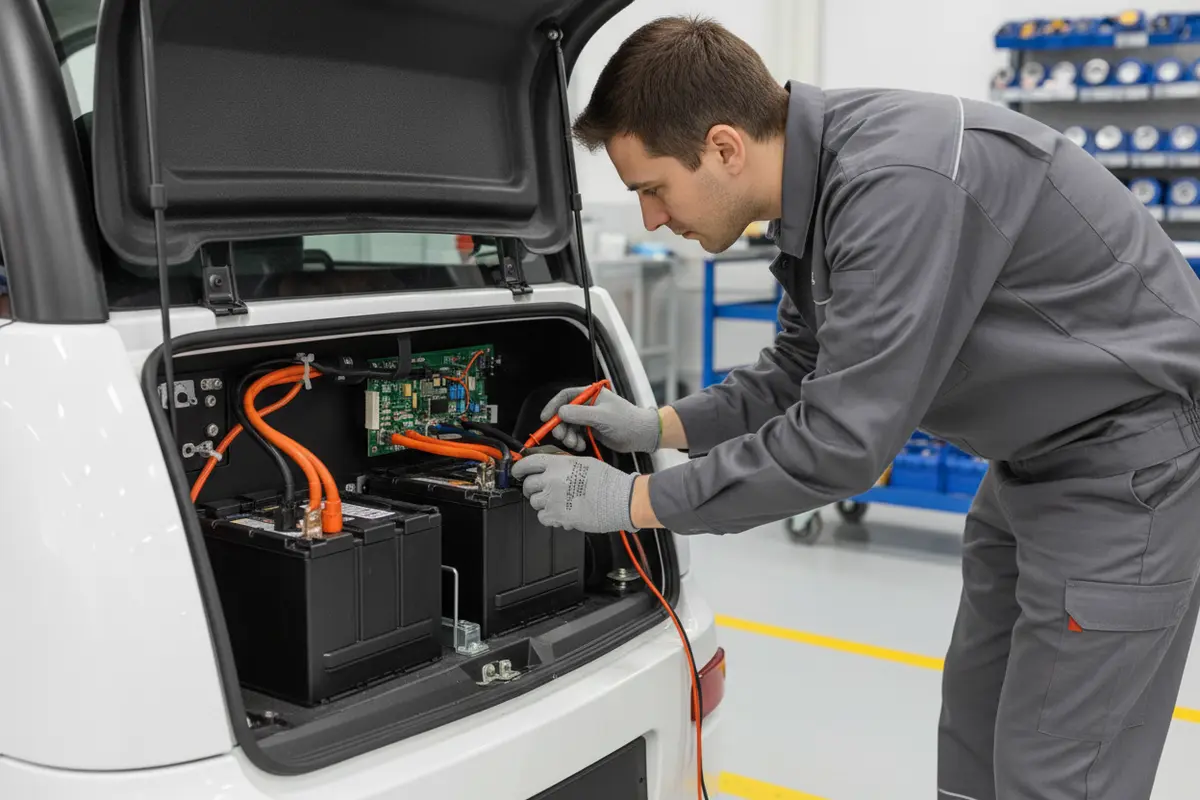
Mobile service may be useful for a property, campus, business, or home where transporting a vehicle is difficult. Availability and the types of work performed can vary, so ask about service area, travel arrangements, and which repairs can be completed on site. c2 Vehicles offers mobile service as part of its regional support; confirm whether it applies to your vehicle and location. For commercial operations, review commercial fleet solutions and ask how consultation, maintenance planning, and regional delivery might fit your operation.
Before signing, ask what happens if a needed part is not immediately available. Find out whether the shop can identify the part, provide an expected next step, and tell you whether the vehicle can safely remain in use while you wait. Do not assume an estimate includes every item: ask whether diagnosis, parts, labor, transport, and any follow-up inspection are treated separately. A written explanation makes it easier to compare support between dealers without relying on broad promises.
| Dealer support area | Questions to ask | Why it matters |
|---|---|---|
| Technicians and diagnostics | Which makes and models do you service? What diagnostics and inspections are available? | Confirms the shop can support the vehicle you are considering. |
| Parts and warranty | Can you source OEM parts? How do you handle warranty documentation and claims? | Clarifies the process for repairs and covered work. |
| Mobile service | Do you travel to my area, and which repairs can be done on site? | Helps assess convenience for properties and fleets. |
| Fleet maintenance | Can you discuss service intervals, downtime, and multiple vehicles? | Helps businesses plan for ongoing use, not just initial purchase. |
| Delivery and road use | What delivery arrangements are available, and what rules apply to my intended routes? | Connects the purchase to practical use and local requirements. |
Do not treat “low-speed vehicle” as a guarantee that every vehicle is street legal in every place. Applicable rules vary by state and municipality, and vehicle eligibility depends on its classification and equipment. Ask the dealer to identify the specific model’s documented status and equipment, then confirm local requirements with the relevant state or municipal authority before driving on public roads.
Federal requirements for low-speed vehicles are set out in the National Highway Traffic Safety Administration’s regulation, 49 CFR § 571.500. It describes federal equipment requirements for vehicles in that category; it does not replace the need to check state and local rules about where and how a vehicle may be operated. Use the regulation as a reference when discussing classification and required equipment, and ask the dealer for documentation for the exact model rather than applying a general label to every cart.
Discuss the route and purpose: private roads, a campus, a neighborhood, or public streets may involve different requirements. Ask specifically about applicable DOT equipment and documentation, rather than relying on appearance or a broad category name. c2 Vehicles offers personal transportation options; browse the personal vehicle information and ask a team member to clarify what is known about a particular model. For golf-focused models, the Club Car vehicle range is another place to start comparing use cases.
Fleet buyers should consider the service plan alongside acquisition. A vehicle that suits a single operator may not meet a campus, resort, municipality, property manager, or industrial site’s needs when several units must remain available. Map daily routes, passenger or cargo needs, charging or fueling access, storage, and the consequences of downtime. Then discuss a maintenance approach and delivery logistics with the dealer.
For example, a resort with vehicles moving between buildings may prioritize on-site troubleshooting and a clear way to report faults. A golf course may focus on routine inspections and parts for the models it uses most. A municipality might need to confirm permitted routes and document who is responsible for maintenance. These are different operating patterns, so a useful dealer conversation starts with the actual work rather than a generic request for “fleet service.”
c2 Vehicles serves consumer, commercial, and rental needs and has service centers across its New England footprint. Its commercial team can discuss fleet requirements; availability and support details should be confirmed for the particular project. Ask whether your sites fall within the relevant service area and how service requests are routed for more than one vehicle.
Delivery is part of the ownership plan, not just the final step in a sale. Confirm where the vehicle will be delivered, what preparation is included, and whether the dealer explains controls, charging or fueling, and maintenance basics at handoff. If you have a narrow driveway, a gated property, or a business site with receiving hours, describe those constraints before scheduling. Clarify who to contact if delivery timing changes or the vehicle needs attention shortly after arrival.
Service access deserves the same practical check. Compare the distance to a service location with any mobile option that applies to your address. Ask how to arrange transportation if a repair cannot be completed on site. If you divide time between a primary home and a seasonal property, explain that pattern and ask which location can support the vehicle. A nearby showroom is useful, but the important question is whether the service process fits where and how you will use the vehicle.
For a buyer who expects mostly private-property use, storage and routine maintenance may be the main priorities. Someone who plans to use a qualifying LSV on permitted public roads also needs to verify model equipment, documentation, and local operating rules. A commercial buyer can add site-by-site route review, operator orientation, and a written maintenance contact process. Working through these scenarios before choosing makes it easier to identify gaps while alternatives are still open.
Use a short list of concrete questions and compare the answers side by side. Include the exact model, where you expect to drive it, and your service location. A showroom visit is useful for checking fit and asking follow-up questions, but verify service details in writing when they affect your decision.
Use the current vehicle inventory as a starting point, then contact the dealer to confirm availability and details. For another dealer-selection step, review the service information and ask about the support that applies to your chosen vehicle. You can also compare options in the utility vehicle collection if your needs include work or cargo tasks.
To make comparisons fair, record each dealer’s answer in the same format: supported model, location or mobile coverage, diagnostic capability, parts and warranty process, delivery details, and any items still needing confirmation. Mark unclear answers as open questions rather than treating them as commitments. This simple scorecard helps distinguish a firm, model-specific response from a general statement about service.
Ask the sales team about your vehicle and service needs
No. Service coverage can vary by make, model, location, and repair type. Ask the dealer to confirm support for the exact vehicle you are considering.
No. A vehicle’s classification and equipment matter, and road-use rules vary by state and municipality. Confirm the model’s documentation and check the rules for the places where you plan to drive.
Ask what battery and charging-system checks the service team performs, which parts it can source, and what warning signs should prompt an inspection. Follow the vehicle maker’s maintenance guidance.
Some dealers can discuss fleet maintenance, mobile support, parts, and delivery. Explain your vehicle count, sites, and operating schedule, then confirm the specific services available.
When you compare low-speed vehicle dealers with service centers, match the dealer’s confirmed service capabilities to your vehicle, route, and ownership plans before making a decision.