
contact us

Lift kit installation in Massachusetts is more than adding height to a golf cart. The lift has to match the vehicle, suspension, wheels, tires, intended terrain, and the way you plan to use the cart. A correct installation can improve clearance for uneven paths. A poor match can affect steering, braking, alignment, ride quality, and component wear.
Start with the job the vehicle needs to do. A cart used on a maintained private property may need a different setup from one used around a campground, coastal property, farm, commercial site, or rough trail. Tell the technician where you expect to drive, how often the vehicle will carry passengers or cargo, and whether you want more clearance, a different appearance, or both.
Document the vehicle before requesting work. Record the make, model, model year if known, powertrain, current tire size, and previous modifications. A vehicle with nonstandard wheels, spacers, a changed steering system, or an earlier lift may require a careful compatibility review. Review current C2 Vehicles inventory if you are comparing vehicles before purchasing accessories.
A useful consultation starts with the cart as it sits today, not a generic kit description. Bring clear photographs of the front suspension, rear axle area, wheels, and any existing modifications if you cannot bring the vehicle in right away. Include the tire label or measured tire dimensions rather than relying on a seller's shorthand. Two vehicles from the same broad model family may have different years, trim levels, or components, and those details can affect fitment.
It also helps to separate essential needs from preferences. If the main problem is occasional contact with a rut or driveway edge, the answer may not require the tallest available lift. If appearance is the main objective, discuss the effect on ride and handling before choosing parts. For a work cart carrying tools or equipment, consider how added height and wheel changes affect entry, loading, and stability under the normal payload.
Golf cart lift kits are not interchangeable. The right kit depends on the chassis and suspension design. Some kits change suspension positions, while others use spacers or replacement parts. The method affects ride behavior, clearance, steering geometry, and tire space.
| Lift approach | What it changes | What to verify |
|---|---|---|
| Spindle lift | Raises the front through replacement spindle components | Compatibility, steering parts, brake routing, and alignment |
| A-arm lift | Uses revised front suspension arms and hardware | Chassis fit, travel, geometry, and fasteners |
| Drop axle lift | Changes axle position to raise the chassis | Axle, frame, brake, and wheel clearance |
| Block or spacer lift | Uses spacers or blocks to increase height | Load, travel, fastener fit, and manufacturer limits |
The table is a starting point, not a parts recommendation. The kit must be made for the exact vehicle platform. Ask whether it includes the required hardware and whether additional steering, brake, shock, or suspension work is needed. Compatibility also includes wheels, tires, fenders, steering components, and battery placement. Electric and gas vehicles can have different weight distribution and clearance considerations.
Before approving a kit, ask the installer to identify the exact platform and the compatibility information used. Confirm whether the kit changes front, rear, or both ends, and whether any original parts will be reused. Find out if the proposed wheel and tire combination is approved for the lift and whether it requires a particular offset. A package described as fitting a vehicle family may still exclude a particular year or configuration.
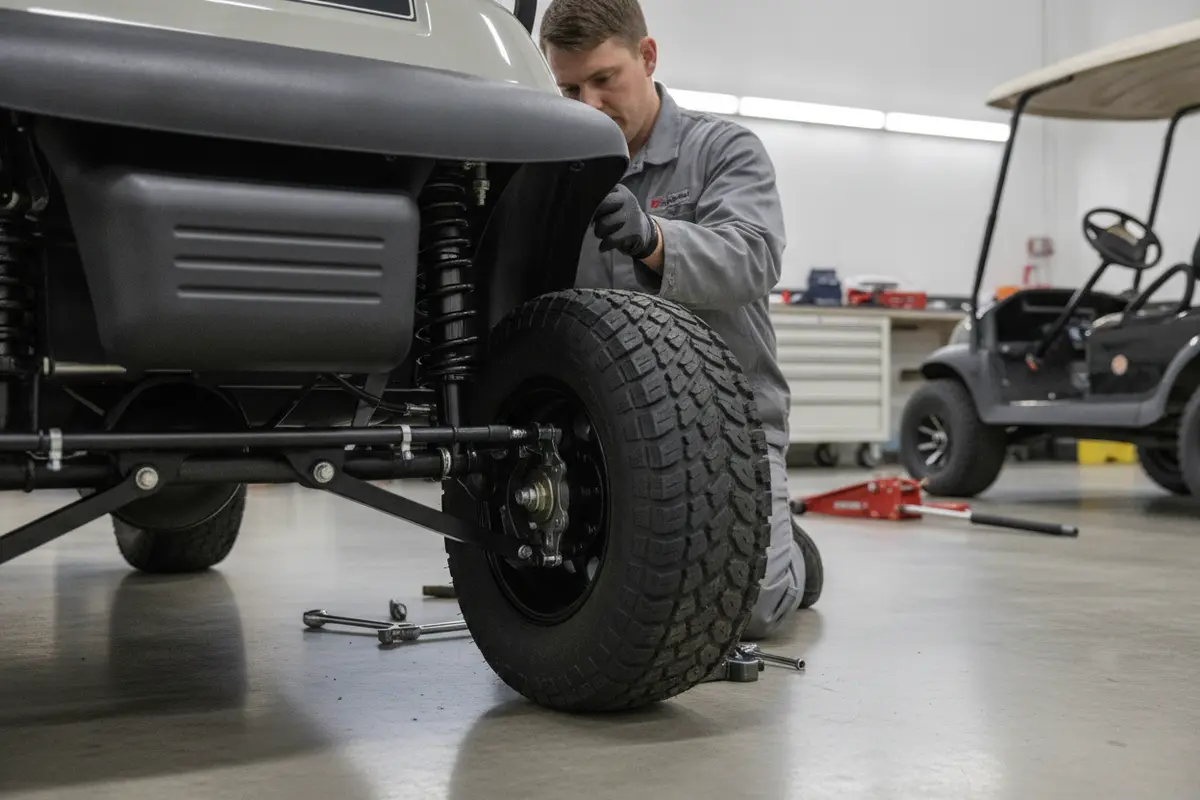
Ask what work is included beyond attaching the kit. Depending on the parts and vehicle, the installation plan may need to account for steering linkage, brake hoses or cables, shocks, bushings, fasteners, and alignment. A shop should flag worn or damaged parts rather than treating the lift as a way to compensate for them. If the cart has an existing modification of uncertain origin, a full inspection is especially important.
For a factory-supported Club Car comparison, visit the Club Car golf cart and fleet solutions page. For a pre-owned vehicle, compare the certified pre-owned inventory, but inspect the actual vehicle before modification. You can also review lift kit options and wheels and tires as part of a fitment conversation; online descriptions should not replace vehicle-specific confirmation.
Lift height is only one part of usable clearance. Ground clearance depends on the lowest components, tire diameter, suspension movement, load, and terrain angle. A taller lift does not automatically make every obstacle safe.
Larger tires can add clearance beneath the axles and frame, but they can change steering effort, braking feel, turning clearance, and drivetrain load. Confirm actual diameter and width. Check clearance at full steering lock and through suspension compression. The tire should not contact the body, fender, suspension, brake components, or wiring.
Think about the obstacle, not just the advertised lift measurement. A raised body may leave an axle or other low component as the limiting point. A tire's actual shape, tread, and sidewall can also affect the way it approaches a rock, rut, or uneven threshold. Approach angles matter, but so do wheelbase, load distribution, and the driver's ability to see the terrain. More height does not eliminate the need to choose a safe route.
Suspension travel is another practical limit. A setup that appears clear while parked can move differently when a wheel rises over a bump or when the cart turns under load. Ask whether the installer checks the tires through steering lock and suspension movement, not only with the cart stationary. Inspect for pinched wiring, stretched brake lines, or parts that may rub as suspension components move.
For a vehicle that needs utility rather than extra height, compare utility vehicles before modifying a golf cart. A vehicle designed for the task may be better than several upgrades to an unsuitable platform. A work vehicle's bed, payload needs, and route may be more important than a higher stance.
Changing ride height can change steering geometry. After installation, inspect steering response, wheel position, alignment, brake operation, and tire clearance. An alignment check can identify changes that cause wandering or uneven wear. If the cart pulls, shudders, makes new noises, or feels loose, stop using it and request an inspection.
Ask what was replaced, what tire pressure is appropriate, whether fasteners need a follow-up check, and what symptoms require a return visit. C2 Vehicles provides golf cart repair and service support.
At pickup, request a clear walk-through of the work performed and any limitations of the new setup. Make sure you understand the recommended tire pressure for the selected tire and the vehicle's use, rather than applying a number from another cart. Ask which parts were changed, whether the alignment was checked, and whether the installer recommends rechecking hardware after an initial period of use. Keep receipts and product information with the vehicle records so a future technician can see what was installed.
Pay attention during the first few drives. Use a familiar, open area and start at low speed. Note whether the steering returns normally, whether the cart tracks predictably, and whether there is any contact or unusual vibration. Tire wear that appears uneven, a new pull, or a change in brake feel deserves prompt assessment; do not wait for a routine service interval if the vehicle feels unsafe.
Test controls and brakes at low speed in an open area. Listen for rubbing, clicking, grinding, or clunks while turning and crossing a small surface change. Recheck clearance after loading the vehicle. A higher center of gravity can affect cornering and stability, especially on slopes. Keep speed appropriate, turn gradually, and follow lift and tire instructions.
When checking, make sure the cart is on stable ground and follow the manufacturer's instructions. Do not crawl beneath a vehicle supported only by a jack. If a wheel, brake, steering, or suspension component seems loose or damaged, have the cart assessed before driving. A quick visual glance is not a substitute for a competent installation and inspection.
Commercial operators should build the changed configuration into their inspection routine. A fleet cart may see repeated loading, varied drivers, and routes with different surfaces. Record the installed components and set a process for drivers to report new noises, rubbing, steering changes, or tire damage. A supervisor can use those reports to take a vehicle out of service for assessment instead of allowing a minor symptom to go unnoticed.
For commercial operators, property managers, event teams, and fleet owners, document inspections and establish checks for tire wear, fasteners, steering, brakes, and suspension. C2 Vehicles supports commercial buyers through commercial utility and fleet solutions. A fleet discussion should include how frequently carts are used, the kind of loads they carry, and who is responsible for reporting a change in handling.
No. A lift kit alone does not make a golf cart street legal or change its classification. Public-road use depends on the vehicle, equipment, approval, classification, and local rules. The Massachusetts Board of Elevator Regulations regulates elevators and related devices, not lifted golf-cart road access. Massachusetts accessibility rules about lifts are a different subject, as shown by 521 CMR § 28.12.
Do not treat a general rule for one vehicle category as permission for another. Before any public-road trip, verify the specific vehicle's classification and requirements with the appropriate authority, and check applicable local restrictions. State rules and municipal rules can differ, and equipment requirements are not replaced by an accessory installation. If road use is a goal, settle the vehicle's qualification and legal-use question before choosing a lift or tire package.
If public-road operation is the goal, identify a qualifying low-speed vehicle or other approved vehicle type before choosing a lift. Do not assume larger tires, lights, mirrors, belts, or a lift satisfy every requirement. Browse street-legal golf carts and utility vehicles, then verify current requirements with the appropriate authority. A listed street-legal model still needs to be operated in places and conditions where its classification permits it.
Professional installation is valuable when the cart has prior modifications, nonstandard tires, worn suspension, uncertain history, or a commercial duty cycle. Before booking, provide vehicle information, terrain, tire plans, expected load, and road-use goals. Ask for compatibility review, lift and wheel details, alignment, brake and steering inspection, testing, and follow-up needs.
A professional discussion is also useful when the desired change affects several systems at once. A kit, tire change, wheel offset, and added accessories can interact. Treating each part as an isolated purchase can lead to interference or a setup that behaves differently than expected. Have the whole planned configuration reviewed together, including any future changes you already expect to make.
For a service appointment, be ready to answer practical questions: What is the exact vehicle model and year? Has it been lifted before? What tire and wheel combination is installed or planned? What surfaces will it cross? Will it carry passengers, equipment, or cargo? Is it intended for private-property use or a qualifying road use? Clear answers help the service team determine what to inspect and what information is still needed.
Choose a service provider who can explain the fitment logic in plain language, identify any worn parts, and describe how the completed work will be checked. Ask what the estimate covers and which additional repairs would require approval. If a proposed combination has unresolved compatibility questions, pause before buying parts. A careful review is more useful than guessing and finding a clearance or handling problem after installation.
Not every cart needs a lift. If the intended route is mostly smooth pavement or maintained paths, a lift may add height without solving a real problem. If the underlying concern is a worn tire, sagging suspension, or a damaged component, repair that issue first. The right recommendation should follow the cart's condition and task, not the assumption that a taller stance is always better.
There is no universal height. The appropriate lift depends on the vehicle, tire size, terrain, suspension, load, and intended use.
It depends on the kit and vehicle. Check width, diameter, offset, steering clearance, suspension travel, and load suitability.
Not necessarily. Ride height, tires, geometry, steering response, and center of gravity can change.
A lift does not grant road access. Verify classification, equipment, approval, and local rules before public-road use.
The right lift installation begins with a vehicle-specific inspection and ends with a tested setup that matches your terrain, load, and legal use.