
contact us

A golf cart charger converts household or facility power into the controlled electrical current a cart’s battery pack needs. The right charger must match the battery chemistry, pack voltage, and charging connection; a plug that fits is not proof that the charger is compatible. Before buying or troubleshooting, check the cart and battery documentation. These basics apply whether you own a personal cart or oversee vehicles for a business or venue.
Explore vehicles and discuss your needs
A charger takes alternating current (AC) from a wall outlet or other suitable power source and supplies direct current (DC) to the battery pack. Its charging controls manage the process rather than simply sending power continuously. Depending on the charger design, it may monitor voltage, current, temperature, or other conditions, then reduce or stop charging as the pack approaches its specified full state.
Many modern chargers have a bulk phase, when they deliver higher current to replenish the pack, followed by a finishing or absorption phase that brings the batteries to full charge more gradually. Some systems then stop automatically or enter a maintenance mode. The details vary by charger and battery. Follow the exact instructions for your equipment; do not assume that every charger uses the same stages or that leaving it connected indefinitely is appropriate.
For a compatible onboard charger, the cart may connect to an outlet through the vehicle’s charging cord. An offboard charger is a separate unit that connects to the pack or its designated charge port. In either arrangement, the charger and battery-management system (where fitted) need to work together. The charger’s output must suit the battery pack, not merely the electrical outlet.
Start with the cart’s make, model, year, battery type, and pack voltage. Use the owner’s manual, labels on the existing charger and batteries, or guidance from a qualified service professional. If components have been replaced or modified, confirm what is actually installed now rather than relying only on the original model year.
| What to verify | Why it matters | Where to check |
|---|---|---|
| Battery chemistry | Charging limits and control requirements differ by battery type. | Battery label and manufacturer documentation |
| Pack voltage | The charger output must be designed for the complete pack voltage. | Vehicle manual, battery configuration, charger label |
| Current and charging profile | Output and charge behavior must stay within battery specifications. | Battery and charger manuals |
| Connector and polarity | A connector that appears to fit may still be wired or configured incorrectly. | Vehicle and charger documentation; qualified inspection |
| Charger type and controls | Onboard, offboard, and battery-management arrangements differ. | Vehicle specifications and charger instructions |
Do not select a replacement based on voltage alone. A charger can have the nominal voltage you expect and still have the wrong chemistry profile, current rating, connector, or control method. Confirm compatibility with the battery maker’s requirements and the cart manufacturer’s guidance. C2 Vehicles offers service and parts support for owners who need help identifying an issue or arranging an inspection.
Good charging habits also mean planning around how the cart is used. A privately owned vehicle used occasionally may need a different routine from a cart in a resort, campus, rental, or commercial fleet. For fleet planning, record which vehicle and charger are paired, keep manuals accessible, and make a simple process for reporting charging faults. That helps staff spot recurring issues without guessing at electrical repairs.
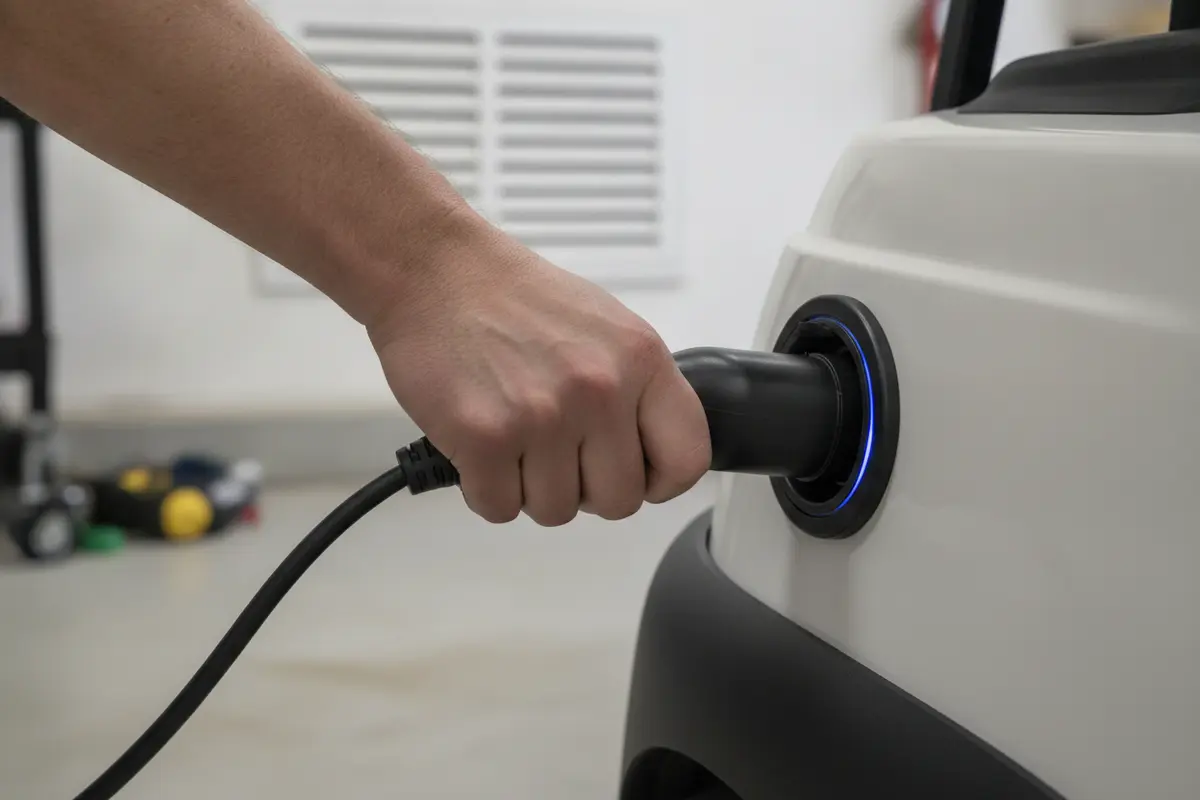
Use only the charger specified for the battery system and follow its instructions. Keep the equipment away from standing water and do not charge where cords can be crushed, driven over, or exposed to heat. Never open a charger or battery pack unless you are trained and authorized to do so. Batteries can store significant energy, and incorrect work can cause shock, burns, fire, or equipment damage.
The U.S. Consumer Product Safety Commission provides general safety information on carbon monoxide, a hazard associated with fuel-burning equipment. Keep gasoline-powered equipment and combustion sources out of enclosed charging spaces; an electric cart charger itself does not produce carbon monoxide, but nearby engines or generators can.
A charger that appears inactive does not automatically mean the charger has failed. The outlet, cable, connector, cart interlock, battery state, or battery-management system can affect whether charging begins. Start with checks permitted by the owner’s manual and stop if there is damage, heat, a warning, or an unfamiliar electrical condition.
For a useful service conversation, write down the cart model, battery chemistry and voltage if known, charger model, any fault code, when the problem began, and what changed recently. A clear description helps a technician decide what checks are appropriate. Avoid repeated resets or trial-and-error charging with a different charger.
Lead-acid and lithium-ion battery systems have different maintenance and charging requirements. The charger must use a profile approved for the specific battery. A charger intended for one chemistry should not be treated as a universal replacement for the other.
Lead-acid batteries may require routine attention described in their manual, including specific inspection or watering procedures for serviceable types. Sealed types have different instructions. Lithium systems typically include electronic management, but that does not remove the need for an approved charger, appropriate storage, or attention to warning indicators. Never infer battery chemistry from the cart’s appearance.
When comparing vehicles, include the charger and battery documentation in the discussion. C2 Vehicles carries lithium vehicle options as well as different new and pre-owned configurations; confirm current specifications and availability for the particular vehicle. You can also review available vehicle inventory and ask about the system fitted to a listing.
Fleet charging is a facilities and workflow question as well as an equipment choice. Before adding carts, identify where vehicles will park, which outlets and circuits are available, who is responsible for daily connection, and how a fault will be reported. Have a qualified electrical professional assess site power when needed; do not assume that several chargers can safely share an existing circuit.
Hotels, campuses, municipalities, rental operators, and other organizations may have different duty cycles and support needs. C2 Vehicles can discuss commercial vehicles and fleet solutions, while event planners can explore golf cart rental options. For a personal vehicle, a visit to one of the company’s New England locations can help make a model-specific conversation easier.
Bring the key details together before purchasing replacement equipment or a cart. Ask whether the supplied charger is intended for the exact battery pack, what outlet and circuit it requires, how the normal cycle is indicated, and what the manual says about storage and maintenance. For a used vehicle, request the charger’s make and model and confirm that it belongs with the installed batteries.
For a new vehicle, ask what charging equipment is included and whether the battery system can be serviced through the support network. C2 Vehicles is the exclusive Club Car distributor in New England and has seven locations across the six New England states. Buyers can compare Club Car vehicles and pre-owned options, then discuss specifications and next steps with the team.
Talk with C2 Vehicles about your vehicle needs
A careful identification process prevents the common mistake of ordering by connector shape or a remembered voltage. Gather the vehicle identification details first: make, model, model year, and any record of battery or electrical-system changes. Photograph the charger label and the battery labels if they can be viewed safely without removing covers. Do not dismantle the pack to find information. The labels and manuals should provide a starting point for confirming the exact equipment.
For example, imagine a cart has a charger with a familiar-looking plug but the batteries were replaced by a previous owner. The safest decision is not to try the old charger to see what happens. First confirm the chemistry and specifications of the installed pack, then verify the charger against those requirements. If battery labels conflict with the vehicle manual, treat the discrepancy as a reason to pause and request an inspection.
Storage plans should come from the battery and vehicle instructions, not from a universal rule about keeping a cart plugged in or disconnecting it. Find out whether the charger has a storage or maintenance mode, whether the manufacturer recommends periodic checks, and what temperature or location conditions are permitted. Battery types and charger designs differ, so a routine that works for one cart may not be right for another.
Before a seasonal period of infrequent use, note the battery state and any instructions for preparing the cart. Make sure the parking area is dry, secure, and suitable for the equipment. Keep the charger cable protected from pests, moisture, pressure, and accidental contact. If the cart will sit for an extended period, ask the manufacturer or service professional how often the system should be checked and whether the charger should remain connected. Do not improvise a maintenance schedule based on a neighbor’s different vehicle.
When returning the cart to regular use, inspect the cord, plug, charge port, and visible battery area for changes. Follow the normal charging procedure and watch for unusual indicators or sounds. If the charger reports a fault or the pack behaves differently than before storage, stop and record what you observe. A note of the storage conditions, elapsed time, and charger indicators can help service staff assess the issue.
For a property with several carts, consistency depends on making the correct procedure easy to follow. Create a short written routine based on the manuals for the actual fleet, not generic instructions copied from another model. Include where each vehicle is parked, which charger belongs to it, who checks the equipment, and how staff report faults. A clear process matters when carts are used across shifts or by temporary event teams.
Consider a venue preparing for a busy weekend. A log shows that one cart repeatedly ends a shift with a charging warning, while the other vehicles charge normally. Staff can record the code and switch that cart out of routine assignments according to their procedures, rather than repeatedly resetting it or swapping chargers at random. A technician then has useful context: the vehicle, charger pairing, frequency, timing, and warning pattern. This approach does not diagnose the fault, but it supports a more focused service assessment.
No. The charger must match the battery chemistry, pack voltage, charging profile, connector, and control system. Verify the exact equipment specifications before connecting it.
Follow the charger and battery instructions. Some systems stop or manage charging automatically, while others have specific connection and storage guidance. Do not assume every charger is designed for indefinite connection.
There is no universal charging time. It depends on the battery system, how depleted it is, charger output, and equipment condition. Use the manufacturer’s estimate for your particular cart and charger.
Do not do so unless the battery manufacturer explicitly approves that charger and its charging profile. Use equipment specified for the installed battery system.
Stop if a cable or connector is damaged, equipment becomes unusually hot, a warning repeats, or you notice smoke, odor, swelling, or leakage. For persistent charging problems, share the cart and charger details with a qualified service professional.
A compatible charger, an appropriate charging area, and the instructions for your particular battery system are the foundation of dependable charging. When equipment details are unclear or a fault persists, get model-specific guidance rather than experimenting with a substitute charger.