
contact us

A broken irrigation line, a guest request, and a delivery at the service entrance can all demand attention within the same ten minutes. On a large property, the distance between those jobs is often the biggest obstacle. A utility golf cart helps maintenance, landscaping, and security teams move people, tools, and materials. Teams can avoid bringing a full-size truck into every courtyard or pathway.
Request help building the right commercial utility golf cart fleet.
The right cart is not simply a passenger golf cart with a box added to the back. It should match the work your team performs, the payload it carries, the terrain it travels, and the hours it must remain available. This guide explains how property managers can choose, equip, and maintain utility carts for dependable daily service.
In short: A utility golf cart helps property teams move people, tools, and materials between work areas quickly. Its compact footprint fits many service paths. Purpose-built cargo and storage options support maintenance, landscaping, security, deliveries, and resident service.
Property teams rarely perform one job in one place all day. Technicians move between mechanical rooms, common areas, parking lots, residences, and storage buildings. Landscapers transport plants, hand tools, soil, and debris. Security staff cover routes where quiet operation and easy access matter. A utility cart helps each team spend less time walking back for supplies and more time completing work orders.
Its compact footprint can also reduce disruption in guest-sensitive or residential areas. Teams can reach narrow service lanes and paved paths that may be impractical for a pickup truck. This is especially useful at resorts, campuses, condominium communities, senior living properties, event venues, and mixed-use developments.
Two maintenance teams may need very different vehicles. One may carry a technician, a compact tool set, and replacement parts. Another may haul bulky landscaping material throughout the day. Start by documenting actual loads, routes, stops, and duty cycles. That operational picture makes it easier to choose capacity without buying too much or too little vehicle.
c2 Vehicles supports commercial buyers across New England with fleet consultation, custom solutions, regional delivery, and service infrastructure. Property managers can explore commercial vehicle solutions before building a specification.
Property teams use utility carts as mobile workstations for repairs, grounds care, patrols, deliveries, and events. The best configuration depends on the department, normal load, routes, weather exposure, and how often the team needs secure storage or specialized accessories during a shift.
A properly configured cart can serve as a mobile workbench. Lockable storage keeps frequently used tools and parts organized, while a cargo bed carries filters, fixtures, paint, or repair materials. Technicians can complete more jobs per trip because they arrive with the right equipment. A windshield, roof, or enclosure can also help crews stay productive through changing New England weather.
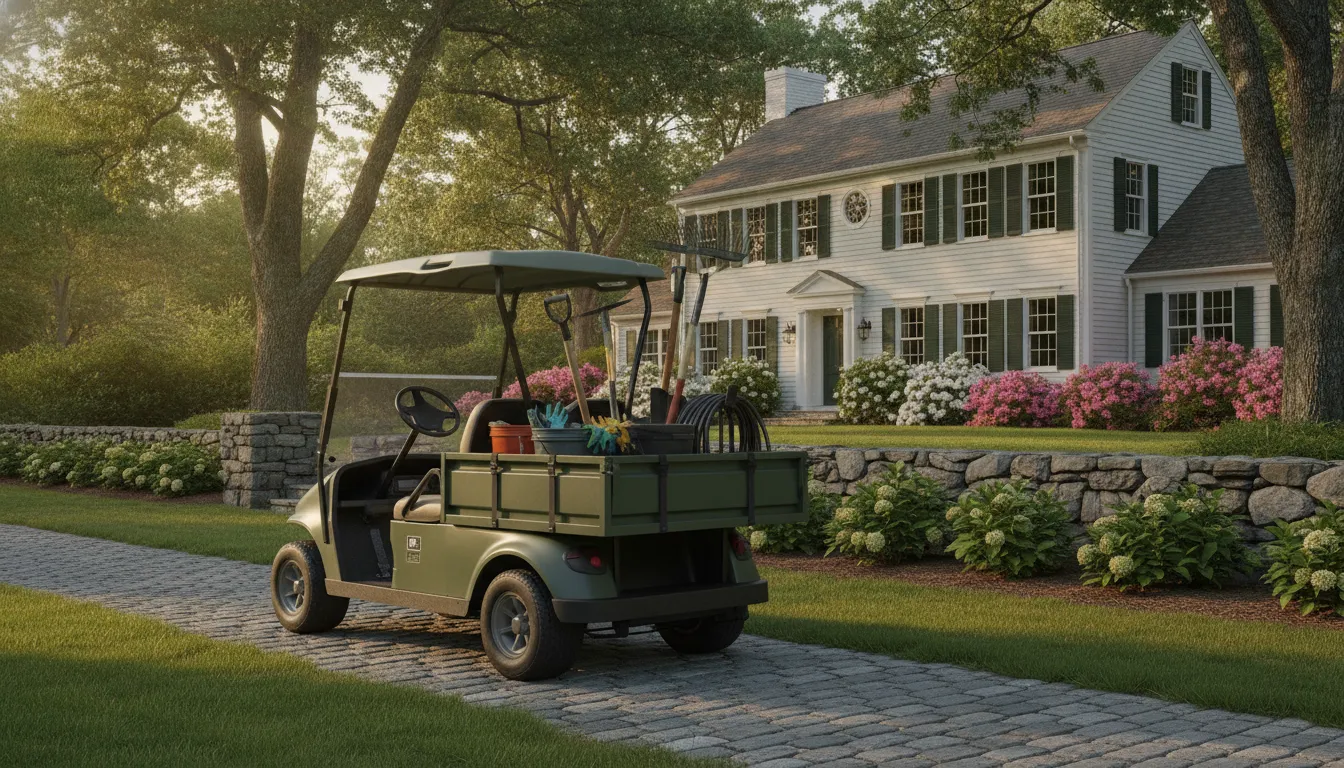
Landscaping crews need room for hand tools, trimmers, plants, soil, and collected debris. A utility cart with an appropriate cargo bed makes short trips between gardens, storage areas, and disposal points more efficient. Bed dividers, tool racks, and tie-down points keep the load controlled. Managers should confirm payload needs before selecting a cart, especially when crews regularly haul dense material.
Security teams benefit from a quiet, highly visible vehicle that can cover parking areas, paths, and common spaces. Lighting, mirrors, weather protection, and secure storage can support patrol work. However, equipment requirements depend on the property and local rules. Managers should establish site-specific driving routes, speed limits, and operating procedures before deployment.
Utility carts can move event supplies, packages, linens, and equipment without occupying a full-size delivery vehicle. They can also support setup and breakdown when a property hosts seasonal programming. For short-term or peak needs, managers can consider golf cart rentals rather than expanding a permanent fleet.
Property managers should compare payload, passenger capacity, terrain, powertrain, weather protection, storage, and service support. A written duty profile turns those factors into a practical specification. It helps avoid a cart that is oversized, overloaded, difficult to store, or unable to complete its normal shift.
The best buying process begins with a written duty profile. Record the heaviest normal load, the number of occupants, daily travel time, steepest route, surface conditions, storage limits, and available charging or fueling infrastructure. Review the profile with the people who will operate and maintain the cart.
| Decision factor | Questions to ask | Why it matters |
|---|---|---|
| Payload and cargo | What tools and materials travel on the busiest day? | Prevents overloading and helps select the right bed configuration. |
| Passenger capacity | Does the cart usually carry one operator or a crew? | Determines seating and usable cargo space. |
| Powertrain | Can the property support charging, or is rapid refueling essential? | Shapes daily operating routines and infrastructure. |
| Terrain | Are routes paved, uneven, wet, steep, or seasonally affected? | Influences tires, clearance, braking, and vehicle selection. |
| Weather protection | Must the team work in rain, wind, or cold conditions? | Guides enclosure, windshield, roof, and heater decisions. |
| Service support | Who handles inspections, maintenance, and urgent repairs? | Protects uptime throughout the ownership cycle. |
A larger vehicle is not automatically more useful. Excess size can make storage, turning, and access more difficult. Conversely, a lightly specified cart may force extra trips or invite overloading. The goal is a safe operating margin for normal work while preserving maneuverability. Review manufacturer specifications and discuss unusual loads with a commercial vehicle specialist.
Managers evaluating available options can view current vehicle inventory, then request help matching models to their property requirements.
The most useful accessories reduce repeat trips, secure tools, improve weather protection, or support safer operation. Property managers should start with a clear workflow, then select compatible storage, racks, enclosures, visibility equipment, and identification features rather than adding upgrades without a defined operational purpose.
Accessories should solve a defined operational problem. A random collection of upgrades adds cost without necessarily improving work. Begin with a standard configuration, then prioritize equipment that reduces repeat trips, protects tools, or improves safe operation.
Custom builds are especially valuable when one department has a repeatable workflow. A maintenance vehicle might prioritize secure compartments and parts bins. A grounds vehicle may need an open cargo bed and tool holders. A security cart may emphasize visibility and weather protection. c2 Vehicles offers custom solutions and a substantial parts and accessories operation to help commercial fleets create practical configurations.
Street use requires separate consideration. Do not assume every utility cart is road legal. Low-speed vehicle requirements and allowed roads vary by state and municipality. Confirm the vehicle's classification, equipment, registration requirements, and local rules before planning any public-road operation.
A dependable fleet begins with a work audit, followed by duty profiles, a real-world pilot, infrastructure planning, operator training, and service tracking. This staged approach gives managers evidence for each purchasing decision and reveals access, storage, charging, loading, or accessory problems before they affect every vehicle.
A pilot helps uncover small issues before they become fleet-wide problems. Operators may find that a compartment door interferes with a narrow workspace or that charging access is inconvenient. Those observations can guide a better build for later vehicles.
Property managers should also decide whether ownership, financing, leasing, or rentals best fit each use case. Permanent daily roles may support a long-term vehicle, while seasonal events or temporary projects may be better served through rentals. A fleet consultation can compare these options against the property's operating schedule.

Choose electric or gas based on operational fit. Electric carts suit quiet, predictable routes with reliable charging access. Gas carts may suit extended shifts, remote areas, or rapid refueling needs. Compare the full duty cycle, infrastructure, noise limits, seasonal conditions, and service plan before selecting either option.
Electric utility carts are often attractive for guest-facing environments, indoor-adjacent work, and predictable routes. Their quiet operation can reduce disruption around residences, hospitality spaces, and events. They require a reliable charging routine, suitable electrical access, and enough downtime to recharge. Managers should also plan for seasonal conditions and confirm that the selected battery system supports the expected duty cycle.
Gas-powered carts may fit teams with long shifts, remote work areas, or a need for rapid refueling. They require safe fuel storage and handling practices, and their noise and exhaust may make them less suitable for some environments. The right choice depends on the property's routes and infrastructure rather than a universal rule.
Purchase price is only one part of the decision. Consider infrastructure, energy or fuel routines, preventive maintenance, operator habits, expected utilization, and service access. If a cart cannot reliably finish the assigned shift, even an otherwise attractive option can create more work than it saves.
Talk with the c2 Vehicles commercial team about a property-specific fleet plan.
For mixed properties, a blended fleet may be appropriate. Quiet electric carts can support resident-facing work, while another powertrain handles remote or extended-duty assignments. Standardizing accessories and operating procedures across the fleet can still simplify training and parts planning.
Protect uptime with clear daily and scheduled routines. Operators should complete pre-use checks, secure loads, and report issues promptly. A designated fleet owner should track maintenance, repairs, downtime, driver rules, approved routes, and seasonal risks. This helps teams address small problems before they interrupt operations.
A utility cart earns its value when it is ready at the start of the shift. Build a brief pre-use inspection into daily routines. Operators should look for visible tire issues, leaks, damaged components, unsecured loads, and anything unusual in the steering or braking response. Follow the manufacturer's instructions for every inspection and service interval.
Assign one person or team to track service schedules and reported issues. Do not rely on each operator to remember maintenance independently. A simple fleet log can record the vehicle identifier, hours or mileage where applicable, inspection findings, repairs, and downtime. Patterns in that log can reveal training needs or a vehicle that no longer fits its assignment.
c2 Vehicles supports customers with factory-trained technicians, OEM parts, mobile service, and service at its regional locations where applicable. Property teams can schedule vehicle service and discuss a preventive plan suited to their fleet.
Define approved drivers, passenger limits, routes, parking locations, key control, load security, and incident reporting. Use signs or route maps where carts share space with pedestrians. Operators should slow down around blind corners, entrances, and active work areas. Never exceed the manufacturer's stated capacities or use an accessory in a way it was not designed to support.
Weather also changes the risk profile. Rain, leaves, ice, snow, and low visibility can affect routes and stopping conditions. Managers should close unsuitable routes when necessary and adapt work plans rather than expecting a cart to handle every surface in every season.
A utility golf cart is a compact work vehicle configured to move people, tools, supplies, or materials. It commonly includes a cargo bed or specialized storage and is selected according to payload, terrain, duty cycle, and work environment.
Yes. Common options include lockable tool storage, bed dividers, racks, windshields, roofs, enclosures, lighting, and property branding. Choose accessories that support a documented workflow and confirm compatibility with the selected vehicle.
Not automatically. Road-use rules vary by vehicle classification, state, municipality, and roadway. Confirm that a vehicle qualifies for the intended use and meets all applicable equipment, registration, licensing, and local operating requirements.
The answer depends on shifts, routes, workload, downtime coverage, and seasonal demand. Begin with a duty audit and pilot. Utilization and work-order data can then support an informed fleet-size decision.
A productive fleet starts with real routes, loads, and operating needs. c2 Vehicles helps commercial property teams across New England compare vehicles. Accessories, financing options, custom builds, delivery, and ongoing service support.