
contact us

Same-looking carts can face different road rules at the next New England town line. Before driving on public roads, confirm what your vehicle is and what your town permits.
Browse C2 Vehicles street-legal LSV inventory
Street legal golf cart laws across New England depend on vehicle classification, state requirements, road speed limits, and local ordinances. A standard golf cart built for course use is not automatically a low-speed vehicle, or LSV, approved for public roads. A road-ready LSV commonly needs manufacturer certification, a VIN, required safety equipment, registration, insurance, inspection, and a licensed driver, depending on the state. Yet compliance does not guarantee access because road speed limits and municipal restrictions can still determine where and when the vehicle may operate. For example, Rochester, New Hampshire, allows registered electric golf carts on roads posted at 35 mph or less, but gas carts cannot be registered.
The central question is not simply whether golf carts can use public roads, but which vehicle can use which road in your town. Street legal golf cart laws in New England: quick answer separates golf carts from LSVs and sets the regional baseline. The path begins with:
The quick answer is that a golf cart is not automatically street legal anywhere in New England. An ordinary golf cart is built for golf course use, not general travel on public roads. A certified low-speed vehicle, or LSV, belongs to a different vehicle class and may qualify for road use where local rules allow it.
Street legal golf cart laws can change by state, town, and road. The vehicle, driver, route, and time of travel may all affect what is allowed. Before buying or driving, confirm the current rules with the state motor vehicle agency and the town that controls the road.
The name used in an advertisement does not decide whether a vehicle is legal on the road. Its factory certification, equipment, registration status, and local rules matter. Adding a few lights to an ordinary cart may not turn it into a certified LSV.
Local golf cart programs can also set their own limits. For example, the Old Lyme golf cart ordinance requires listed safety equipment, a permit, and a valid driver's license. It also limits operation to designated roads and daylight hours. These rules apply in Old Lyme, not across Connecticut or New England.
Do not assume a cart that is allowed in one town can enter the next town. A municipality may limit eligible roads, operating hours, driver qualifications, power types, or required safety gear. State registration rules may add another layer.
New Hampshire shows why local research matters. Rochester states that eligible electric carts may be registered when they meet required provisions. The same city guidance says gas-powered carts cannot be registered for street use in New Hampshire. C2 Vehicles' street legal golf cart regulations provide a useful starting point, but local officials give the final answer.
Use this short checklist before taking any golf cart or LSV onto a public road:
These steps reduce surprises, but they are not legal advice. Rules can change, and enforcement details may differ by town. If you are weighing financing, registration timing, and model availability, review C2 Vehicles' financing resources. If you are comparing road-ready options, View Our Inventory and ask C2 Vehicles which models have the right certification for your area.
A golf cart, a low-speed vehicle, and a neighborhood electric vehicle may look much alike. Their paperwork and permitted uses can differ. For example, one Connecticut ordinance defines a golf cart as a low-speed, four-wheeled vehicle built for golf course use. That local definition appears in the Old Lyme golf cart ordinance.
An off-road or neighborhood golf cart is often meant for private property, a golf course, or roads allowed by a local rule. A federally certified low-speed vehicle should have records showing that its maker built and certified it for road use. Vermont may also use neighborhood electric vehicle language in its rules. Buyers should not assume that these three labels mean the same thing.
Before buying, ask the seller to show the vehicle identification number, title status, and manufacturer certification. Also ask whether the vehicle was certified to meet applicable DOT and NHTSA standards when built. These records help the motor vehicle office decide how to register the vehicle. A windshield, lights, mirrors, or seat belts alone do not prove its legal class.
This distinction is central to street legal golf cart laws. A town may allow certain golf carts under a permit program, while the state may register a certified LSV. New Hampshire offers a useful example: eligible electric golf carts must meet stated provisions before registration. Once registered, they may use roads posted at 35 mph or less, according to the City of Rochester registration guidance.
Safety upgrades can help a cart meet a local equipment list. Yet adding parts does not necessarily create the original maker certification, VIN record, or title needed for another vehicle class. Rules can also separate electric and gas carts. The same Rochester guidance says gas-powered golf carts cannot be registered for street use in New Hampshire.
Start with the intended roads, then confirm the vehicle class with the state and town before purchase. Ask what documents, registration, insurance, equipment, and operator credentials apply. C2 Vehicles' guide on how to buy a street-legal vehicle can help buyers compare options. The safest choice is a vehicle whose original records match its planned use. Buyers who want an open-air electric option can also compare Moke America models with local road requirements before purchase.
Street legal golf cart laws differ across New England, and the vehicle class matters. A road-ready low-speed vehicle (LSV) is not the same as an ordinary golf cart. State rules may also give towns authority to limit use on roads they control.
The table below gives a cautious overview based on current state law notes. It is a starting point, not legal advice. Before driving, confirm the vehicle class, required documents, equipment, and approved roads with the state motor vehicle agency and town.
| State | Road speed-limit rule | License, registration, and key notes | Local caveat |
|---|---|---|---|
| Massachusetts | Not allowed on roads above 30 mph or on limited-access and express state highways. | Registration, title, insurance, and inspection are required. Operator needs a Class D permit or license. | Cities and towns may add rules. |
| Connecticut | Confirm approved roads and crossings before use. | An LSV is treated as a motor vehicle. Do not assume an ordinary golf cart qualifies. | Town ordinances can set equipment, permit, road, and operating-hour rules. |
| Rhode Island | Allowed on public roads posted at 35 mph or less. Limited higher-speed intersection crossings may be allowed. | Registration number, slow-moving vehicle emblem, and inspection are required. | A municipality may prohibit use where traffic creates an unreasonable safety risk. |
| New Hampshire | Current notes limit low-speed utility vehicles to roads posted at 35 mph or less. | An older cited law also notes a 25-mile range from the registrant's home or business. | Check current RSA, DMV guidance, and town rules before relying on these limits. |
| Maine | Allowed only on roads posted at 35 mph or less. Higher-speed roads may be crossed at intersections. | Operator must hold a valid Class A, B, or C driver's license. | Maine DOT or a municipality may prohibit use on specific roads for safety. |
| Vermont | Neighborhood electric vehicles generally cannot use highways posted above 35 mph. Limited crossings may be allowed. | Vermont uses the term neighborhood electric vehicle and ties it to the federal LSV safety standard. | State or municipal authorities may prohibit use on roads under their control. |
Connecticut's statewide definition treats an LSV as a motor vehicle, while ordinary golf carts have a narrow golf-course crossing exception. Local programs may set stricter terms. For example, Old Lyme's golf cart ordinance requires listed safety equipment, a permit, and a valid driver's license. It also limits use to daylight hours.
New Hampshire also calls for a local check. Rochester says eligible electric golf carts must meet set provisions before registration. Once registered, they may use roads posted at 35 mph or less. The city's street-use registration guidance also says gas golf carts cannot be registered for street use in New Hampshire.
Start by confirming whether the vehicle is an LSV, neighborhood electric vehicle, low-speed utility vehicle, or golf cart under the relevant rule. Then ask the state agency about title, registration, insurance, inspection, license, and required safety equipment. A dealer description alone does not prove road eligibility.
Next, contact the town or city that controls the roads you plan to use. Ask about approved streets, posted-speed limits, crossings, permits, and time-of-day limits. C2 Vehicles' street legal golf cart regulations can help buyers prepare questions, but state and local authorities make the final call.
Ask C2 Vehicles which street-legal models fit your town

Street legal golf cart laws do not rely on one equipment checklist across New England. A state may permit road use, while each town sets added rules for certain roads. Start with the rules where you plan to drive, not a generic conversion kit.
Many local checklists focus on visibility, control, and passenger safety. Old Lyme's golf cart ordinance, for example, requires headlights, brake lights, turn signals, a windshield, reflectors, a horn, a rearview mirror, and passenger restraints.
That list is a useful starting point, but it is not a statewide New England standard. Depending on the vehicle class and town, a road-ready setup may include headlights, tail lights, brake lights, and turn signals.
Other common requirements may include a horn, mirrors, a windshield, reflectors, approved safety belts, reliable brakes, safe tires, or a slow-moving vehicle emblem.
Equipment alone may not make a cart legal for public roads. Your local process may also call for a VIN, title, registration, permit, insurance, or inspection. Ask which documents apply to a golf cart and which apply only to a low-speed vehicle.
Vehicle type matters before any parts are added. Rochester, New Hampshire, says electric golf carts must meet set provisions before registration. Once registered, they may use roads posted at 35 mph or less. Its registration guidance also says gas golf carts cannot be registered for street use in New Hampshire.
Before buying or modifying a cart, contact the town clerk, motor vehicle office, or local police department. Confirm allowed roads, required equipment, driver rules, operating hours, inspection steps, and permit details. Also ask whether a slow-moving emblem is required and where it must be mounted.
C2 Vehicles can help buyers compare eligible street-legal models and common equipment packages, then coordinate with factory-trained service support when maintenance or accessory installation is needed. Local officials still make the final call on where and how a vehicle may operate. Review C2's street legal golf cart regulations, then verify the current rules in your municipality before driving.
Street legal golf cart laws differ by state, town, vehicle class, and road. A cart that is allowed in one community may not qualify in the next. Start with your town clerk or motor vehicle agency, then confirm the rules for each road you plan to use.
Ask whether your vehicle must be titled, registered, insured, permitted, or inspected before it enters a public road. These terms are not interchangeable. A local golf cart permit may not provide the same road access as an LSV registration.
The vehicle's power source can also affect eligibility. For example, Rochester, New Hampshire, says qualifying electric golf carts may be registered for street use. Its golf cart registration guidance says gas-powered carts cannot be registered for street use in New Hampshire.
Before applying, gather the vehicle identification details and proof of ownership. Ask the issuing office which insurance proof, inspection record, and safety equipment it requires. C2 Vehicles' street legal golf cart regulations page can help you frame questions before contacting local officials.
Confirm who may drive and where operation is allowed. Some local rules require a current driver's license and do not accept learner permits. Old Lyme, Connecticut, applies that rule to operators under its local golf cart ordinance.
Road speed limits matter even when the vehicle itself travels slowly. Rochester allows registered electric golf carts only on roads posted at 35 mph or less. Your town may use a different limit or restrict carts to named roads.
Ask officials about crossings as a separate issue. A town may allow travel on one road but limit crossing a faster road or state highway. Also check permitted travel hours, since Old Lyme's golf cart ordinance limits operation to the period from sunrise to sunset.
Use this short process before taking delivery or planning your first public-road trip. It helps separate vehicle requirements from route-specific rules. Keep copies of all permits and documents with the vehicle when local rules require them.
Rules can change, and local permission may be narrow. Recheck them after moving, changing routes, modifying the vehicle, or renewing its registration. This checklist is a planning tool, not legal advice; local officials remain the best source for current requirements.
Street legal golf cart laws do not always give the same answer from one New England town to the next. State rules set the broad framework. Yet local ordinances may control approved roads, hours, permits, and operating areas. A vehicle allowed near one coastal home may be restricted in the neighboring town.
Start by asking the town clerk or police department whether the vehicle may use the exact roads in your planned route. Do not rely on rules from a nearby town. Also confirm how the town classifies your vehicle.
Local rules can be detailed. For example, Old Lyme requires listed safety equipment, a permit, and a licensed driver. Its ordinance also limits golf cart use to designated roads between sunrise and sunset. Review the Old Lyme golf cart ordinance to see how specific one town's rules can be.
A daily trip may cross several types of roads. Your route could include a town road, a state route, and a private lane. Approval for one part does not prove that the whole route is allowed. Ask whether crossings are allowed and whether any road is excluded.
Private communities, resorts, campuses, and campgrounds may set their own vehicle policies for roads they manage. These policies can cover driver age, parking, charging, guest use, and operating hours. They may also restrict vehicle classes even when public-road rules allow them nearby.
Property managers should map each planned route before choosing vehicles and review C2 Vehicles' rental options when short-term events need compliant transportation. Mark public roads, private roads, pedestrian areas, loading zones, and any road crossings. Then compare each area with town rules, property policies, insurance terms, and the vehicle's intended use.
Buyers should bring the intended route and use case to each local authority. Ask which roads are approved, who may drive, and whether permits or registration apply. Also ask about required equipment, insurance, hours, crossings, passengers, and seasonal restrictions.
Commercial buyers often need a different plan for each property or town. C2 Vehicles' Commercial Fleet Solutions team can help match vehicle types to planned routes and work needs. The local authority still makes the final decision on public-road use.
Rules and property needs can change, so confirm them again before delivery and before changing a route. Keep written policies where drivers can find them. To discuss a planned use case with a nearby team, find a location or request a quote.
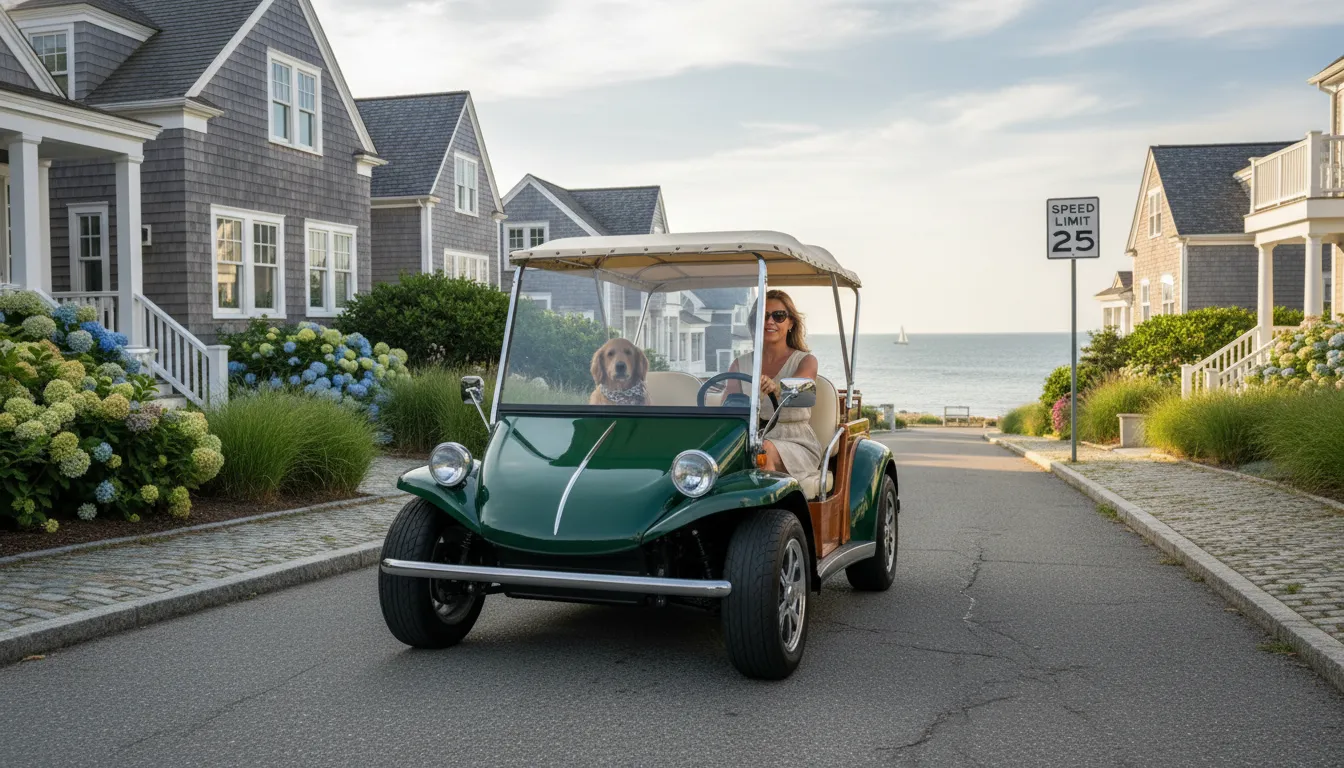
Start with the roads you plan to use, not a favorite color or seat layout. Street legal golf cart laws differ across New England states and towns. A vehicle that works for one community may not qualify in the next town.
Before visiting a dealer, list your usual routes and contact each town about its current rules. Ask about vehicle classes, allowed roads, operating hours, registration, insurance, and driver license requirements. This step helps narrow the search to models that fit your real trips.
A true low-speed vehicle and a golf cart are not always treated the same way. Confirm the exact model is built and documented for the vehicle class your town allows. Do not assume that adding lights to a standard cart makes it road legal.
Required equipment can also vary by town. For example, Old Lyme's golf cart ordinance lists headlights, brake lights, turn signals, seatbelts, a windshield, reflectors, a horn, and a mirror. Use your local rule as the final checklist, since another town may set different terms.
Once eligibility is clear, compare how each option fits your routine. Passenger capacity should match the people you expect to carry, without relying on seats added later. Think about storage space, weather protection, charging access, hills, and the length of a normal round trip.
Lithium power can suit buyers who want simple charging and an electric drive. A gas powertrain may fit other uses, but it may not qualify under some local rules. Compare each powertrain only after your town confirms which vehicle class and fuel type it permits.
Browse C2 Vehicles' street-legal inventory with those needs in hand. Compare road-ready models, including Club Car options, by classification and intended use rather than appearance alone.
Ask to see the VIN, title status, compliance label, and available sales documents before agreeing to buy. Match the VIN across the vehicle and paperwork. Also ask which documents the dealer will provide for registration and which forms you must complete.
For a pre-owned LSV, review service records and confirm that key road equipment still works. Check lights, signals, horn, mirrors, windshield, restraints, tires, brakes, and charging gear. Ask whether past changes affected the vehicle's approved configuration or paperwork.
Financing, delivery, and service access also shape the right purchase. Ask how warranty work and routine service will be handled near your home. A nearby regional team can also help explain documents, but your state and town remain the final legal authorities.
Bring your route list and local requirements when you find a C2 Vehicles location or request a quote. The team can help match those needs to eligible models and review the next steps before delivery.
Plan a compliant commercial or property fleet with C2 Vehicles
A golf cart is designed mainly for golf course use, while an LSV is built and certified for limited public-road use. The Town of Old Lyme defines a golf cart as a low-speed, four-wheeled vehicle made specifically for golf courses. Before buying, confirm the vehicle's certification and your local road rules.
Required equipment depends on the state and municipality. Common items include lights, turn signals, mirrors, a windshield, seatbelts, reflectors, a horn, and reliable brakes. For example, Old Lyme's ordinance lists each of these safety features. Adding equipment alone may not qualify a cart, so confirm certification, registration, and permit rules locally.
Not automatically. Public-road access depends on the vehicle type, state law, road speed limit, and local ordinance. In Rochester, New Hampshire, qualifying electric golf carts may be registered for roads posted at 35 mph or less. The city's registration guidance says gas-powered golf carts cannot be registered for street use in New Hampshire.
License rules vary by state, municipality, and vehicle classification. Some local ordinances require a current driver's license and do not allow learner permits. For example, Old Lyme's golf cart ordinance applies that rule to permitted operators. Check the current DMV requirements and municipal ordinance before anyone drives a golf cart or LSV on public roads.
Waiting until after purchase to review local LSV rules can lead to registration delays, extra costs, or a vehicle that does not fit your plans. Starting your research now gives you time to compare suitable options, confirm local requirements, and prepare the right questions before visiting a dealer. A clear plan also helps you avoid rushed choices and move from research to ownership on a timeline that works for you.
Ready to narrow your options? Explore c2 Vehicles' street-legal inventory to compare available vehicles, then contact a New England c2 Vehicles location and request guidance based on your town's rules. Begin now so you have time to confirm details, select the right vehicle, and prepare for the next steps without last-minute surprises.