
contact us

Choosing between a Moke and golf cart decides where you can drive, how passengers experience every mile, and what kind of support you will need after the sale. A traditional cart favors simple, lower-cost mobility; a Moke turns short New England trips into open-air outings.
Compare Moke options from c2 Vehicles before you choose your next neighborhood, coastal, or resort cruiser.
Moke vs golf cart is a choice between a premium electric low-speed vehicle and a simpler vehicle built mainly for courses, properties, and communities. A Moke offers four-passenger, open-air style with a 75-mile listed range. A golf cart usually costs less and fits buyers focused on golf, utility, or private-property travel.
The right answer depends on your routes, passenger needs, budget, storage space, and plans for service after the sale. This guide compares street legality, range, comfort, pricing, and New England ownership support so you can match the vehicle to the way you actually plan to use it.
A Moke is the better fit for buyers who want a premium, open-air low-speed vehicle with bold styling and public-road potential where local rules allow it. A golf cart is the practical choice for lower-speed transportation on courses, private property, campuses, resorts, and approved communities.
The clearest Moke vs golf cart difference is design intent. A Moke is built to feel more like a small, open-air car. It has a distinctive body, four-passenger layout, electric drive, and equipment associated with low-speed vehicle use. A standard golf cart is more compact and purpose-built for short trips on courses, private roads, properties, and neighborhoods.
Street use needs a careful look. Federal rules define a low-speed vehicle by equipment and speed capability, but state and local rules still decide where it can travel. That means a Moke may be road-legal on some approved streets while a standard golf cart may be limited to private property or locally approved routes.
| Comparison point | Moke | Golf cart |
|---|---|---|
| Best fit | Premium open-air cruising in coastal, resort, and neighborhood settings. | Course use, private property, errands, campuses, and practical local transport. |
| Street use | Designed as an LSV; state and municipal rules apply. | Standard carts are usually not LSVs; some upgraded models may qualify. |
| Passenger feel | Car-like seating and standout styling. | Compact, simple, and easy to park. |
| Price expectation | Premium purchase price. | Wide range from budget carts to luxury builds. |
| Support needs | Choose a dealer familiar with Moke and LSV systems. | Choose a dealer with golf cart service, parts, and battery expertise. |
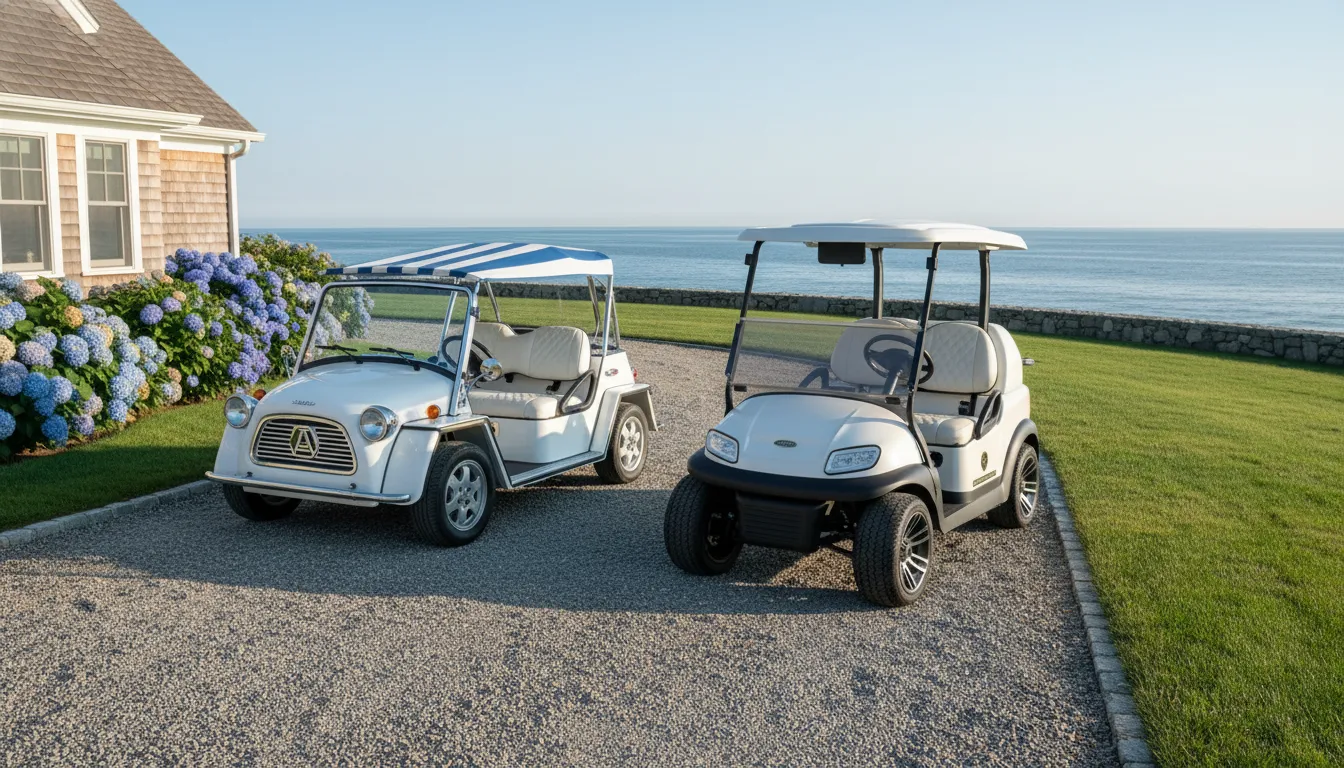
Start with the roads and spaces you use most. If you want a stylish open-air vehicle for approved streets, coastal communities, and resort settings, a Moke is worth serious attention. If you need simple transport around a golf course, campground, school, estate, or private community, a golf cart may be the more efficient option.
c2 Vehicles carries both lifestyle and work-focused options, so shoppers can compare the Moke vehicle overview, current Moke inventory, and broader all available inventory without treating the choice as one-size-fits-all.
In New England, a Moke often fits beach towns, vacation communities, resorts, and approved neighborhood routes where open-air style matters. Golf carts fit golf courses, campuses, marinas, private communities, estates, and commercial properties where compact transport and utility matter more than road presence.
A Moke is easy to imagine near the shore. It has the visual personality many vacation-home owners, resort guests, and coastal residents want from a short-trip vehicle. The open cabin makes local drives feel like part of the outing, not just transportation between two stops.
That same personality can be less important when the vehicle is mostly moving equipment, supplies, or staff. A golf cart or utility vehicle can be easier to stage, park, and maintain around marinas, club grounds, campgrounds, and large properties.
Golf carts remain strong for controlled environments because they are compact and familiar. They work well on cart paths, around maintenance yards, and within private communities where rules allow them. They can also be configured for different passenger counts, storage needs, and terrain.
A Moke may suit a gated neighborhood or resort when owners want a more car-like presence and a more memorable passenger experience. The tradeoff is space. A Moke can need more room to park and turn, and the open sides offer less protection in cold, rainy, or windy weather.
New England ownership is not just about summer. Storage, batteries, winterization, tires, brakes, and pickup or mobile service all matter. c2 Vehicles supports owners through seven regional locations, factory-trained technicians, and service options that help keep vehicles ready before the busy season arrives.
A Moke configured as a low-speed vehicle can be street legal on certain roads, but only when federal equipment, registration, insurance, licensing, state rules, and local road limits line up. A standard golf cart is usually not street legal unless specifically upgraded and allowed by local law.
Low-speed vehicles are not the same as standard golf carts. Federal LSV rules cover equipment such as lights, mirrors, seat belts, windshields, brakes, reflectors, and vehicle identification requirements. They also limit speed capability. Those federal standards are only part of the decision.
States and municipalities control where these vehicles can operate. Some roads may be allowed, others may not. Speed limits, crossings, licensing, registration, and insurance rules can vary. Before driving any Moke or golf cart on public roads, confirm the rules for your town, community, and planned routes.
Golf carts are often allowed on courses and private property. Some communities also allow them on designated local roads or paths. That does not mean every golf cart can be used everywhere. A cart that works perfectly at a campground or club may not be allowed on a public street nearby.
If street access is central to your decision, ask c2 Vehicles to help compare an LSV-ready vehicle with a traditional cart. A clear route check is better than assuming a vehicle is legal because it looks road capable.
Moke performance is tuned for smooth electric cruising and short public-road trips where LSV rules allow use. Golf cart performance varies by model, battery, lift, tires, and payload. Moke listings from c2 Vehicles cite a 75-mile range, while golf cart range depends heavily on configuration.
A Moke has a larger, more planted feel than many traditional carts. It is meant to carry passengers with a more car-like experience, so it feels at home on planned neighborhood, resort, and coastal routes. That size can also make it less nimble in tight maintenance areas or cart-path environments.
Golf carts feel lighter and simpler. That can be a major advantage for courses, campuses, private estates, campgrounds, and other places where parking space is limited and low-speed movement matters more than presence.
c2 Vehicles lists Moke America models with a 75-mile range and standard 110-volt charging. That makes the vehicle practical for many short-trip routines when owners have a reliable charging location. Real-world range can change with temperature, route, passenger load, hills, accessories, and battery condition.
Golf cart range varies more widely. Battery age, chemistry, terrain, tire size, and payload all affect how far a cart can travel between charges. Buyers comparing a Moke with a golf cart should look at the exact unit, not just the category.
A Moke gives four passengers a social, open-air experience. A golf cart can be set up for two, four, six, or more passengers depending on the model. Some buyers care most about style and road presence. Others care most about seating flexibility, cargo, utility beds, or course compatibility.
A Moke generally costs more than a traditional golf cart because it includes premium styling, electric LSV equipment, and a more car-like ownership experience. Golf carts span a wider price range. The best value depends on use case, battery needs, accessories, financing, warranty, and service access.
c2 Vehicles has listed Moke America pricing around $26,998, while golf carts can range from lower-cost pre-owned units to premium lithium, lifted, or street-legal builds. Comparing only the purchase price can be misleading. Seating, batteries, accessories, delivery, warranty, and service support can change the real cost of ownership.
Buyers should also compare the cost of making a vehicle useful for their setting. A cart for a private property may need a utility bed, enclosure, lights, or weather gear. A Moke buyer may focus more on color, upholstery, canopy, and road-use requirements.
After the sale, the most important costs are batteries, tires, brakes, inspections, winter storage, accessories, and repairs. New England weather makes storage and seasonal readiness especially important. Local support can save time when an issue appears right before a summer weekend, event, or golf season.
Buying from a regional dealer matters because these vehicles are used locally and serviced locally. c2 Vehicles has seven New England locations, parts inventory, factory-trained technicians, and mobile or door-to-door service options where available. That support matters whether you choose a Moke model, a Club Car, a utility vehicle, or another small-wheeled vehicle.
Ready to compare real vehicles? Explore current c2 Vehicles inventory and narrow the list by passengers, price, powertrain, and use case.
For personal lifestyle driving, a Moke wins when style, passenger experience, and approved-road use are priorities. For golf, work, and property movement, a golf cart or utility vehicle often wins on simplicity and function. Commercial buyers should match vehicle type to routes, riders, cargo, and service needs.
A Moke often makes sense for personal trips in coastal communities, vacation areas, resorts, and neighborhoods where open-air style matters. Buyers should confirm each planned route allows the selected LSV and understand any licensing, registration, and insurance requirements before driving on public roads.
A golf cart is often the practical choice for golf courses, private property, campgrounds, schools, municipalities, and lower-speed neighborhood travel. Utility models can support grounds teams, events, rental operations, resorts, and industrial sites.
For a larger operation, c2 Vehicles can help match vehicles to routes, riders, cargo, and service needs through its commercial solutions. Rental support can cover events or seasonal demand, while c2 service helps owners plan maintenance and repairs across New England.
Common Moke vs golf cart questions focus on street legality, licensing, price, battery range, and service. The short answer is that a Moke is a premium LSV-style option for approved roads and lifestyle use, while golf carts remain practical for courses, properties, and communities.
A Moke sold and registered as a low-speed vehicle can be used on certain public roads. Unlike a standard golf cart, an LSV includes federally required road-safety equipment. Federal standards define the equipment baseline, but each New England state and municipality controls where an LSV may travel.
You generally do not need a Moke-specific license, but public-road operation typically requires a valid driver's license, registration, and insurance. Drivers must also follow state and local LSV rules. Confirm requirements with the relevant motor vehicle agency and municipality before driving.
Yes. Mokes generally cost more than traditional golf carts because they combine distinctive styling, electric power, passenger comfort, and LSV equipment. A golf cart often costs less when its main job is course, property, or private-community travel.
c2 Vehicles lists Moke America models with a 75-mile range and standard 110-volt charging. Actual range can vary with cold weather, hills, passenger weight, tire condition, accessories, and driving style. Compare the exact vehicle specification with your daily route and charging access.
Yes. c2 Vehicles supports Moke owners through its regional service network, with factory-trained technicians, battery testing, repairs, inspections, winterization, and door-to-door service options where available. Confirm the nearest service location, seasonal maintenance plan, warranty terms, and pickup or mobile-service availability for your address.
The best next step is to compare real inventory with your routes, passengers, budget, and local rules in mind. c2 Vehicles can help New England buyers compare Moke and golf cart options, confirm fit, plan service, and choose a vehicle with confidence.
Putting off your choice can mean missing the vehicle that suits your passengers, local roads, budget, and seasonal plans. Starting now leaves time to compare how each option feels, confirm where you can use it, and prepare for ownership without pressure.
Ready to find a vehicle that fits your New England plans? View available Moke and golf cart inventory, then contact c2 Vehicles to request help comparing your best options and planning your next steps.