
contact us

Choosing between a new vs used golf cart comes down to how you plan to use it, what you want to spend now, and how much predictability you expect after purchase. A new cart offers current features, factory-backed coverage, and extensive configuration choices. A well-inspected pre-owned cart can deliver excellent value at a lower upfront cost. This guide explains the practical tradeoffs so you can buy with confidence.
Explore c2 Vehicles inventory to compare new and pre-owned golf carts.
There is no single right answer for every buyer. A homeowner seeking a comfortable neighborhood cruiser may prioritize appearance and accessories. A golf course, resort, school, municipality, or property manager may care more about uptime, payload, fleet consistency, and service support. In either case, condition and dealer support matter as much as the model badge.
With more than 40 years in business and locations across all six New England states, c2 Vehicles helps personal and commercial buyers compare options based on real operating needs. Use the sections below to identify the ownership path that best fits your budget, expected mileage, climate, and maintenance preferences.
A new golf cart is usually best for buyers who want the latest features, a known history, factory coverage, and broad customization. A pre-owned cart is often best for buyers focused on lower upfront cost and proven value, provided its battery, mechanical condition, service history, and warranty are carefully reviewed.
| Factor | New golf cart | Pre-owned golf cart |
|---|---|---|
| Purchase price | Higher upfront investment | Lower upfront investment |
| Condition | Unused, with a fully known history | Varies by age, use, care, and inspection |
| Warranty | Factory coverage generally included | Dealer or certified coverage may be available |
| Features | Current technology and configurations | May have older features or prior upgrades |
| Customization | Can often be configured before delivery | Can be upgraded, subject to compatibility |
| Depreciation | Largest decline usually occurs early | Much of the initial decline may already have occurred |
| Best fit | Buyers prioritizing predictability and choice | Value-focused buyers comfortable assessing condition |
Buying new gives you control over the cart's starting condition and configuration. You can choose seating, color, powertrain, tires, storage, lighting, weather protection, and other compatible options before delivery. You also begin with a fresh battery or engine and no uncertainty about prior use.
Current models may include updated displays, improved charging systems, modern lithium battery options, refined suspension, and convenience features. Buyers considering passenger capacity can also review new 4-seater golf cart models to understand the choices available for families and guests.
A pre-owned cart can make a higher trim level, premium brand, or useful accessory package affordable within a tighter budget. Because the first owner absorbed the earliest depreciation, a carefully selected cart may also retain a greater share of its purchase price over the next few years.
Condition varies widely, so the seller and inspection process are critical. Dealer-serviced options provide more confidence than an unknown private sale. Learn more about the benefits of pre-owned golf carts, including how certification and support can reduce ownership uncertainty.
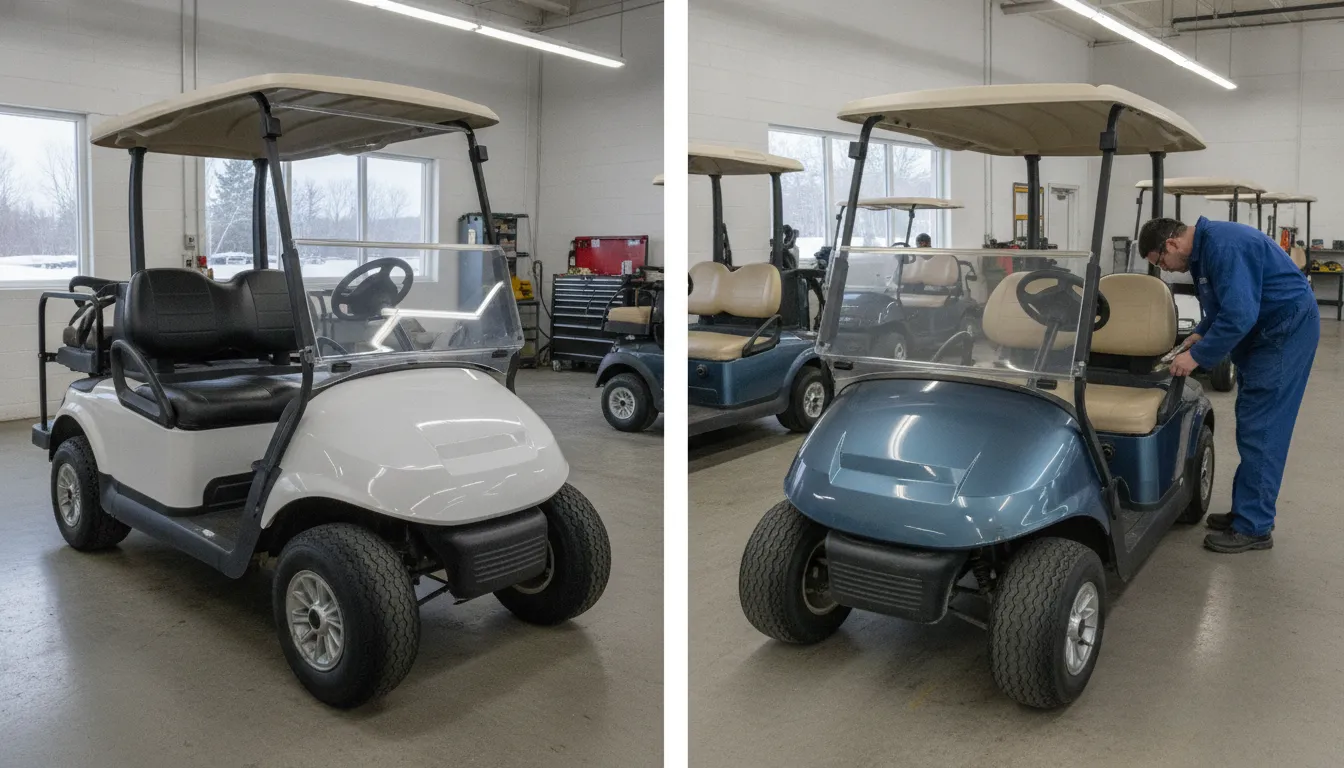
Compare more than the advertised price. Your real cost includes financing, taxes, delivery, accessories, battery or fuel expenses, scheduled service, repairs, insurance where applicable, and resale value. A less expensive pre-owned cart can be the better value, while a new cart may offer more predictable costs during early ownership.
New carts generally cost more because they include unused components, current technology, and factory coverage. Financing can make that investment easier to manage by spreading payments over time. It may also let a buyer select the correct cart now instead of compromising on capacity or essential features.
Pre-owned carts usually require less cash upfront. That can leave room in the budget for delivery, weather enclosures, rear seats, storage, tires, or other practical upgrades. Before adding accessories, confirm that the underlying cart is mechanically sound and that each upgrade is compatible with the model.
A new cart typically has fewer immediate wear-related needs, but it still requires routine care. Electric carts need correct charging habits, tire checks, brake inspections, and battery maintenance where applicable. Gas carts need oil changes and additional engine-related service. Following the manufacturer's schedule helps protect reliability and warranty coverage.
A pre-owned cart may cost less initially but require near-term work. Ask whether tires, brakes, suspension components, batteries, chargers, belts, or filters are approaching replacement. A professional inspection converts these unknowns into a realistic ownership budget. The full golf cart buying guide offers more questions to ask before purchasing.
Like most vehicles, a new cart usually experiences its steepest depreciation early. Buyers who keep a cart for many years may be less concerned about that initial decline. Buyers planning to trade again soon should consider how model demand, condition, maintenance documentation, and upgrades may affect resale value.
A well-kept pre-owned cart has already passed through part of that early decline. However, the cheapest option is not automatically the best value. Deferred maintenance, a weak battery pack, poor-quality modifications, or unavailable replacement parts can erase the savings quickly.
New carts usually include manufacturer warranty protection with defined terms, while pre-owned coverage depends on the seller, age, condition, and certification program. Always request the warranty in writing, confirm what parts and labor it covers, note exclusions, and understand where eligible service must be completed before buying.
Factory coverage is a major reason buyers choose new. It can reduce the financial impact of qualifying defects during the coverage period and provide a clear service process. Warranty length and terms vary by manufacturer, component, and use. Commercial applications may have different terms from personal use, so read the actual agreement.
Ask whether the vehicle, battery, charger, accessories, and labor have separate coverage periods. Confirm whether adding aftermarket equipment could affect a claim. Keeping service records and following maintenance requirements can help preserve protection.
Certified pre-owned carts can bridge the gap between a standard used purchase and a new model. At c2 Vehicles, Certified Pre-Owned carts are up to five years old, serviced in-house, and backed by a three-year bumper-to-bumper warranty. That combination makes condition and coverage easier to evaluate.
Certification standards are not identical across sellers. Ask for the inspection criteria, completed repairs, warranty terms, and any remaining limitations. A cart that has been professionally assessed and supported by a regional service network may justify a higher price than an unverified private-sale option.
Schedule service or a professional inspection before committing to a pre-owned golf cart.
For an electric cart, battery condition is one of the most important value factors because replacement can materially change the total cost. For a gas cart, focus on engine performance, leaks, noise, starting behavior, and records. Every pre-owned cart should receive a complete inspection and test drive.
Ask the battery type, installation date, usage pattern, charging routine, storage history, and available test results. Lead-acid batteries require correct water levels and regular charging. Lithium batteries use a battery management system and generally require less routine maintenance, but their condition and compatible charging equipment still need verification.
Inspect terminals and cables for corrosion, looseness, damage, or overheating. Confirm that the charger works properly and is intended for the installed battery chemistry. During a test drive, watch for unexpected power loss, reduced range, warning lights, or weak hill performance. Research on predictive maintenance reinforces why battery condition and operating data matter when estimating remaining useful life.
A gas cart can be useful when long run times or rapid refueling matter. Start it cold when possible, listen for unusual sounds, look for smoke or leaks, and check acceleration and braking. Ask for records showing oil changes, filter replacements, belt service, and other manufacturer-recommended maintenance.
Regardless of powertrain, inspect steering, suspension, tires, brakes, frame, lights, seats, body panels, and safety equipment. Check the vehicle identification details and confirm that the cart is being sold by its lawful owner. A full 25-point check can reveal issues that are easy to miss during a brief walkaround.
New carts offer the cleanest path to a coordinated build because compatible colors, seating, powertrains, and accessories can often be selected before delivery. Pre-owned carts can also be personalized cost-effectively, but buyers should first confirm the cart's condition, accessory compatibility, electrical capacity, and effect on warranty coverage.
Ordering new allows you to start with the correct platform and avoid paying to replace features you never wanted. Think about passengers, cargo, terrain, storage space, seasonal use, and daily distance before selecting accessories. A family cruiser, golf course cart, work utility vehicle, and event shuttle each need a different configuration.
Useful choices may include rear seating, cargo solutions, windshields, enclosures, mirrors, lighting, upgraded upholstery, wheels, tires, audio, and storage. Some vehicles may qualify as low-speed vehicles when properly equipped, but never assume every golf cart is street-legal. Rules vary by vehicle, state, and municipality.
A pre-owned cart can be an excellent base for a personalized build. It may already include valuable accessories at a lower package price. Begin with safety and reliability, then prioritize improvements that support how the cart will actually be used.
Before modifying the cart, verify its weight limits, electrical system, suspension, powertrain, and compatible parts. Poorly installed lifts, oversized tires, wiring, or seating can reduce reliability and create safety concerns. Professional installation helps ensure accessories work together and do not create avoidable service problems.
Personal buyers can choose new or pre-owned based on comfort, style, budget, and expected use. Commercial buyers should place extra weight on uptime, fleet consistency, payload, safety, warranty terms, parts access, and service response. For demanding operations, dependable dealer support may matter more than the lowest purchase price.
For neighborhood trips, golf, vacation properties, campgrounds, and family recreation, start by defining passenger count and terrain. A new cart offers a tailored look and current features. A pre-owned cart may provide more equipment for the same budget, particularly when it has been inspected and supported by a warranty.
Consider where the cart will be stored and charged, whether it must handle cold weather, and how often guests will ride. If road use is part of the plan, research the applicable state and local rules before purchase. Only known qualifying LSV or DOT-approved models should be described as street-legal.
Golf courses, schools, resorts, municipalities, industrial sites, property managers, campgrounds, and event venues often need a repeatable fleet plan. New carts can simplify standardization and replacement schedules. Professionally maintained pre-owned carts can lower acquisition costs for less intensive duties or seasonal demand.
Commercial buyers should assess route length, hills, payload, towing, shift duration, charging windows, storage, and operator training. c2 Vehicles offers dedicated territory managers. Fleet consultation, custom solutions, regional delivery, financing and leasing options, parts support, and mobile service. Explore commercial services for help planning a fleet around operational needs.
Cold winters, coastal air, hills, and seasonal storage can influence performance and maintenance. Buyers should discuss battery care, charging temperature guidance, corrosion prevention, tires, weather protection, and winter storage with a knowledgeable dealer. The best cart is one configured for the conditions it will actually face.
c2 Vehicles maintains seven locations across all six New England states. A rental fleet of more than 500 vehicles, more than $1 million in parts inventory, and factory-trained technicians. That regional support can be valuable when a personal cart needs seasonal service or a commercial fleet needs to minimize downtime.
Choose by defining the cart's job first, then compare candidates on condition, powertrain, warranty, service history, configuration, dealer support, and total ownership cost. Test drive every serious option, request written documentation, and avoid stretching the budget for cosmetic features before essential safety and reliability needs are satisfied.
When uncertainty remains, compare similar new, standard pre-owned, and Certified Pre-Owned options side by side. A knowledgeable dealer can explain which differences affect reliability and which are primarily cosmetic. Do not rely on the advertised price alone, and do not skip an inspection because a cart looks clean.
New golf carts generally cost more upfront because they include unused components, current features, and factory warranty coverage. Pre-owned prices vary significantly by brand, model, age, condition, battery health, accessories, and warranty. Compare the complete ownership cost, not only the advertised price, and verify current pricing with the seller.
Inspect battery or engine condition, brakes, steering, suspension, frame, tires, lights, charger, accessories, and body. Request service records, warranty terms, and ownership details, then complete a thorough test drive. A professional dealer inspection is especially valuable because it can identify deferred maintenance and estimate near-term repair costs.
Pre-owned simply means the cart had a previous owner. Reconditioned generally means a seller inspected it and completed selected repairs or improvements, but standards vary. Certified Pre-Owned usually follows a defined inspection and warranty program. Ask exactly what work was completed and request all coverage terms in writing.
Battery life varies by chemistry, quality, usage, charging habits, temperature, storage, and maintenance. Rather than relying on age alone, ask for the installation date and available test results, inspect the charging system, and evaluate performance during a test drive. Follow manufacturer guidance to protect range and useful life.
The best purchase is not automatically the newest or least expensive cart. It is the one that meets your real needs with a clear condition, sensible total cost, appropriate warranty, and dependable support. Comparing qualified options side by side makes the final decision easier and reduces expensive surprises after delivery.
c2 Vehicles carries new and pre-owned carts for personal and commercial buyers across New England. The team can help you compare powertrains, passenger and cargo needs, accessories, financing, trade-ins, delivery, and service. For added confidence, ask about Certified Pre-Owned options serviced in-house and backed by c2 Vehicles' three-year bumper-to-bumper warranty.
View current inventory and request a quote from c2 Vehicles today.