
contact us

In a rental program, maintenance works best when responsibility is clear before the vehicle leaves the provider's yard. The renter uses the cart safely, completes any requested pre-use check, and reports problems promptly. The provider keeps the fleet inspected, serviced, documented, and ready for the next reservation.
Golf cart rental maintenance is usually shared: renters handle safe operation, basic checks, and immediate issue reporting. While the rental provider handles scheduled maintenance, repairs, records, and decisions to remove a vehicle from service. The rental agreement and manufacturer's service schedule should control the details.
That division protects both the customer experience and fleet uptime. University of Missouri guidance recommends following the manufacturer's schedule and taking a cart out of service when a fault is found: see the inspection guidance. For New England operators managing seasonal demand, campuses, resorts, events, or recurring commercial rentals, the first step is defining what each side must do.
Schedule New England golf cart service
Short answer: In most rental arrangements, the provider handles scheduled maintenance, inspections, repairs, maintenance records, and fleet readiness. The renter handles safe operation, follows the provider's instructions, completes any requested basic pre-use checks, reports problems promptly, and does not attempt unauthorized repairs. The rental agreement controls the specific responsibilities, so review it before the vehicle is used.
Renter responsibilities are primarily about safe use and early reporting. Follow the operating instructions, use the cart only as permitted, and pay attention to warning signs such as unusual noise. Steering changes, weak braking, visible leaks, damaged tires, or a battery issue. A quick check before use can help identify an obvious problem. The University of Missouri recommends inspecting a cart each day it is used and consulting the owner's manual for additional inspection and maintenance recommendations.
If something is not working properly, stop using the vehicle in a safe location and contact the rental provider. Do not try to adjust brakes, repair wiring, service batteries, or make other mechanical changes unless the provider specifically authorizes that work. A cart with a fault should be reported and removed from service until repairs are made, according to the same safety guidance: golf cart inspection and maintenance guidance.
The provider should maintain the fleet according to each vehicle manufacturer's service schedule. That includes arranging inspections, completing required maintenance, correcting faults, documenting repairs, and deciding when a cart is ready to return to service. Providers should also keep maintenance and repair records so recurring issues can be identified and vehicles can be managed consistently.
For a single personal rental, this work may happen behind the scenes between customers. For a resort, campus, event operation, or recurring rental fleet, the same principle requires a more organized process. The provider and operator should clarify who receives issue reports, who takes a vehicle out of service, and how urgent repairs are escalated. Those details belong in the rental agreement or operating plan, rather than being assumed.
A quick check before moving can catch a problem before it becomes a safety issue or interrupts the day. Follow the rental provider's instructions and the vehicle owner's manual, since controls and equipment vary by model. The University of Missouri recommends inspecting a cart each day it is used, including both visible condition and safety devices.
These checks support safe use; they do not replace the provider's scheduled maintenance or inspection program. The University of Missouri golf cart safety guidance also advises consulting the owner's manual for additional inspection and maintenance recommendations.
Between rentals, the provider should return each vehicle to a documented, safe, ready-to-use condition. That responsibility generally includes inspection, cleaning and readiness checks, scheduled service, repairs, and decisions about whether a cart can go back into the fleet. The rental agreement remains the authority for damage reporting, renter-caused damage, and any charges or exclusions, so operators should not assume every issue is handled the same way.
A provider should review the cart after it comes back, including visible damage, tires, leaks, steering, brakes, lights, controls, mirrors, horn, and battery or fuel condition as applicable. The exact checklist should reflect the vehicle model and the manufacturer's instructions. The University of Missouri recommends following the manufacturer's service schedule. The Texas Department of Insurance also advises regular inspection, maintenance, and documentation: Texas Department of Insurance golf cart safety guidance.
Scheduled work may include model-specific tasks identified in the owner's manual. It can also include cleaning, battery or charging checks for electric vehicles, fluid and filter service for gas vehicles, tire attention, and safety-equipment inspections. Do not substitute a generic calendar for the manufacturer's requirements. Keep a record of the inspection date, mileage or usage information when available, reported concerns. Work performed, parts used, and the person or technician who approved the return to service.
If a cart has a brake, steering, tire, electrical, battery, fuel, or other safety-related fault. It should be tagged and kept out of service until the issue is evaluated and repaired. A cart that looks clean is not necessarily ready for another renter. Providers should also track recurring faults, missed inspections, and damage patterns. This helps them address a maintenance problem rather than repeatedly resetting the same vehicle.
For damage discovered between rentals, compare the condition with the checkout and return records, photographs, inspection notes, and the agreement's reporting process. Separate normal wear, a mechanical failure, and documented impact damage before assigning responsibility. For larger fleets, a planned maintenance program and access to technicians can reduce downtime. c2 Vehicles offers New England golf cart service, including diagnostics, repairs, maintenance, and inspections for commercial sites.
Reliable golf cart rental maintenance starts with a repeatable operating system, not a last-minute repair call. For every vehicle, create an intake record that identifies the cart, condition at return. Reported symptoms, battery or fuel status, and whether it is ready for the next reservation. A short rental may need a focused return inspection. A recurring fleet needs the same process applied consistently across every vehicle and shift.
Use one issue log for renter reports, staff observations, inspection findings, and repairs. Record when the issue appeared, what was checked, who evaluated it, and whether the vehicle was returned to service. Keep maintenance and repair records with the vehicle history, as recommended by safety guidance. If a cart has a braking, steering, control, tire, electrical, or other safety-related fault, tag it out of service until a qualified person confirms that it is ready. Do not let a busy weekend turn an unresolved note into an informal handoff.
Maintain a parts plan for predictable wear items and common failure points. Keep model-specific parts and diagnostic information available to the technician. Ask the service partner how parts are sourced, how urgent repairs are escalated. And whether technicians can work at the rental site. c2 Vehicles' factory-trained mobile technicians provide diagnostics, repairs, maintenance, and inspections at commercial locations. Confirm the provider's response process and service scope before signing a rental or fleet agreement.
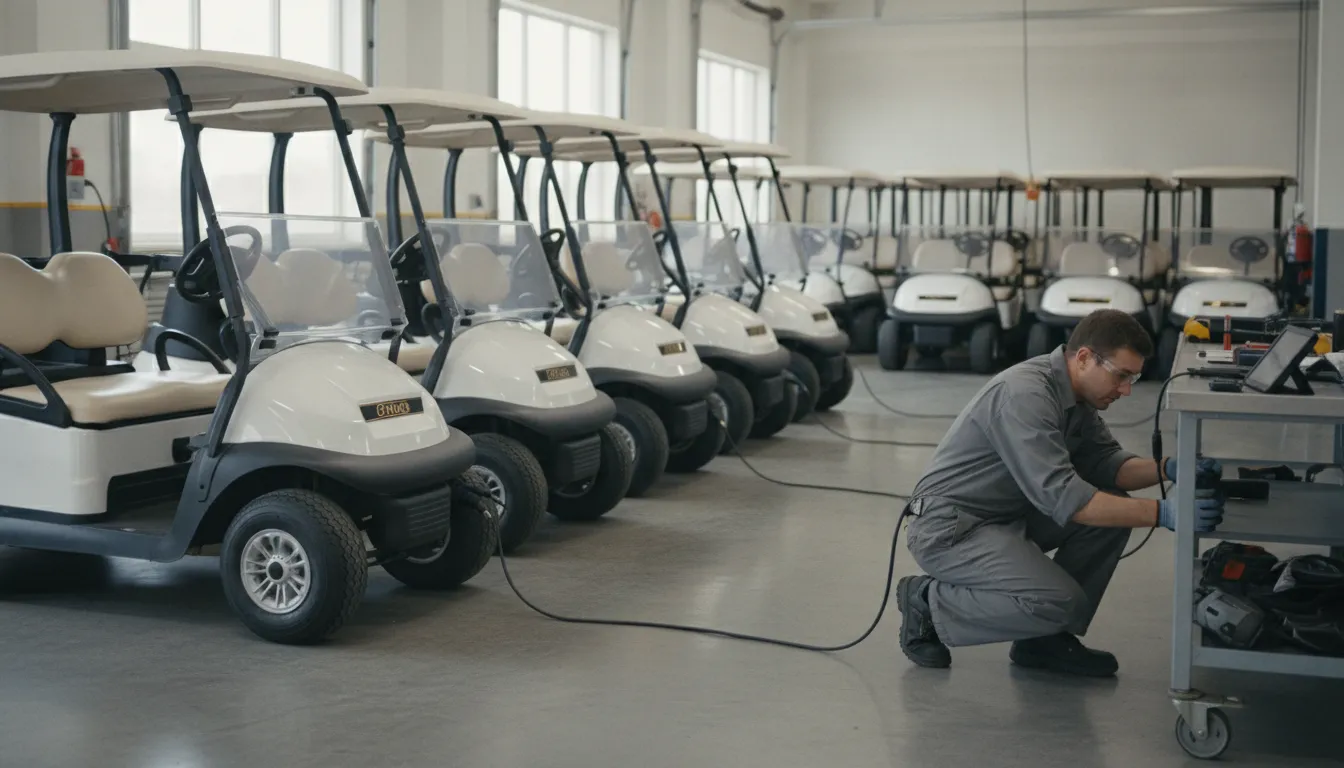
For larger or recurring fleets, review the log regularly. Look for repeat failures by vehicle, location, route, season, or operator process. That trend can justify preventive work before a vehicle misses a reservation. It can also reveal a training or charging problem rather than a mechanical defect. Follow the rental agreement and the manufacturer's service schedule, and document each decision so the next person has the same information.
When a repair cannot wait for transport to a shop, mobile golf cart maintenance may help reduce downtime by bringing service to the fleet location.
Schedule New England golf cart service
The maintenance plan should follow the vehicle model and manufacturer's manual, but the powertrain changes where operators focus their attention. Electric carts center on battery condition and charging practices. Gas carts add engine-related fluids, filters, and fuel-system concerns. The daily safety inspection remains important for both.
| Maintenance area | Electric cart | Gas cart |
|---|---|---|
| Battery and charging | Use the correct charging procedure in the owner's manual. Watch for unusual battery behavior, visible damage, leaks, or charging concerns, and report them rather than attempting an improvised repair. | The starting battery still needs attention, but the primary operating system also depends on fuel and an engine that starts, runs, and responds normally. |
| Fluids and filters | There is no engine oil or engine air filter to service, though the cart may still have other components that require model-specific inspection. | Service may include engine oil and filter changes, along with inspection of other engine and fuel-related components. The manual determines what applies. |
| Routine inspection | Check tires, leaks, steering, brakes, lights, mirrors, horn, controls, and other safety equipment before use. A fault should take the vehicle out of service until it is repaired. | |
| When to call a technician | Escalate charging, battery, electrical, braking, steering, or driveability concerns. | Escalate starting, fuel, engine, braking, steering, or driveability concerns. |
These are planning distinctions, not a substitute for a model-specific service schedule. University of Missouri guidance emphasizes following the manufacturer's recommendations and using the owner's manual for inspection and maintenance details. It also warns that battery charging must follow the correct procedure. Review the safety guidance before creating a rental-fleet checklist.
For a mixed fleet, keep separate maintenance records for electric and gas vehicles instead of using one generic checklist. A provider may recommend battery testing or replacement when inspection findings and the manufacturer's schedule call for it. Rental operators should confirm whether those services fit their cart and service plan with c2 Vehicles' New England golf cart service team. For gas carts, oil and filter changes may also be part of model-specific service, so ask the provider to confirm what applies. Exact needs depend on the cart, its operating environment, and the manufacturer's instructions.
New England weather makes seasonal readiness an operating priority for rental fleets. Freezing temperatures, moisture, road salt, storage conditions, and long periods of reduced use can affect batteries, tires, controls, bodywork, and starting reliability. The right plan depends on each vehicle, its powertrain, storage environment, and rental agreement. So operators should follow the manufacturer's service schedule rather than rely on a universal calendar.
Winterization should be treated as more than parking vehicles indoors. A provider or fleet technician can inspect the cart, prepare the battery system, check for damage or corrosion, and address service needs before the vehicle sits unused. Electric and gas vehicles have different requirements. Battery care and charging should follow the owner's manual. Gas vehicles may need the appropriate oil, filter, and fuel-related attention. Ask the service provider which seasonal services it currently offers for your vehicle and storage conditions.
When rental demand increases, inspect each vehicle before placing it back into service. Check tire condition and inflation, steering, brakes, lights, mirrors, controls, visible leaks, and battery indication. Review maintenance records and resolve any issue that could affect safe operation. A cart with a fault should remain out of service until it is repaired, rather than being assigned to the next renter.
Regional coverage also matters when weather exposes a problem or a fleet needs preparation at multiple sites. c2 Vehicles provides service through seven service centers and mobile technicians across all six New England states. Coverage also extends into Eastern New York. Operators can use the New England golf cart service page to discuss inspections and repair needs while keeping seasonal readiness tied to the manufacturer's guidance.
The right service partner should support uptime before a problem becomes a guest complaint, missed event commitment, or campus transportation disruption. Look for a provider that can handle both routine New England golf cart service and practical fleet coordination.
Also confirm that records are kept, manufacturer guidance is followed, and responsibilities are clear in writing. c2 Vehicles supports a rental fleet of more than 500 vehicles. That operating experience gives rental operators a useful basis for discussing readiness and service needs without assuming every fleet has the same requirements.
Schedule service support for your rental or commercial fleet
Usually, the rental provider handles scheduled maintenance, inspections, repairs, service records, and fleet readiness. Renters are responsible for safe operation, following the rental agreement, completing any requested pre-use checks, and reporting damage or unusual behavior promptly. Do not attempt an unauthorized repair.
Inspect the cart before each use, while the provider follows the vehicle manufacturer's service schedule and its own fleet procedures. Checks can include tires, leaks, steering, brakes, lights, mirrors, horn, controls, and battery status. The University of Missouri recommends daily, pre-use cart inspections. Read the University of Missouri guidance.
The provider should inspect safety systems, address visible damage, confirm the cart is clean and ready. Complete model-specific preventive maintenance, document repairs, and remove unsafe vehicles from service until repaired. Exact tasks depend on the cart, its powertrain, the manufacturer's manual, and the rental agreement.
Stop in a safe location, turn the cart off if appropriate, and contact the rental provider using the support instructions in your agreement. Describe the symptoms and location, and do not continue driving if steering, braking, acceleration, tires, or another safety-critical system is affected. The provider should decide whether to troubleshoot, dispatch service, or remove the cart from service.
Reliable rental operations depend on clear inspections, timely repairs, and a service plan that fits the vehicles and conditions your team manages. If you need fleet inspections, preventive maintenance, or help resolving a service issue, c2 Vehicles can help you identify the next practical step.