
contact us

If your golf cart is losing range, slowing down on hills, or spending more time on the charger than on the road, the battery pack is usually the first place to look. Golf cart battery replacement cost depends on the battery chemistry, cart voltage, number of batteries, charger compatibility, installation labor, and whether the cart needs related service at the same time.
Schedule golf cart battery service with c2 Vehicles
For many owners, the real question is not just what a new pack costs. It is whether lead-acid, AGM, or lithium makes sense for how the cart is used. A neighborhood cruiser, a seasonal beach cart, a golf course fleet, and a utility vehicle at a resort can all need different answers. The right choice should balance upfront cost, runtime, maintenance, expected lifespan, safety, and support after installation.
Local guidance matters because c2 Vehicles supports personal and commercial golf cart owners across New England with parts, service, accessories, new vehicles, pre-owned vehicles, rentals, fleet support, and location-based guidance. Use this guide to understand the main cost drivers before you request a quote, schedule service, or compare replacement options.
Golf cart battery replacement cost usually starts with the battery pack itself. Most electric golf carts use a pack made from several batteries wired together to reach the vehicle's required voltage. Common configurations include 36-volt and 48-volt systems, though newer vehicles and upgraded carts may use different layouts. A pack with more batteries, higher capacity, or lithium technology will usually cost more than a smaller flooded lead-acid pack.
Lead-acid batteries often have the lowest upfront parts cost, which makes them familiar to many owners. They can be a practical choice for carts used lightly, carts that already have a compatible charger, or owners who are comfortable with regular maintenance. The tradeoff is that flooded lead-acid batteries need watering, terminal cleaning, proper charging habits, and careful storage. If maintenance is skipped, performance can decline faster than expected.
Lithium batteries usually cost more upfront, but they can reduce maintenance, cut weight, improve usable range, and deliver steadier performance during the charge cycle. Depending on the cart, a lithium conversion may also require a compatible charger, battery management system, mounting changes, or a review of controller compatibility. That is why a lithium quote should include more than the battery price alone.
Labor is another part of the replacement cost. Batteries are heavy, wiring sequence matters, and improper installation can damage components or create safety risks. A professional service visit may include pack testing, terminal and cable inspection, corrosion cleanup, installation, charger checks, disposal or recycling handling, and a post-installation performance review.
The safest way to budget is to treat online ranges as planning information only. Your final cost depends on the exact cart, battery size, chemistry, charger condition, parts availability, usage needs, and whether any related components need attention. For a precise recommendation on golf cart battery replacement cost, contact c2 Vehicles service or ask the parts team to confirm the correct battery type for your model.
The biggest battery decision is usually lead-acid vs lithium. Both options can work, but they serve different priorities. Lead-acid batteries are familiar, widely available, and usually lower cost at purchase. Lithium batteries are lighter, require less routine maintenance, and can deliver strong performance for owners who use their carts often or want a cleaner ownership experience.
AGM batteries sit between traditional flooded lead-acid and lithium in some use cases. AGM batteries are sealed, so they reduce watering needs, but they still have lead-acid characteristics. They may fit owners who want lower maintenance than flooded batteries without moving all the way to lithium. Compatibility and correct charging still matter.
| Battery option | Cost profile | Maintenance | Best fit |
|---|---|---|---|
| Flooded lead-acid | Lower upfront cost | Needs watering, cleaning, and careful charging | Light personal use or carts already set up for lead-acid batteries |
| AGM lead-acid | Mid-range upfront cost | Sealed design reduces watering needs | Owners who want less maintenance without a full lithium conversion |
| Lithium | Higher upfront cost | Low routine maintenance with compatible charging | Frequent users, fleets, and owners prioritizing range, weight, and uptime |
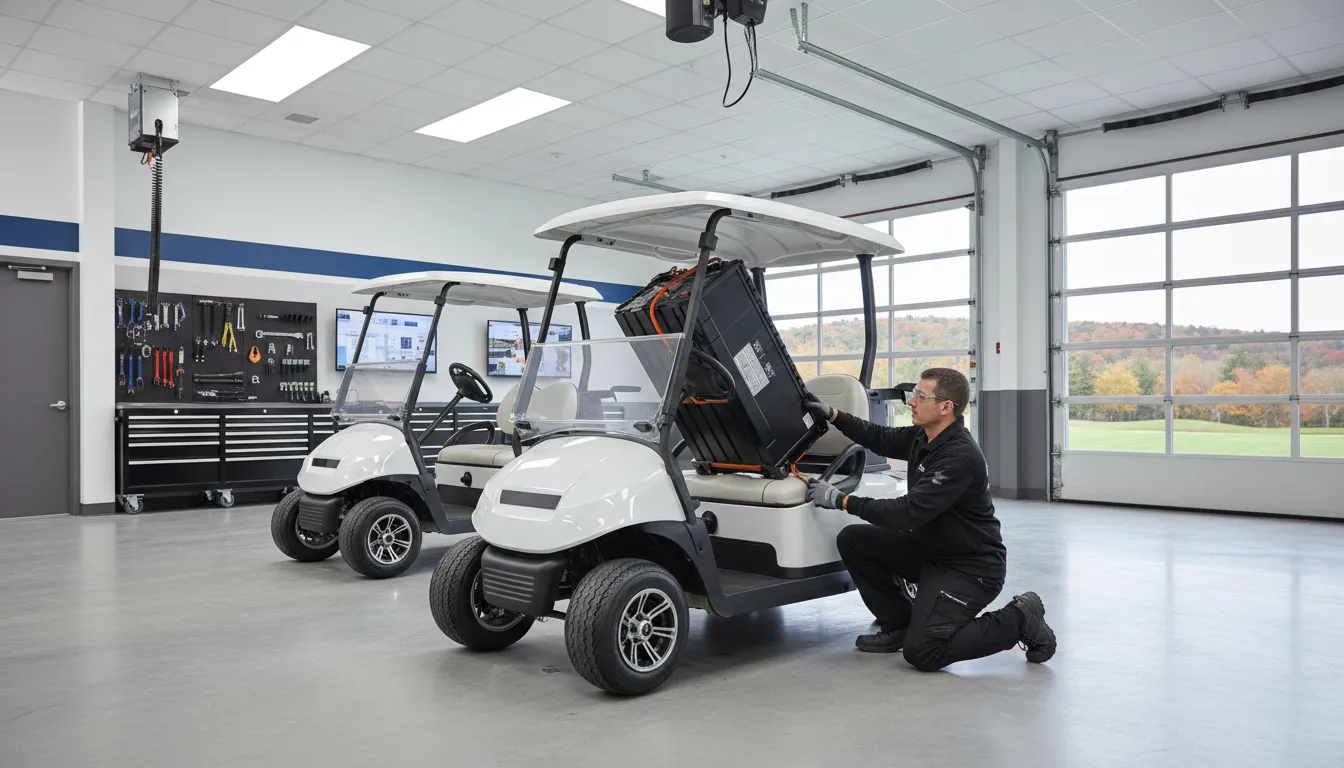
For personal buyers, the choice often comes down to how often the cart is used. A cart used on weekends around a neighborhood may not need the same battery investment as a cart used daily at a campground. A resort, school, marina, or golf course has different needs, and commercial operators should also consider downtime, technician access, charging routines, and replacement scheduling across the fleet.
Lithium can be especially attractive when weight, runtime, and maintenance time matter. Removing weight from the cart can help efficiency, and the lack of watering is useful for busy owners and fleet teams. However, not every cart should be converted without inspection. The vehicle's controller, charger, wiring, and mounting space should be reviewed before a lithium battery pack is selected.
Battery problems often appear gradually. The cart may still run, but it does not feel the same. One of the clearest signs is shorter runtime after a full charge. If the cart used to complete several trips and now struggles to finish the same route, the battery pack may be losing capacity.
Slow acceleration and weak hill performance are also common warning signs. A tired battery pack can sag under load, which makes the cart feel sluggish even when it shows some charge remaining. This is especially noticeable on hilly properties, golf courses, coastal roads, or utility routes with cargo and passengers.
Charging behavior matters too. If the charger runs longer than normal, shuts off early, shows repeated fault lights, or seems inconsistent, the battery pack should be tested. The charger may be the issue, but weak or uneven batteries can also create charging problems. Replacing batteries without checking the charger can lead to another round of frustration.
Physical condition is important. Corroded terminals, loose cables, swelling cases, leaks, unusual smells, heat, or damaged hold-downs should be addressed quickly. Battery acid and high-current electrical connections can be hazardous. Do not ignore visible damage or try to force a cart through another season if the pack looks unsafe.
Age is another clue, but age alone is not a diagnosis. Storage habits, charging habits, water levels, climate, terrain, and usage frequency all affect battery life. A professional test can separate a failing pack from a single weak battery, a cable issue, a charger problem, or another electrical concern.
Choosing the right pack is part product match and part service decision. The goal is to restore reliable performance without overspending on a battery that does not fit the cart or underbuying for how the vehicle is used.
Owners shopping for a replacement pack should also consider whether the vehicle itself still fits their needs. If a cart needs batteries plus other major repairs, it may be worth comparing the repair path with available new and pre-owned inventory. A service team can help you compare both paths without guessing.
New England golf carts often live seasonal lives. Some are used heavily through spring, summer, and early fall, then stored during cold months. Storage conditions can make a major difference, which is why seasonal battery maintenance and winterization service can be useful for New England owners. A battery pack left discharged through winter can suffer damage, while a properly charged and maintained pack is more likely to return strong performance when the season starts.
Cold weather can reduce apparent range and charging efficiency. That does not always mean the battery pack has failed, but it can reveal weakness in an older pack. Owners in Massachusetts, Connecticut, Rhode Island, Vermont, New Hampshire, Maine, Cape Cod, the Islands, and nearby markets should plan storage and charging around local conditions rather than assuming year-round warm-weather behavior.
Coastal environments add another challenge. Salt air and humidity can contribute to corrosion around terminals, cables, trays, and hardware. Regular inspection matters for carts used near beaches, marinas, vacation communities, and coastal resorts. A battery replacement visit is a good time to inspect cables and clean or replace corroded components.
Terrain and payload also affect battery life. Hills, passengers, cargo beds, towing, frequent starts, and utility routes all increase demand. A commercial cart moving staff, tools, linens, supplies, or event equipment may need a more durable battery plan than a lightly used neighborhood cart.
That is where regional service helps. c2 Vehicles has regional experience across personal, golf, and commercial use cases. With multiple New England locations, factory-trained technicians, OEM parts support, and broad parts infrastructure, the team can help owners choose batteries based on real use. That is more useful than choosing only by the lowest shelf price.
Some mechanically confident owners can replace golf cart batteries themselves, but it is not a casual job. Golf cart batteries are heavy, the cables must be reconnected in the correct sequence, and the pack can produce enough current to create serious risk if tools bridge terminals or wiring is wrong. Personal safety should come before saving a small amount of labor.
DIY replacement also creates diagnostic risk. If the real problem is a charger fault, a damaged cable, corrosion, a controller issue, or one weak battery inside a mixed pack, replacing batteries may not solve the issue. A service department can test the system before recommending parts, which helps avoid unnecessary spending.
Disposal is another factor. Batteries should be recycled through proper channels. Professional service can help with core handling, recycling, and safe removal. This is especially useful for owners who do not have the equipment or space to handle several heavy batteries at once.
Warranty and compatibility should also be considered. Battery manufacturers and vehicle brands may have requirements for installation, charging, and maintenance. If a lithium upgrade is involved, the stakes are higher because the charger, battery management system, mounting, and vehicle electronics need to work together.
If you are unsure, ask c2 Vehicles to confirm the correct parts and service path. The right answer may be a simple like-for-like replacement, a lithium upgrade, a charger review, or a broader service appointment.
The best place to get golf cart batteries is a provider that understands both the battery pack and the vehicle. A battery is not just a box on a shelf. It connects to the charger, controller, cables, usage pattern, and safety of the cart. For New England owners, local service support is especially important because seasonal timing, storage, and availability can affect the replacement plan.
That support should fit many kinds of owners. c2 Vehicles supports personal buyers, golf courses, country clubs, schools, municipalities, property managers, resorts, campgrounds, rental operators, and commercial fleets. That mix matters because a homeowner may care most about dependable neighborhood range. While a fleet manager may care about uptime, maintenance intervals, and consistent performance across many vehicles.
If your cart needs batteries, start with Schedule Service or contact the parts team through c2 Vehicles contact options. If you are also considering whether to repair or replace the cart, browse current inventory and compare the cost of a battery service visit with newer or pre-owned options.
Commercial and fleet buyers should ask about service planning, delivery, parts availability, and support across locations. Coordinating battery replacement before peak season can reduce downtime and keep vehicles available when customers, guests, staff, or residents need them most.
Golf cart battery replacement cost depends on voltage, number of batteries, battery chemistry, labor, charger compatibility, and related repairs. Lead-acid is usually lower upfront, while lithium usually costs more upfront but may reduce maintenance and improve performance.
Lithium can be worth it for frequent use, longer runtime goals, lower maintenance, and fleet operations. It is not automatically right for every cart. Have the charger, controller, wiring, and mounting reviewed before choosing a lithium conversion.
Sometimes a single battery can be replaced, but mixing old and new batteries can create uneven performance. A service test can show whether one battery is the problem or whether the full pack is near the end of its useful life.
Check the cart model, pack voltage, battery count, and individual battery voltage. A parts or service team can confirm the correct fit and make sure the charger matches the battery type.
Ready to move from research to a clear recommendation? Contact c2 Vehicles for golf cart battery service, parts support, or help comparing lead-acid and lithium options. The team can confirm the right pack for your vehicle, inspect related components, and help you plan a safe replacement for personal, golf, rental, or commercial use across New England.
Schedule golf cart battery service or request parts support.