
contact us

A commercial golf cart rental can help a New England business add transportation capacity without committing to a permanent fleet. Resorts, campuses, municipalities, property managers, event venues, and rental operators can use rented carts for seasonal demand, temporary projects, peak guest volumes, or a new program that still needs to prove its fit. The key is to plan the rental around the work, the route, the timing, and the support required.
Request commercial rental guidance from c2 Vehicles
A commercial golf cart rental is usually the best fit when an organization needs reliable low-speed transportation for a defined period, but does not yet need to own every vehicle it may use. Renting can support a seasonal operation, a temporary construction or property project, a large managed event, a campus move-in period, or a demand spike while a long-term fleet decision is still being evaluated.
Renting is also useful when the business needs different vehicle configurations at different times. A passenger cart may be right for guest transportation, while a utility vehicle with a cargo bed may be better for grounds work. A short-term or seasonal program can reveal which mix is actually used before the organization invests in ownership, leasing, storage, and replacement planning.
Fleet sizing should begin with routes and assignments, not a guess based only on the number of people at a property. A practical estimate considers the number of simultaneous routes, passenger loads, trip frequency, peak arrival and departure windows, operating hours, charging or refueling time, and a reserve for maintenance or unexpected demand. The goal is enough capacity to keep the operation moving without paying for vehicles that sit unused.
| Operational need | Vehicle direction to discuss | Planning question |
|---|---|---|
| Guest or visitor transportation | Passenger golf cart or small electric vehicle | How many passengers and stops must be served at peak times? |
| Maintenance and grounds work | Utility vehicle with cargo bed or work accessories | What tools, materials, or payload must travel on each trip? |
| Campus or resort circulation | Passenger configuration matched to route and access needs | Are the routes private, public, or a combination? |
| Event operations | Mixed passenger and utility fleet | Which assignments are fixed, and which will change during the event? |
| Seasonal rental program | Repeatable configuration with service plan | What happens when demand, weather, or the season changes? |
For a large or unfamiliar operation, ask a commercial rental provider to review the route map and deployment schedule. A useful planning conversation should identify the number and type of vehicles, delivery windows, staging space, operator responsibilities, service contacts, and the process for reporting a problem.
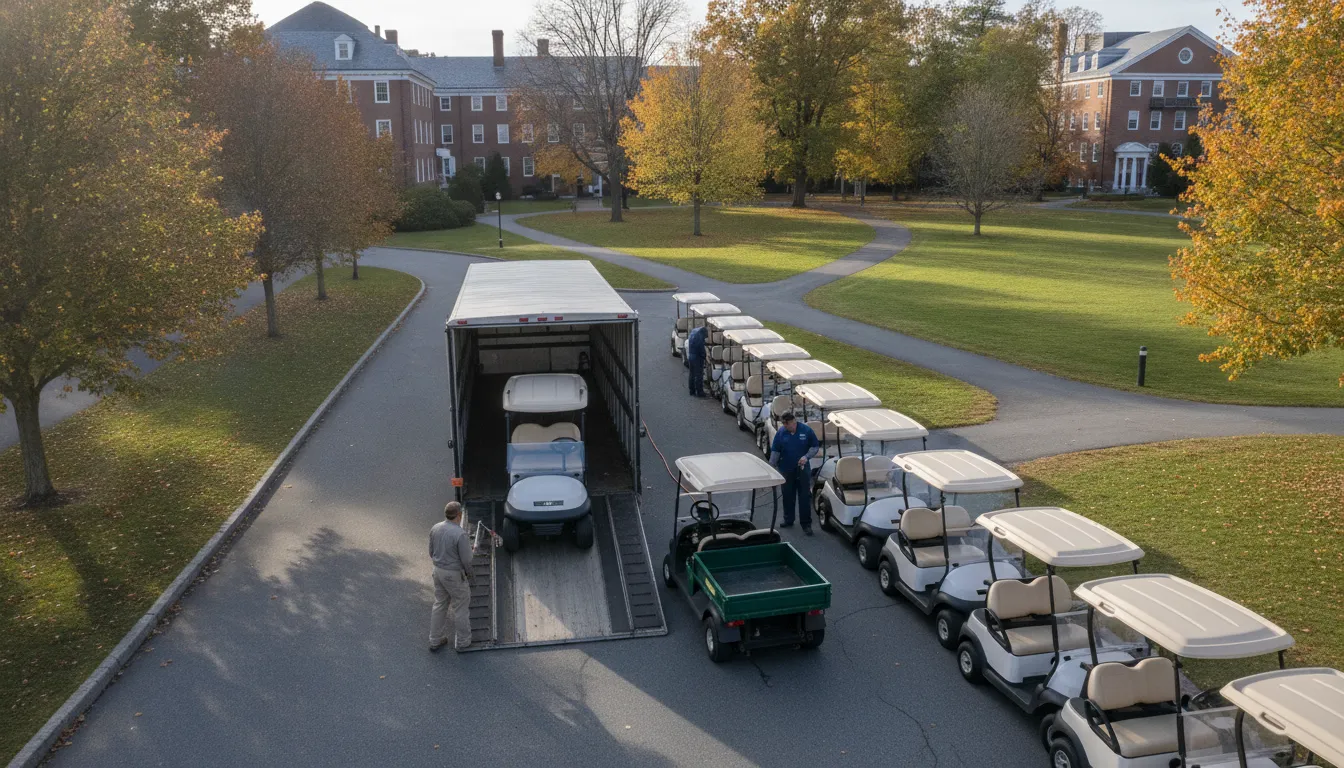
The right vehicle depends on the assignment. A commercial rental program may include several types rather than one universal cart. Passenger vehicles prioritize people movement and access around a property. Utility vehicles prioritize cargo, tools, and job-site productivity. Enclosed or specialized vehicles may be appropriate when weather, terrain, or the operating season creates additional requirements.
Passenger golf carts can support guest shuttles, campus transportation, parking assistance, venue circulation, and staff movement. When comparing configurations, consider passenger capacity, turning space, route width, visibility, entry and exit needs, and whether the vehicle will be operated by trained staff or by a customer-facing team.
Utility vehicles are designed for work that includes tools, supplies, materials, or grounds equipment. Cargo-bed size, payload requirements, access to the work area, and the need for attachments should be reviewed before the rental is confirmed. A utility vehicle can be more useful than a passenger cart when the main objective is to reduce walking, carrying, or repeated truck trips.
Powertrain selection should reflect the route, charging or refueling plan, operating hours, noise expectations, weather, and available infrastructure. c2 Vehicles' commercial fleet solutions include options across industries. A rental request may call for passenger golf carts, commercial utility vehicles, or both, depending on the assignment and current availability. Do not assume that a vehicle is street-legal simply because it is electric or has safety equipment. Confirm the intended operating area and applicable requirements with the rental provider and the relevant authority.
Explore c2 Vehicles commercial fleet solutions
Delivery is part of the rental program, not an afterthought. A vehicle that arrives late, at the wrong entrance, or without a clear staging plan can create more disruption than the rental solves. Share the site address, access restrictions, delivery contact, unloading area, route map, event or operating schedule, and any requirements for gates, docks, parking, or security review before the delivery date.
New England operations may also need a weather contingency. Coastal venues, island properties, ski-area businesses, and seasonal campuses should discuss how weather-related changes affect delivery, storage, route safety, and the rental period. Specific timing and availability should be confirmed directly with the rental team because fleet schedules change.
Maintenance responsibility should be written into the rental agreement before vehicles arrive. Ask which checks the customer performs, which issues require an immediate call, who provides roadside or on-site support, and what the replacement process is if a vehicle cannot safely continue. A dependable commercial program has a clear service path rather than leaving an operator to diagnose an unfamiliar vehicle during a busy shift.
c2 Vehicles supports commercial customers with factory-trained technicians, mobile service, OEM parts, and service locations across New England. Its service page should be treated as the current source for service-request details and coverage. Ask the commercial or rental team to confirm what is included for the specific rental arrangement, location, and vehicle group.
Insurance and compliance requirements depend on the business, property, vehicle, route, operators, and local rules. A rental provider can explain the vehicle and agreement, but the customer should also consult its insurance professional, property owner, and relevant local authority. Treat the following as a conversation checklist, not a substitute for legal or insurance advice.
Street-legal status is not automatic and can vary by state and municipality. If a route includes public roads, identify the exact jurisdictions before selecting a vehicle or advertising a service. Keeping every route on private property may lead to a different planning outcome than connecting two sites by public road.
c2 Vehicles operates a 500-plus vehicle rental fleet and serves commercial customers throughout New England. Its regional model combines rental vehicles with commercial fleet knowledge, service infrastructure, delivery coordination, and multiple locations. That can be useful for an organization managing a seasonal property, a multi-day event, a campus operation, or a temporary commercial need across Massachusetts, Connecticut, Rhode Island, Vermont, New Hampshire, Maine, Cape Cod, or the Islands.
The company also positions its commercial team as a partner for moving people, equipment, and supplies. Depending on the assignment, the planning conversation may include passenger carts, utility vehicles, custom solutions, service coverage, delivery, and a longer-term fleet alternative. Current fleet mix, timing, delivery scope, and availability should be confirmed rather than assumed from a general article.
Find a c2 Vehicles location for regional support
Before approving a commercial golf cart rental, put the operational details in writing. A short, specific brief helps the rental team recommend the right mix and gives the customer a clear basis for comparing proposals.
A commercial golf cart rental works best when it is managed as an operating program, not just a vehicle reservation. Define the routes, choose vehicles by assignment, plan delivery and support, and confirm insurance and compliance requirements early. For New England businesses that need a regional rental partner, c2 Vehicles can help scope the request and identify the right next conversation without promising inventory or timing that has not been confirmed.
Request a commercial golf cart rental consultation
Resorts, campuses, municipalities, property managers, event venues, campgrounds, rental operators, and industrial or temporary operations may use commercial golf cart rentals for passenger transport, equipment movement, seasonal demand, or scheduled projects.
The number depends on simultaneous routes, passenger loads, trip cycle time, operating hours, peak demand, vehicle assignments, and reserve requirements. A route and deployment review is more reliable than choosing a number from average attendance alone.
Yes. A mixed fleet may be appropriate when an operation needs guest or staff transportation as well as cargo beds, tools, supplies, or grounds equipment. The rental team should match each vehicle to its assignment.
Not automatically. Street-legal eligibility and operating rules vary by vehicle, state, municipality, and route. Confirm the intended roads and requirements before selecting a vehicle for public-road use.
The agreement should identify the customer's daily checks, the rental provider's support process, the service contact, and the response or replacement plan. Confirm whether mobile or on-site support is available for the specific property.
Start as soon as the dates, site, route, and approximate vehicle needs are known. Earlier planning allows time to confirm vehicle type, delivery access, insurance documents, operator procedures, staging, and seasonal scheduling.