
contact us

A 4 passenger golf cart is usually the best all-around choice for families and property owners who want comfortable seating without giving up easy maneuverability. A 6-passenger cart makes more sense when moving larger groups in one trip is a regular need. The right decision comes down to more than two extra seats: consider your typical passenger count. Storage needs, route, parking space, and whether the vehicle must qualify for use on public roads.
View current c2 Vehicles inventory and compare passenger layouts.
This guide compares the practical tradeoffs for personal buyers and commercial fleets in New England. So you can choose a vehicle that works on an ordinary Tuesday, not only on your busiest day.
| Decision factor | 4-passenger cart | 6-passenger cart |
|---|---|---|
| Best fit | Families, couples with guests, neighborhood trips, smaller properties | Resorts, campuses, event venues, extended families, frequent group transport |
| Passenger capacity | Up to four, depending on the model and seating layout | Up to six, depending on the model and seating layout |
| Maneuverability | Typically easier in tight turns and compact parking areas | Longer body generally needs more turning and parking room |
| Cargo flexibility | Some rear-seat configurations convert to a cargo deck | More people capacity, but luggage can require a dedicated cargo solution |
| Transport and storage | Usually easier to fit in a garage or transport setup | Requires careful measurement before purchase |
| Typical buying priority | Versatility and everyday convenience | Fewer trips when moving groups |
Simple rule: buy for the number of people you carry most often. If you normally carry two to four people, a four-seater avoids the size and handling compromises of a larger cart. If you routinely leave people waiting for a second trip, six seats can improve efficiency.
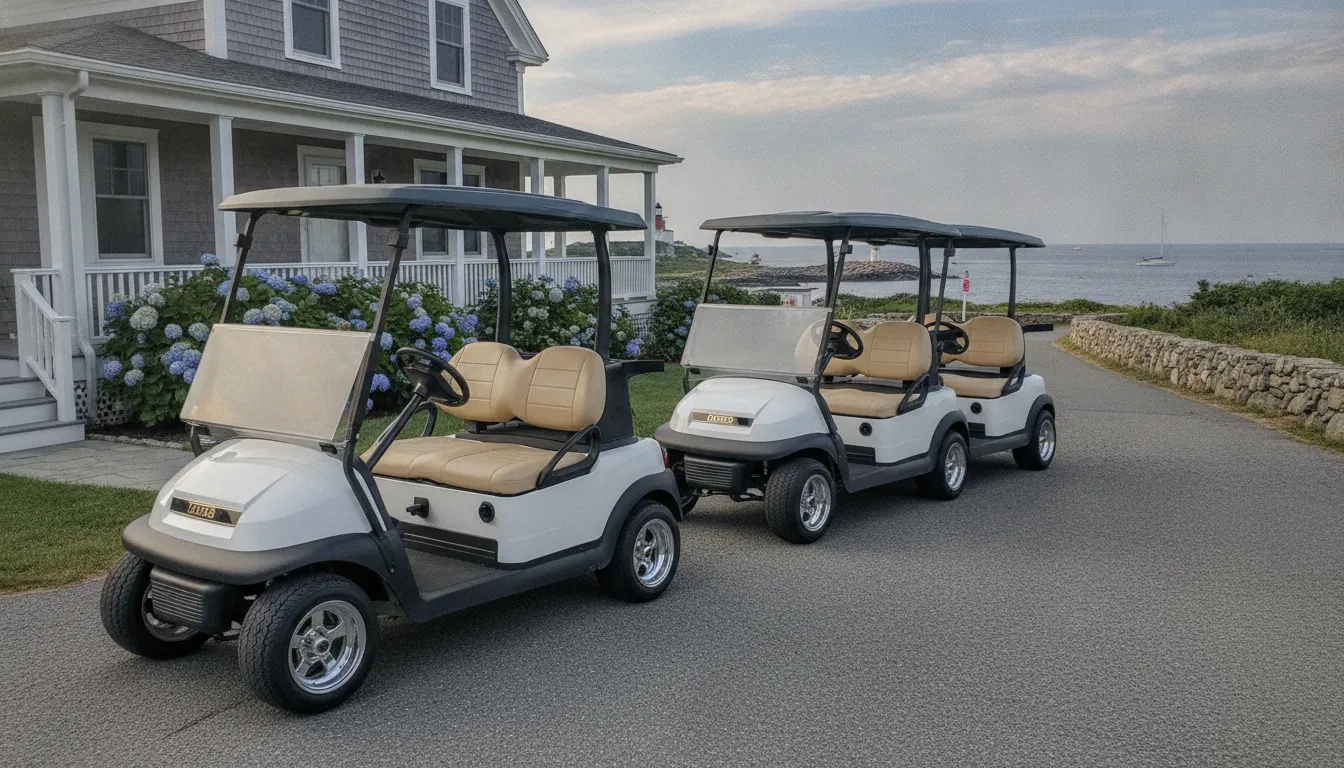
A four-passenger cart occupies the practical middle ground between a compact two-seater and a longer group shuttle. It can carry a family or a few guests while remaining manageable around driveways, marinas, vacation properties, golf communities, and commercial sites. Many buyers also appreciate the range of available layouts, including forward-facing rear seats or rear-facing seats that may convert into a cargo platform.
That flexibility matters when the cart serves more than one job. On Saturday, all four seats may carry family members to a neighborhood gathering. On Monday, a folding rear seat may create space for groceries, beach gear, or light supplies. The exact conversion and rated capacity depend on the model, so buyers should confirm specifications rather than assume every rear seat works the same way.
For shoppers comparing available options, start with c2 Vehicles' current vehicle inventory. Because vehicle dimensions and seat layouts vary by model, compare the specifications of the actual carts you are considering rather than relying on seat count alone.
A six-passenger cart earns its space when group transportation is the primary job. It can reduce repeat trips between a parking area and an event venue, move guests across a resort, or help staff transport visitors around a campus. For a large household that regularly travels together, the added seats may also be more useful than the easier handling of a smaller cart.
Consider a resort moving 24 guests from a parking lot to check-in. At full seating capacity, a six-passenger model can complete that movement in four trips, while a four-passenger model requires six. That difference can matter during busy arrivals. Yet the longer vehicle still needs enough turning, staging, and parking space, and passenger luggage may require a separate cargo plan.
Commercial buyers should look beyond seat count and map the full operating route. c2 Vehicles helps organizations evaluate passenger movement. Charging or fueling, service requirements, and fleet configuration through its commercial vehicle solutions.
Request help planning a personal vehicle or commercial fleet configuration.
The best seating capacity is the one that removes friction from the trips you make repeatedly. Use these five factors to turn a showroom preference into a decision based on your real route, riders, and ownership needs.
Write down how many riders will use the cart on most trips, then note how often demand rises above that number. Buying a six-seater for one annual gathering may create daily compromises. Conversely, buying four seats for a busy hospitality route can create unnecessary repeat trips. For commercial use, observe peak periods and calculate how many trips each option requires.
Passenger capacity does not automatically equal useful cargo capacity. Six people may also bring bags, coolers, golf equipment, or work materials. Ask where those items will go while every seat is occupied. A four-passenger cart with a convertible rear seat may be more practical for a buyer who alternates between carrying people and hauling supplies. If passengers and cargo must move together, discuss purpose-built storage options and payload needs with a vehicle specialist.
Longer vehicles generally require more space to turn, stage, and park. Before purchasing, measure the narrowest gate, sharpest turn, garage opening, trailer, elevator, and parking location on the route. Include room for passengers to enter and exit safely. A test drive on a representative route is more useful than judging either cart from a showroom floor.
Seat count is only one part of vehicle selection. Consider hills, surface conditions, trip distance, climate, and how often the cart will be used. Electric and lithium-powered options may appeal to buyers prioritizing quiet operation and straightforward charging, while gas models can suit other operating patterns. Actual range and performance depend on the specific model, passenger load, terrain, weather, accessories, and vehicle condition. Compare model specifications and explain your route to the sales team.
A cart that fits today should also be practical to maintain. Ask about factory-trained service support, parts access, warranty coverage, and mobile or door-to-door service options. c2 Vehicles supports owners across New England with vehicle service, OEM parts, and technicians who can help keep personal vehicles and fleets operating.
Possibly, but seat count does not determine road legality. Do not assume a golf cart is street-legal because it has lights, seat belts, or extra seats. A golf cart and a low-speed vehicle (LSV) are not automatically the same thing. Road-use requirements vary by state and municipality, and rules can address vehicle equipment, registration, insurance, licensed drivers, and eligible roads.
If public-road use matters, begin with models designed and approved for that purpose, then confirm the rules for every community where you expect to drive. Some four-passenger models, including certain LSV configurations, may suit neighborhood travel, but eligibility is model-specific. Never treat a seating conversion or an accessory package as proof that a vehicle is road legal.
c2 Vehicles offers a dedicated street-legal vehicle collection and can help identify appropriate options. The final responsibility for confirming state and local requirements remains with the owner and operator.
There is no universal winner because a neighborhood owner, golf course, and resort solve different transportation problems. The strongest choice connects capacity to the cart's primary job while accounting for the busiest repeatable demand, not an unusual once-a-year peak.
A four-passenger cart often gives households the most useful balance of guest seating, simple parking, and everyday maneuverability. It is especially practical when the rear seating area can switch between riders and light cargo. Choose six when a larger family consistently travels together and the property has enough storage and route clearance. Before selecting either size, map where the cart will be parked overnight and how riders will enter and exit at each stop.
Match the vehicle to its job. Golfer transportation, guest tours, food and beverage service, maintenance work, and event shuttling have different seating and cargo requirements. A mixed fleet may serve the operation better than using one seating layout for every role.
Six-passenger carts can improve group throughput, while four-passenger carts may be more agile for staff movement and smaller groups. A mixed fleet often handles demand better than forcing every trip into one vehicle size. Larger shuttles can serve scheduled guest routes, while four-passenger carts support supervisors, tours, and shorter trips. Evaluate route bottlenecks, accessibility needs, operator training, charging or fueling, and service coverage before deciding on fleet quantities.
Choose capacity based on the guest movement plan. Not a rough attendance estimate. c2 Vehicles maintains a large regional rental fleet and can help plan the vehicle mix for an event or temporary need. Explore golf cart and utility vehicle rentals to discuss dates, routes, and passenger volume.
Find your nearest c2 Vehicles location and schedule a test drive.
Bring measurements and a written use-case list when you compare vehicles. That preparation helps a sales specialist rule out carts that will not fit the route and focus on models that match your normal passenger and cargo needs.
For many households, yes. A four-passenger cart can carry a family of four while staying easier to park and maneuver than a longer six-passenger model. Confirm the model's seating layout, passenger limits, storage, and intended use before buying.
Some models have rear seats that convert into a cargo deck, while others use fixed forward-facing seats. Cargo capacity, payload limits, and accessory compatibility differ by model. Confirm the specifications before carrying heavy or bulky items.
It is not necessarily difficult to drive, but its longer body generally needs more room for turns, parking, and route clearance. Operators should test the vehicle in conditions similar to its intended route and receive appropriate training.
Seat count alone does not determine road legality. Only qualifying vehicles operated under applicable state and local rules may be used on eligible public roads. Confirm the specific model's classification and local requirements before purchase or operation.
Not always. Six seats help move groups, while four-passenger or utility vehicles may handle smaller groups, staff travel, or cargo more efficiently. Many organizations benefit from a mixed fleet designed around distinct jobs.
Choose a four-passenger cart when versatility, maneuverability, and everyday family use lead the decision. Choose a six-passenger cart when moving larger groups in fewer trips is a frequent, measurable need. In either case, compare actual model dimensions, seating layouts, cargo solutions, terrain requirements, and local road rules before committing.
c2 Vehicles is the largest distributor of golf carts and other small-wheeled electric and gas vehicles in New England, with seven locations across all six New England states. Find a c2 Vehicles location to test drive options, compare inventory, and get help selecting a cart for personal or commercial use.